Background
START trial randomized ART-naïve individuals with CD4>500 cells/μL to immediate or deferred ART until CD4 declined to 350cells/μL or AIDS developed. From 2015, all participants were recommended to initiate ART, followed through 2021. We examined the predictive value of updated immunological biomarkers on long-term clinical outcomes after ART initiation.
Methods
Cox models assessed risk of the primary event (serious AIDS, serious non-AIDS event [SNA], or death) after ART initiation in relation to time-updated CD4 count, CD4%, CD4/CD8 ratio, HIV-RNA, CD8 count, CD8%. The two biomarkers with best predictive performance (based on AIC) were selected. Analysis restricted to those who were event-free prior to initiating ART. Participants were grouped by treatment group and CD4 at ART initiation: Immediate, Deferred >500, Deferred 351–500, and Deferred ≤350 cells/μL. Analyses were repeated for SNA events.
Results
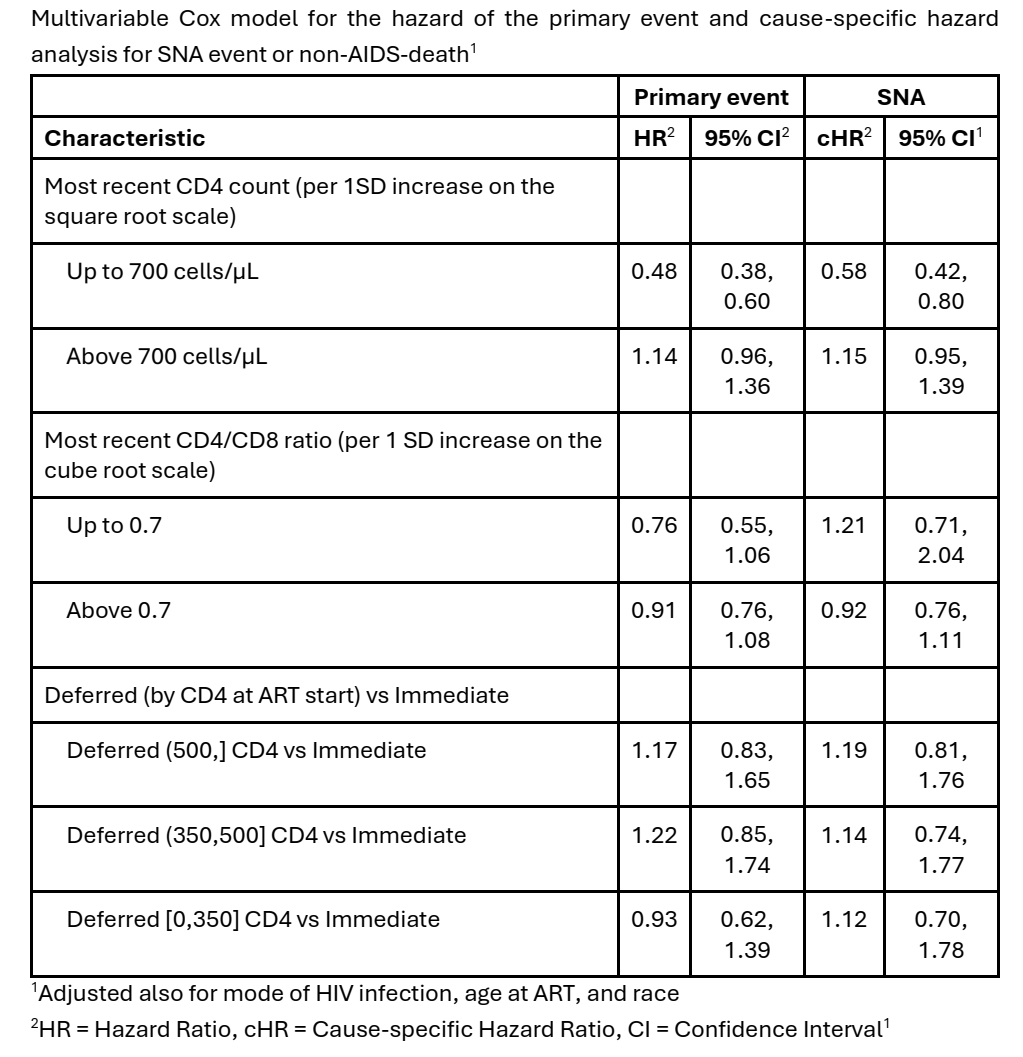
Of 4420 participants, 2302 (51.4%) were in the Immediate and 915 (21.0%), 671 (15.5%), and 532 (12.1%) in the three Deferred groups, respectively. A total of 266 primary events occurred: 5.6% in Immediate vs 5.4%, 6.6%, and 8.1% in Deferred groups. Eight-year estimated cumulative incidences: 4.2% (95%CI 3.5–5.1) for Immediate, 5.3% (4.0–7.0), 5.5% (4.1–7.3), and 6.3% (4.6–8.6) for Deferred groups. CD4 count and CD4/CD8 ratio were the strongest predictors. Results indicated that most recent CD4 strongly predicted primary events if below 700 cells/μL (HR per 1SD increase on the square-root scale= 0.48, 95%CI 0.38–0.60), with no effect above 700 cells/μL. A lower recent CD4/CD8 ratio (<0.7) was associated with a nonsignificant risk increase (HR=0.76 per 1SD on cube-root scale 95%CI 0.55–1.06; global p=0.084; Table). Biomarkers’ effects on SNAs were smaller. Unadjusted for biomarkers, Deferred>500 did not significantly differ from Immediate (HR=1.19, p=0.323), whereas Deferred 351–500 and ≤350 had significant 47% and 62% higher primary event risks, respectively. After adjusting for time-updated CD4 and CD4/CD8, between-group differences diminished being no longer significant (global p=0.510).
Conclusions
Post-ART risks were associated with lower current CD4 counts, with additional but smaller effects of CD4/CD8 ratio. Risk declined up to ~700 cells/μL, then leveled off. After accounting for these time-updated variables, differences between immediate and deferred ART groups disappeared, highlighting that CD4, and to a lesser extent CD4/CD8, remain central for predicting long-term outcomes.
Table or Figure