Background
Antimicrobial resistance in gonorrhea is a growing concern. Doxycycline post-exposure prophylaxis (DoxyPEP) has been proposed to reduce bacterial sexually transmitted infections (STIs). Aim is to assess DoxyPEP impact on gonorrhea antimicrobial susceptibility.
Methods
This is a retrospective study including people with culture-positive gonorrhea infections diagnosed between 2022-2025 at San Raffaele Institute, Milan, Italy. Minimum inhibitory concentrations (MICs) of ceftriaxone (CRO), ciprofloxacin (CIP), tetracycline (TET), azithromycin (AZM), and benzylpenicillin (penG) and β-lactamase activity were determined using gradient-test strips. CIP, TET and penG resistance (R) were defined as per EUCAST recommendations (v15.0), TET high-level resistance (HR) as MIC>8mg/L, AZM-R based on the ECOFF of MIC>1mg/L and CRO-decreased susceptibility (DS) of MIC>0.032mg/L, as no R was observed. DoxyPEP use was self-reported during routine visits. Logistic regression with Generalized Estimating Equations (GEE), to account for repeated measures, was used to assess the associations between DoxyPEP use and HR/R/DS rates. GEE model with log-transformed MICs was applied to compare geometric means between exposed and non-exposed groups. The models were also adjusted for age, PrEP use, HIV status and number of prior STIs.
Results
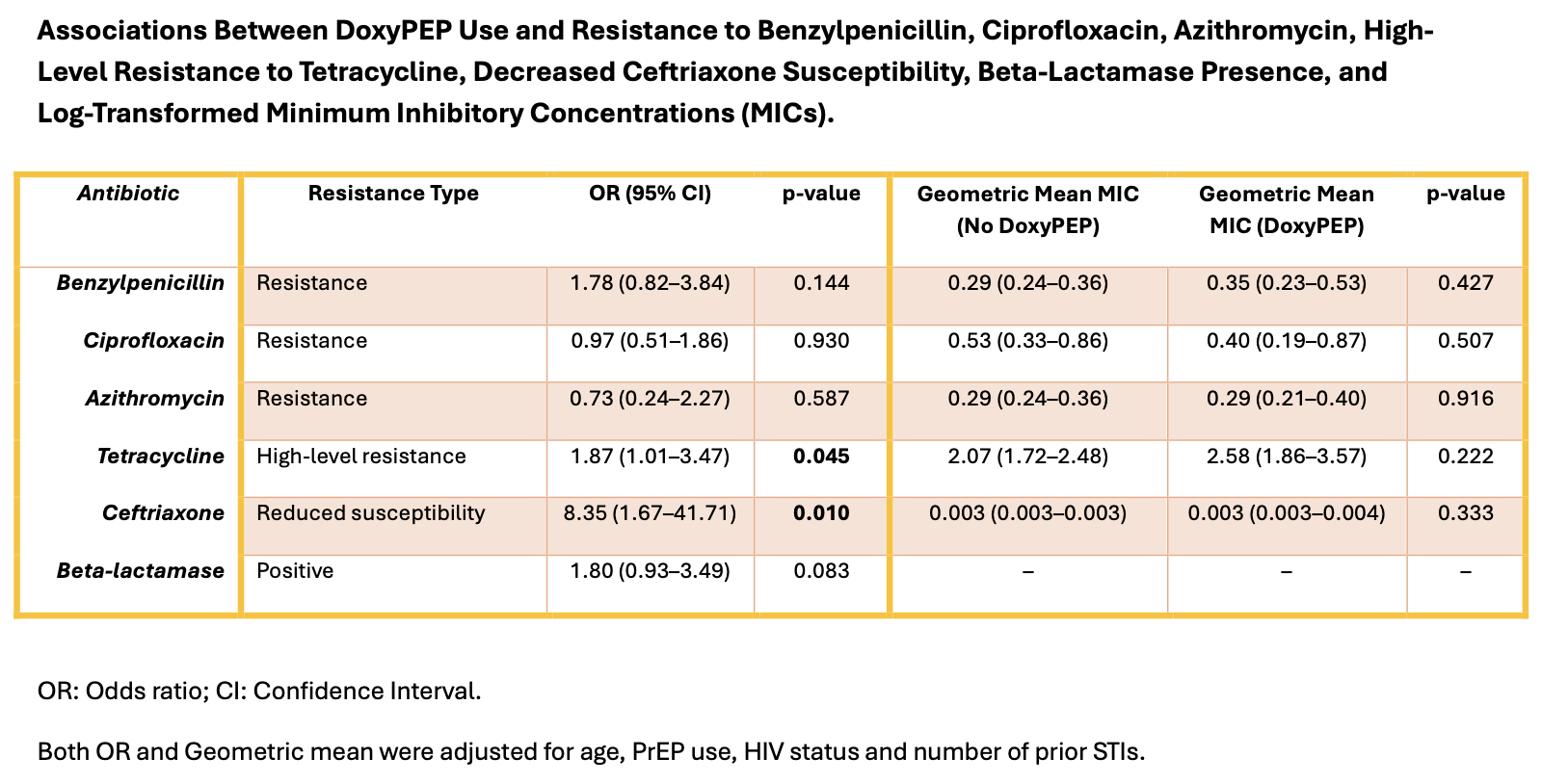
A total of 376 gonorrhea episodes among 318 individuals were included. Median age at diagnosis was 34.8 years (IQR 30.0–39.8), and 99.2% were male. Infections occurred in 217 cases (57.7%) during PrEP and 76 (20.2%) among people with HIV. Overall, 77 (20.5%) episodes occurred after DoxyPEP exposure and in 254 (67.6%) episodes people had ≥1 prior STI. Isolates were R to CIP in 250 cases (73.1%), TET in 360 (96%) with HR in 64 (17.1%), AZM in 36 (10%), and penG in 40 (11.8%); CRO-DS was detected in 8 (2.1%) and β-lactamase positivity in 58 (17.3%). Adjusted models revealed a significant association between DoxyPEP and TET-HR (OR 1.87, 95%CI 1.01–3.47, p=0.045) and CRO-DS (OR 8.35, 95%CI 1.67–41.71, p=0.01). No significant associations emerged for penG, CIP and AZM. Geometric mean MICs did not differ significantly by DoxyPEP exposure (Table).
Conclusions
In this cohort TET resistance was very frequent regardless of DoxyPEP exposure, with a significant association between DoxyPEP and TET-HR. Despite absence of CRO-R and very low frequency of CRO-DS, DoxyPEP was associated with reduced ceftriaxone susceptibility. These findings highlight the need for enhanced resistance surveillance.
Table or Figure