Background
The gut mucosa is the largest reservoir of HIV and features the most substantial CD4+ T cell depletion at all HIV stages. Gut microbiome alterations have been identified in people living with HIV (PLWH) and associated with disease features, but causative commensal impacts on HIV manifestations remain elusive. We longitudinally assessed gut microbiome alterations during the progression from HIV to AIDS, and studied their causal contribution to opportunistic infection.
Methods
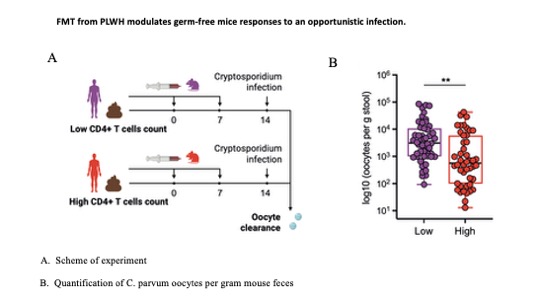
We characterized the fecal microbiome in two geographically-distinct, trans-continental cohorts of PLWH and controls (n=294), followed by fecal microbiome transplantation (FMT) from PLWH donors categorized as having high versus low peripheral CD4+ T cell counts, into recipient germ-free mice. In recipient mice, we assessed the impact of the human HIV microbiome on intraepithelial (IEL), lamina propria, and systemic CD4+ T cells at day 14 following FMT. Finally, we colonized groups of mice with fecal samples obtained from ‘high’ and ‘low’ CD4 T cells PLWH, followed, after 2 weeks, by infection with 750000 C. parvum oocytes. We compared C. parvum clearance between the two groups.
Results
We identified distinct microbiome signatures in PLWH in comparison to healthy individuals (HC) across biogeography, which correlated with their degree of immune deficiency. Upon FMT from humans into germ free mice, colonic intraepithelial CD4+ T cells became significantly elevated in recipient mice colonized with stool samples from either HC or the ‘high’ CD4 T cell group, as compared to recipients of the ‘low’ group (P<0.0001). Mice gavaged with microbiomes from ‘high’ donors featured a significantly improved C. parvum oocyte clearance compared to mice receiving FMT from the ‘low’ donors (p=0.008).
Conclusions
Our results suggest a causal link between systemic immune dysfunction in PLWH, an altered gut microbiome, and a resultant impairment in gut mucosal immunity, that may predispose to opportunistic gut infection. The microbiome during HIV carriage state or in a well-treated state is characterized by commensals that induce intraepithelial CD4 T cells, thereby preventing devastating opportunistic infections. During advanced stages of disease, immune deficiency becomes so pronounced that this microbial configuration is no longer able to be maintained, leading to a loss of the microbiome’s immune-contributory function. As such, restorative microbiome interventions may prevent or ameliorate intestinal infectious complications in PLWH.
Table or Figure