Background
Criminal legal involved (CLI) persons who use drugs are at high risk for HIV yet are often not offered pre-exposure prophylaxis (PrEP). Two models of care, Patient Navigation (PN) and Mobile Health Units (MHUs), have been shown individually to have some success in engaging persons in HIV related care; however, they have not been compared to evaluate PrEP initiation.
Methods
A 5-year hybrid type 1 effectiveness-implementation randomized controlled trial comparing PN and MHU service delivery of linking CLI persons living with or at risk for HIV with pre-incarceration histories of opioid and/or stimulant use was conducted in 4 sites in Texas and Connecticut. The primary outcome was time to PrEP/ART initiation based on baseline HIV status. Eligible and consented persons were randomized 1:1 to either (1) PN, where participants were linked to established brick-and-mortar HIV and SUD prevention and treatment services or (2) services delivered via an MHU, where a clinician and community health worker on a mobile healthcare unit went to where participants lived and provided integrated HIV prevention/treatment, primary care and SUD services for a 6-month intervention period.
Results
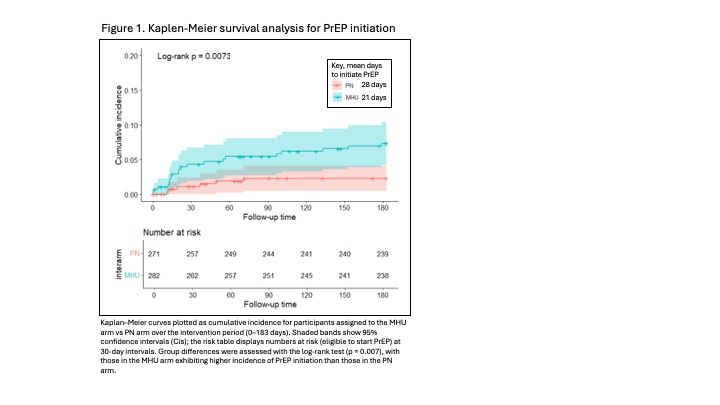
Of the 601 individuals who were randomized to the two linkage systems, 553 (N=271 PN, N=282 MHU) tested negative for HIV at baseline, were PrEP eligible and had 6-month evaluable primary outcome data. Participants were a mean age of 41 years, 76% male, 26% Black, 25% Hispanic, 65% unhoused/unstably housed, and 35% uninsured. The median time to PrEP initiation was 28 days (IQR 12,50) in the PN arm and 21 days (IQR 13-77) in the MHU arm. By 180 days (end of intervention), 2.2% of the PN arm vs 7.1% of the MHU arm had initiated PrEP. The log-rank test confirmed a statistically significant difference in the timing of PrEP initiation between arms (p=0.007) (Figure 1). Forty-five percent of the MHU participants initiated injectable Cabotegravir while no participants did in the PN arm.
Conclusions
Mobile health unit provision of a ‘one-stop shop’ integrated HIV, substance use and primary care service delivery system that went to where people lived was associated with a faster time to PrEP initiation as compared to patient navigation linkage to traditional community brick-and-mortar healthcare delivery systems, suggesting that bringing healthcare services to where people live might lead to improvements in PrEP initiation among PWUD.
Table or Figure