Background
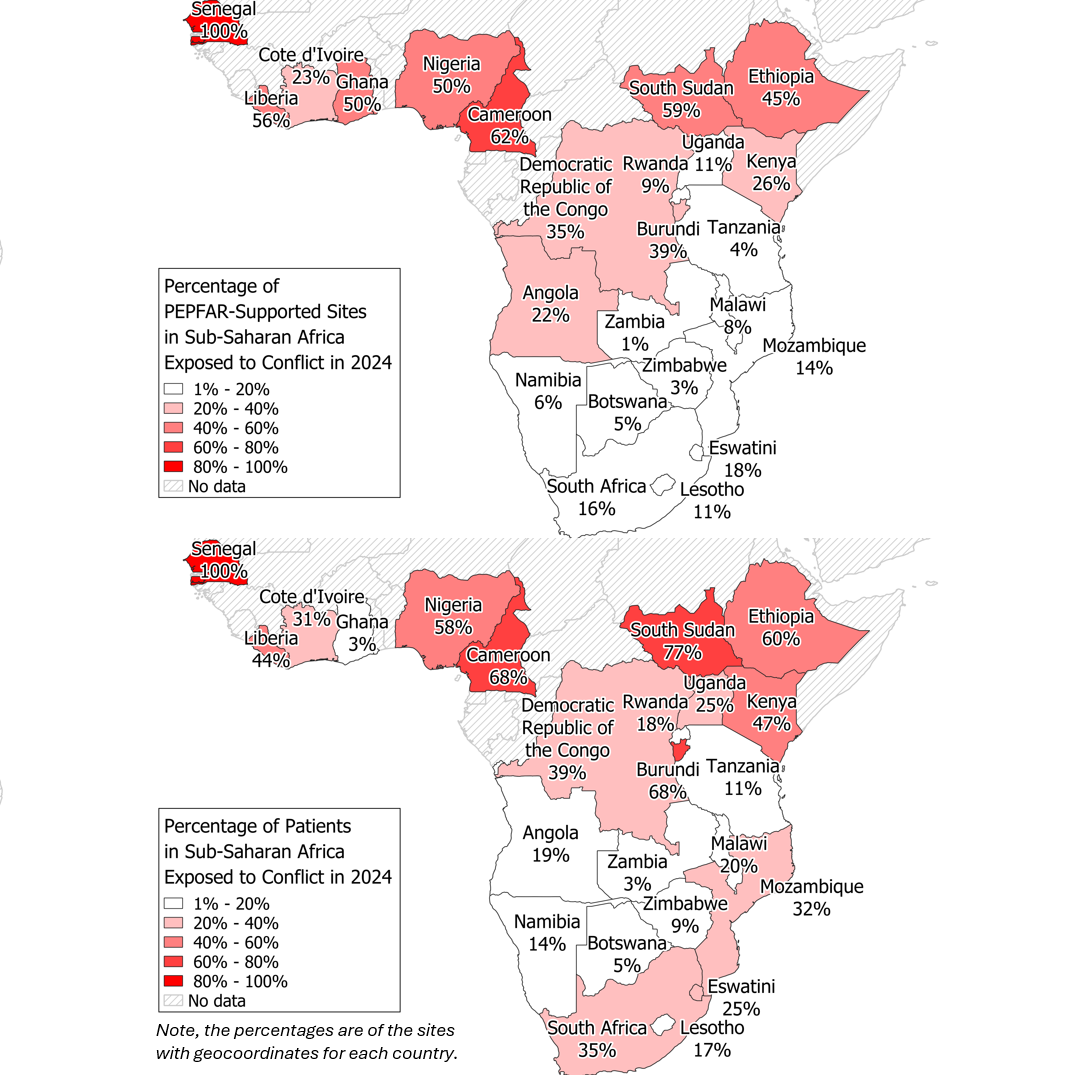
Sub-Saharan African countries supported by the President’s Emergency Plan for AIDS Relief (PEPFAR) frequently experience conflict events such as battles, explosions, riots, and violence against civilians. These events can disrupt the continuity of antiretroviral therapy (ART) treatment for people living with HIV. Understanding the scope of conflict exposure on PEPFAR-supported sites and their beneficiaries is essential to prevent service delivery disruptions and ensure treatment access and outcomes.
Methods
We sourced 2024 conflict data from the Armed Conflict Location and Event Data Project (ACLED) for 24 sub-Saharan African countries. We extracted PEPFAR’s Monitoring, Evaluation, and Reporting indicator data for the number of adults and children currently receiving ART from an active site, defined as sites reporting at least one patient in 2024, from PEPFAR’s Data for Accountability, Transparency and Impact Monitoring system. We estimated conflict exposure with ACLED’s exposure guidelines which specify the distance of influence for different conflict types (five kilometers for battles, explosions/remote violence, and violence against civilians with at least one fatality; two kilometers for riots and violence against civilians with no fatalities). We calculated the proportion of sites and their patients within the radius of any conflict event to the total number of sites with useable geocoordinates.
Results
In 2024, PEPFAR supported 26,368 active sites serving 18,451,306 patients in sub-Saharan Africa; 22,693 (86.0%) of these sites had useable geocoordinates for analysis. A total of 3,980 (17.5%) of the sites were exposed to a conflict event, serving 5,014,693 patients or 29.9% of all patients currently on ART. Sub-Saharan African sites averaged 1.6 events per site (SD = 6.6). By event type, 18.3% of sites were exposed to at least one battle event; 5.2%, explosions/remote violence; 24.8%, violence against civilians with at least one fatality; 22.8%, riots; 14.1%, violence against civilians with no fatalities.
Conclusions
Conflict events pose a significant threat to many PEPFAR-supported sites and to national health systems providing HIV care and treatment in sub-Saharan Africa. Future analyses are needed to identify and predict conflict hotspots and assess countries’ resilience to different conflicts. Incorporating resilient service delivery adaptations may help ensure treatment continuity of services in security-challenged areas.
Table or Figure