Background
There are ~1.2 million people with HIV (PWH) in the United States. Among them, ~1% are heavily treatment-experienced (HTE) and harbor multidrug-resistant (MDR) HIV-1. MDR HIV-1 is most observed in individuals with extensive prior exposure to antiretroviral therapies (ARVs). For this underrepresented and clinically complex population, achieving and sustaining virologic suppression remains a significant challenge due to the limited availability of active agents for constructing fully suppressive regimens. The PROMISE-US registry aims to assess the real-world effectiveness of treatment strategies used in HTE individuals with MDR HIV-1, addressing a critical gap in care for patients with high unmet medical needs.
Methods
PROMISE-US (CT.gov Identifier: NCT05388474) is a Phase 4, observational, non-interventional, multicenter study with both retrospective and prospective data collection. The primary aim is to assess the long-term effectiveness and durability of ibalizumab (IBA)-based regimens by comparing clinical outcomes between participants receiving IBA (Cohort 2; C2) and matched controls not receiving IBA (Cohort 1; C1). To be enrolled in either cohort a change to the participant’s antiretroviral (ARV) regimen and documented resistance to at least 3 ARV classes were required. This abstract presents the initial comparative analysis of matched participants from both cohorts.
Results
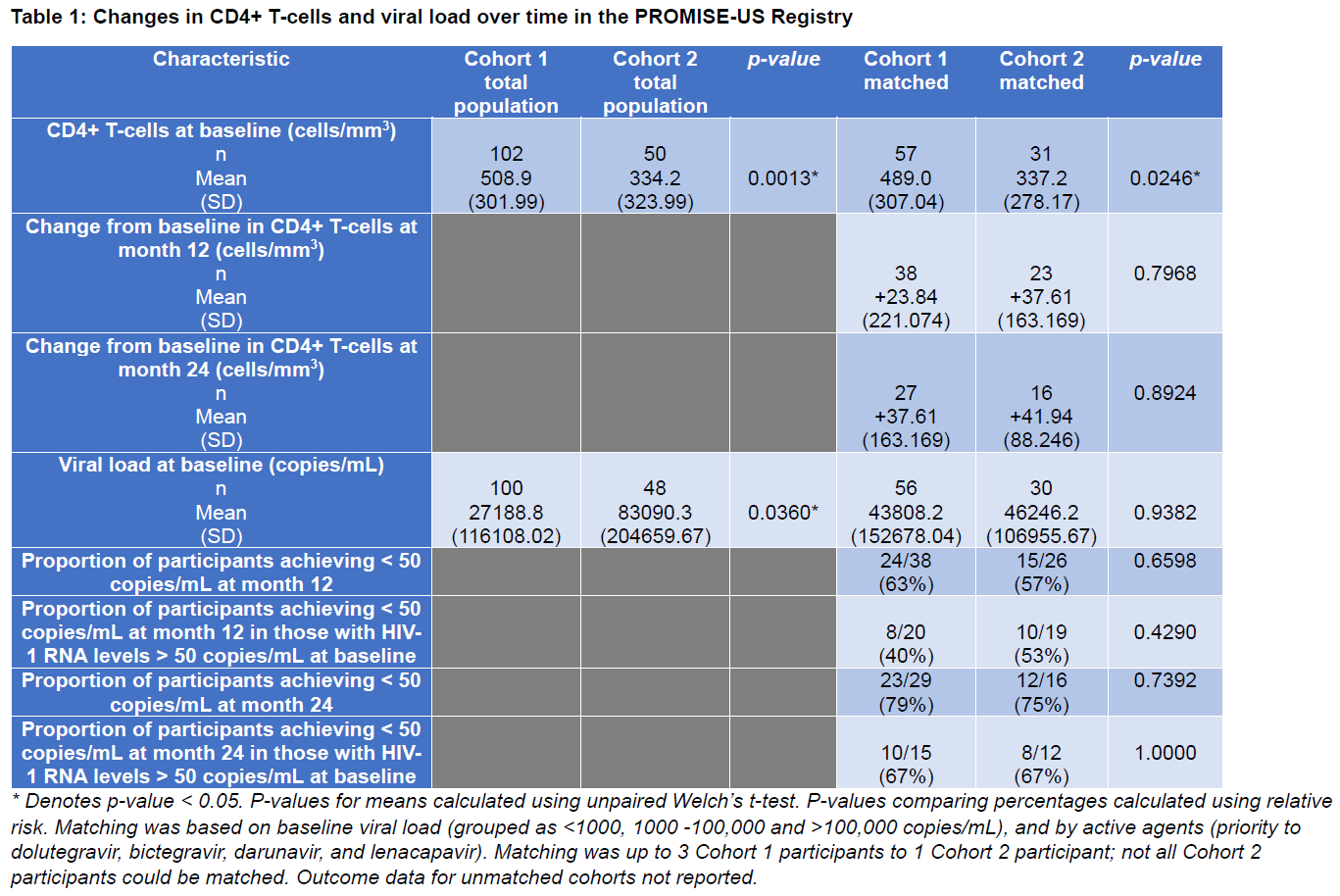
By 1-Aug-2025, a total of 167 participants were enrolled; 113 in C1, 54 in C2. Participants in C2 had a statistically significantly higher viral load (VL) and lower CD4+ T-cells compared to C1 (p=0.0360 and 0.0013 respectively). This imbalance in CD4 persisted even after matching for baseline VL and active agents in the optimized background regimen (OBR) (p=0.02) as per the pre-specified matching algorithm. Despite this, as shown in Table 1, participants treated with IBA achieved similar long-term VL and CD4-related outcomes compared to C1. This is observed even when the results are stratified by the number of active agents in the OBR. ~70% of participants remained on IBA for > 24 months.
Conclusions
Despite presenting clinical indicators of more advanced HIV disease, individuals receiving IBA-containing regimens demonstrated comparable rates of virologic suppression and immunologic recovery to those not receiving IBA. Interpretation of these findings is limited by the small sample size and differences in baseline disease severity between cohorts.
Table or Figure