Background
Previous studies show that individuals’ perception of their risk influences preventive behaviors, yet evidence on whether self-perceived risk as a reliable predictor of sexually transmitted infection (STI) remains limited. We evaluated the association between STI risk perception and STI prevalence at baseline among women enrolled in the DoxyDOT Study.
Methods
We conducted a secondary analysis of STI risk perception at baseline and correlation to STI diagnosis. Surveys on demographics, sexual behavior, STI symptoms and STI risk perception were completed. C. trachomatis, N. gonorrhoeae, and T. pallidum were tested with nucleic acid amplification tests and serology. Risk perception of acquiring an STI in the next 3 months was dichotomized to high risk (strongly agree/agree) or low risk (strongly disagree/disagree). Poisson regression with robust standard errors was used to estimate the association between STI risk perception and laboratory-confirmed STI diagnosis. We adjusted for demographic characteristics and sexual behavior; age was included as priori, and variables with p<0.10 in univariate analyses were retained in multivariable model.
Results
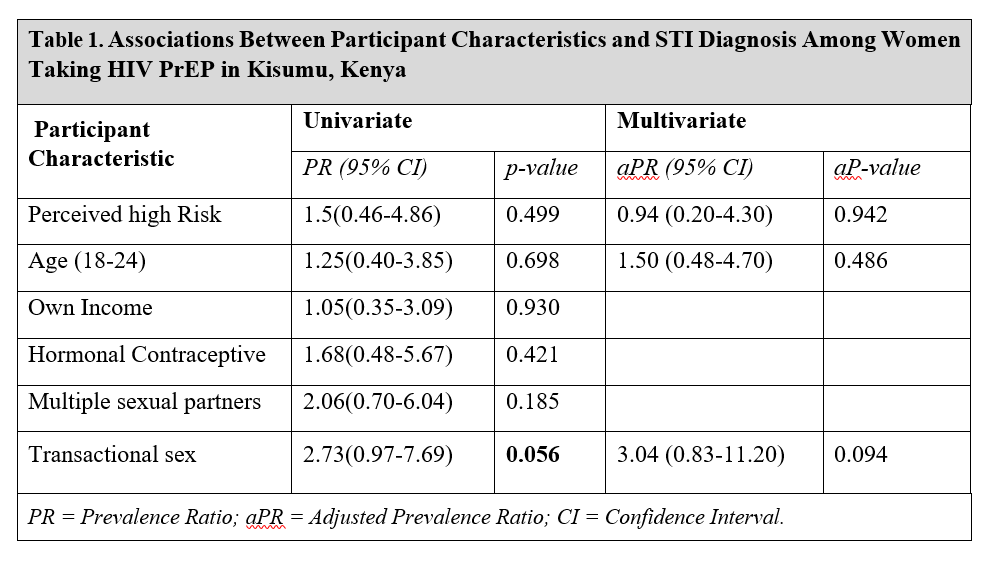
From August 2024 to June 2025, 60 women enrolled in the DoxyDOT study. Median age was 24 years (IQR: 21–26), the median age difference with their most recent sexual partner was 5 years (IQR: 3–7), 23% engaged in transactional sex and 22% had more than one sexual partner. The majority (83%) were single and 65% had post-secondary education. Less than half (45%) reported having their own income. Contraceptive use was high at 72%. One in five (20%) of the women perceived themselves at high risk for acquiring STIs. Laboratory-confirmed prevalence of any bacterial STI was 18.3% (11/60). In the adjusted model, high risk perception (aPR =0.942; 95% CI: (0.20-4.30); was not associated with STI diagnosis. However, recently engaging in transactional sex showed a trend towards high STI diagnosis at baseline (aPR = 2.73; 95% CI: 0.97–7.69).
Conclusions
While the prevalence of bacterial STIs among women taking HIV PrEP in Kisumu was high, self-perceived STI risk was low and not associated with STI diagnosis. These findings may not be powered given the small sample size and regardless, highlight a key challenge with identifying those who would benefit most from STI prevention. Prevention programs should emphasize benefits independent of perceived risk.
Table or Figure