Background
People living with HIV (PWH) face an elevated risk of cardiovascular disease (CVD), partly attributable to chronic inflammation and altered body composition. Although Obesity-, lipid-, metabolic-, and inflammatory-related indices (OIMIs) have been linked to subclinical atherosclerosis (SCA) in the general population, their comprehensive evaluation in PWH remains limited. This study aimed to systematically assess the associations of multiple OIMIs with SCA and high-risk carotid plaque in PWH.
Methods
In this cross-sectional study, 1,390 PWH aged ≥40 years were recruited from the Shanghai Public Health Clinical Center. Thirty-seven OIMIs were calculated using anthropometric, biochemical, and hematological measurements. Carotid ultrasound was performed to identify SCA and high-risk (hypoechoic) plaques. Logistic regression models were applied to evaluate the associations between OIMIs and SCA, with sequential adjustments for demographic, metabolic, and HIV-related factors (Models 1–3). Indices independently associated with outcomes across all models were further assessed for discriminative performance using receiver operating characteristic (ROC) curves. Subgroup analyses were performed by sex, age, and other clinical variables, with forest plots used to visualize effect sizes. Restricted cubic spline (RCS) regression explored potential linear and non-linear associations, and subgroup analyses were performed by sex.
Results
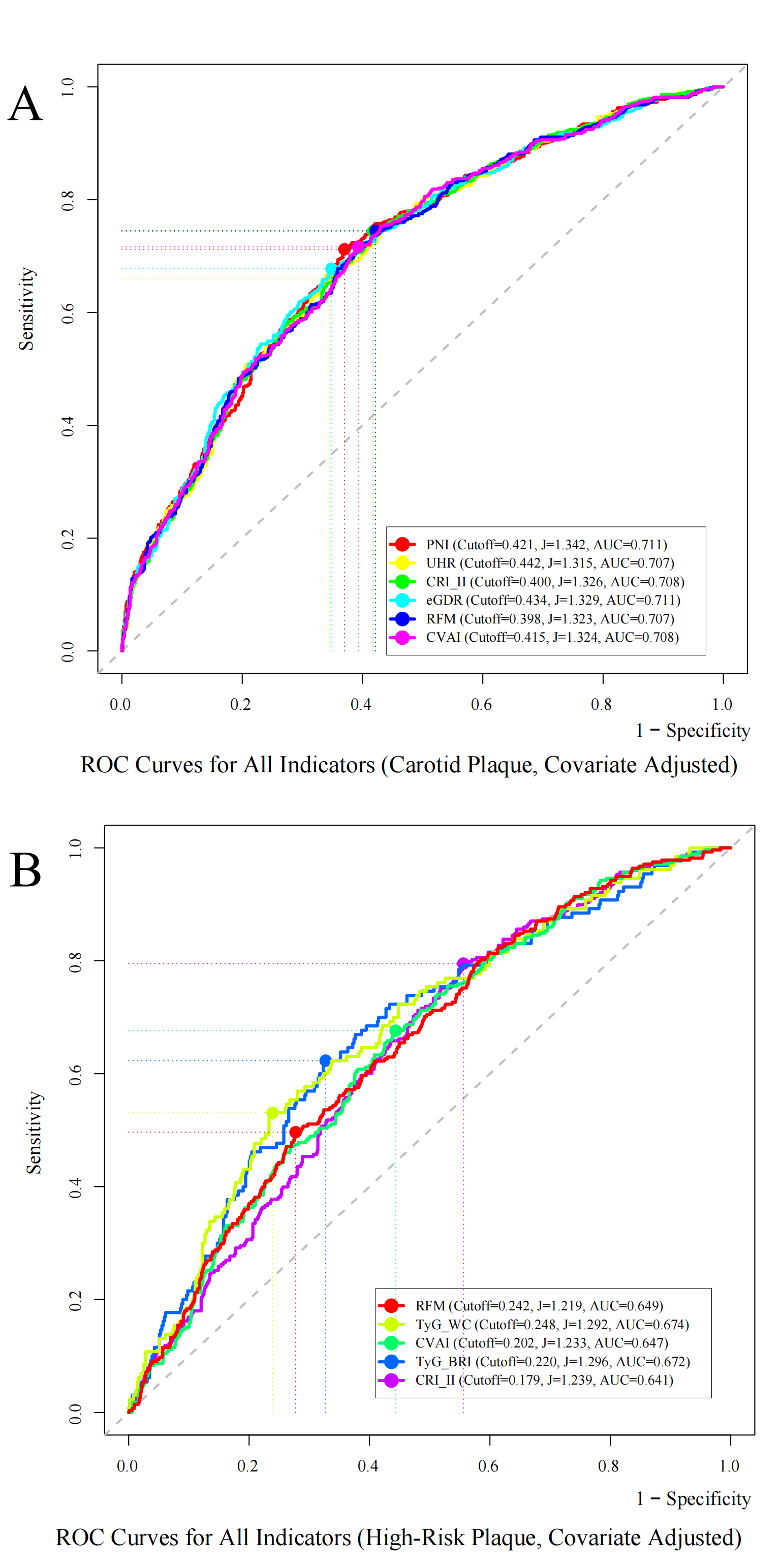
Among 37 OIMIs evaluated, 21 showed significant intergroup differences. After covariate adjustment, RFM, CVAI, CRI-II, UHR, PNI, and eGDR remained independently associated with carotid plaque, while RFM, CVAI, CRI-II, TyG-BRI, and TyG-WC were independently associated with high-risk plaque. ROC analyses demonstrated that for SCA, PNI and eGDR exhibited the highest discriminative ability (AUC = 0.711), whereas for high-risk plaque, TyG-WC (AUC = 0.674) and TyG-BRI (AUC = 0.672) performed best. RCS analysis revealed a statistically significant non-linear association between PNI and high-risk plaque (P for nonlinear = 0.040)
Conclusions
Multiple OIMIs were independently associated with SCA and high-risk carotid plaque in PWH. Indices such as eGDR, PNI, and TyG-related metrics demonstrated good discriminative performance, suggesting their potential utility for early CVD risk stratification in this population.
Table or Figure