Background
Vertical transmission of HIV remains a major challenge in low- and middle-income countries, compounded by rising NNRTI resistance. Doravirine, a second-generation NNRTI, has a favourable resistance profile, but data on safety and pharmacokinetics (PK) in pregnancy are limited.
Methods
DoraDO is an ongoing randomised, controlled, open-label study of 76 pregnant South African women initiating ART (at ≥8 to <26 weeks’ gestation) and randomized 1:1 to doravirine (100 mg in combination with TDF/3TC once daily) or standard-of-care. Intensive maternal plasma (MP) PK sampling (0–24 h) was conducted in the second (T2; 20–28 weeks) and third (T3; 32–36 weeks) trimesters, and 6 weeks (±10 days) postpartum (PP). Time-matched MP, infant plasma (IP) and dried breastmilk were collected at delivery and PP in breastfeeding mothers at maternal predose and ~2 h post Tmax. Doravirine concentrations were quantified by Liquid Chromatography-Mass Spectrometry. Geometric mean ratios (GMR; 90% CI) were estimated using linear mixed-effects. We present PK results from the first 15 mothers and safety data for all participants enrolled to date (n=43).
Results
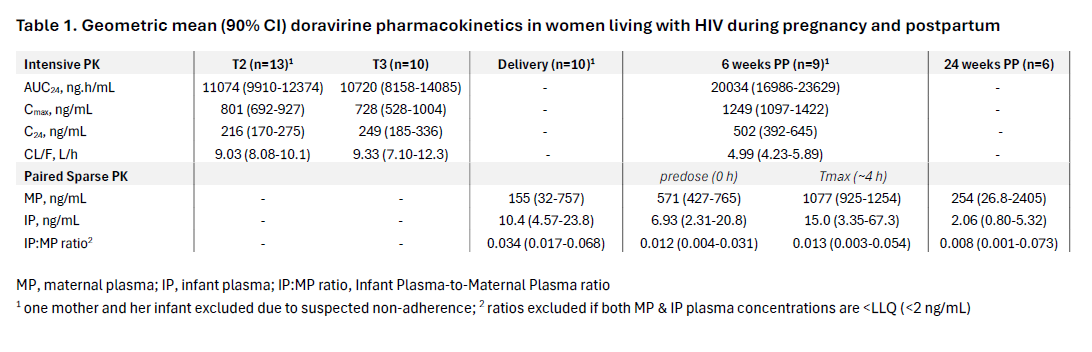
Fifteen mothers (aged 21-42 years) and 11 infants (7 male/4 female) were sampled; one mother-infant pair was excluded from PK evaluation due to suspected non-adherence. Doravirine PK parameters are summarised in Table 1. Among mothers with paired visits (n=8), a significant reduction in doravirine AUC24 at T2 [0.60 (0.49-0.73)] and T3 [0.58 (0.44–0.77)] vs. PP was observed. All MP C24 values were above the in-vitro target (6x protein-adjusted EC50; 33 ng/mL) but using a higher cutoff (10th percentile; 230 ng/mL) target concentrations were attained in 38%, 60% and 100% mothers in T2, T3 and PP respectively. IP concentrations exceeded the EC₅₀ (5 ng/mL) in 7/10 infants at delivery. IP:MP ratios decreased from ~3% at delivery to ~1% at PP.
In the 43 mothers enrolled to date, there have been no HIV transmissions in either arm. There have been 14 maternal and 5 infant serious adverse events, with no significant differences between arms. No birth defects were detected.
Conclusions
Doravirine exposure is reduced in T2 and T3 of pregnancy, but trough concentrations remain above target (>33 ng/mL), with no HIV transmissions observed. Infant levels at PP are low and may reflect breastmilk transfer and maturation of CYP3A4-mediated metabolism. Ongoing follow-up will determine clinical implications for maternal dosing and infant safety.
Table or Figure