Background
Tracking changes over time in proportions and characteristics of persons living with HIV who are part of molecular clusters (clustering rates), has potential to provide valuable insights into HIV transmission dynamics and help guide targeted public health interventions for prevention.
Methods
We monitored clustering rates patterns and changes over time among key populations in the statewide HIV-1 epidemic in Rhode Island from 1991 to 2023. Partial HIV-1 pol sequences were grouped by year of HIV diagnosis, and molecular clusters were identified in cumulative annual phylogenies. Mann-Kendall statistics were used to estimate trends in clustering rates over time in newly-diagnosed and prevalent HIV infections, and among key populations defined by selected socio-demographic characteristics and transmission risk factors.
Results
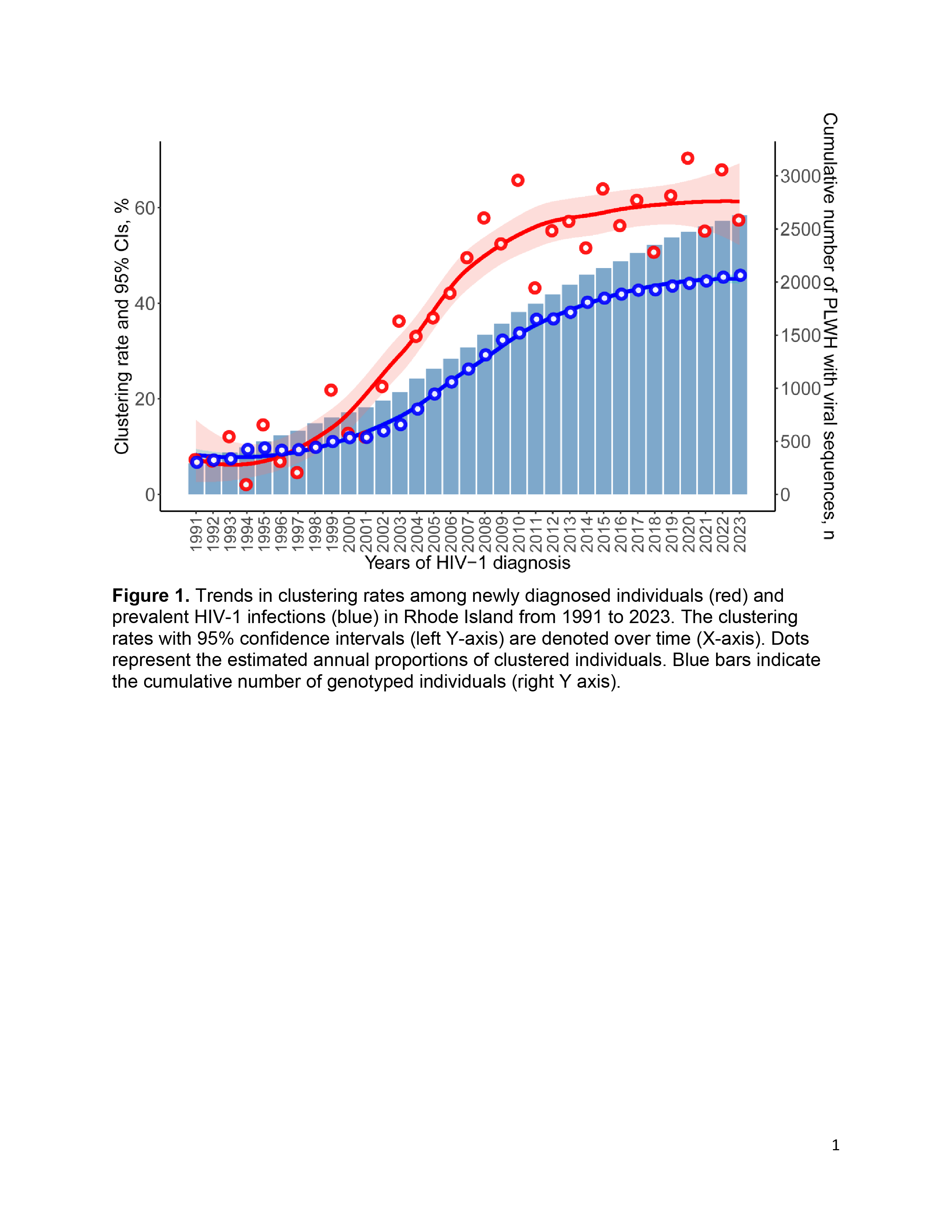
By the end of 2023, 2,630 persons with sequences represented the statewide Rhode Island HIV-1 epidemic. Overall, clustering rates increased from 7% in 1991 to 46% in 2023, correlating with cumulative sequence increase. Specifically, clustering rates increased significantly over time more among newly-diagnosed persons compared to prevalent infections mostly since 1998 (Figure), males versus others since 2009, people >40 years at HIV diagnosis versus others since 2005, MSM versus non-MSM since 2009, Whites versus others since 2005, persons with mental illness versus those without it since 2013, persons with HIV-1 subtype B versus non-B since 2013, and US-born versus foreign-born persons since 2007. Crossovers and divergence patterns in clustering rates identified over time among some groups further characterized clustering trend dynamics.
Conclusions
Monitoring HIV molecular clustering rates over three decades in a statewide epidemic revealed evolving trends and diverse patterns among key populations over time, suggesting a gradual shift toward a more localized HIV-1 epidemic in Rhode Island. Findings emphasize the importance of tracking clustering rates to guide targeted interventions and prevent new transmissions.
Table or Figure