Background
Timely HIV diagnosis and treatment is necessary to prevent transmission. The US Centers for Disease Control and Prevention (CDC) provide funding for HIV testing to community organizations and local health departments. We sought to estimate the additional number of HIV infections that would result from ending or interrupting CDC funding for HIV tests in US states.
Methods
We used the Johns Hopkins Epidemiologic and Economic Model (JHEEM), a validated model of HIV transmission, to simulate HIV epidemics in 25 US states. We projected incidence forward across 1,000 simulations under two scenarios where all CDC-funded HIV testing ends in February 2026 and (1) never resumes or (2) returns (linearly) to previous levels from January 2029 to December 2029. For both scenarios, we calculated excess incident HIV infections compared to a scenario where CDC-funded testing continues uninterrupted.
Results
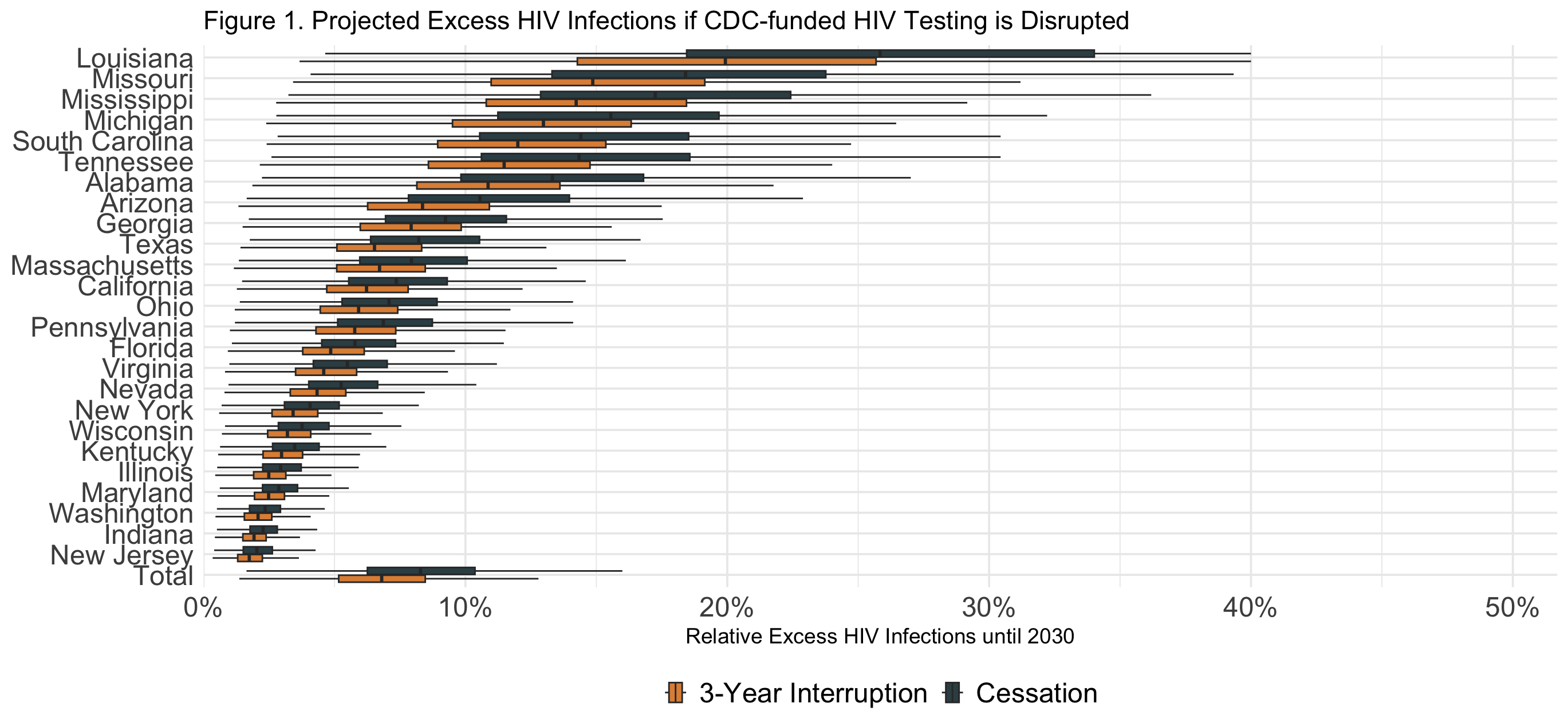
If CDC funding for HIV tests were to permanently end on February 1, 2026, we project 12,714 additional infections across 25 states by 2030 (95% CrI 4,589 to 21,764) – 8.0% more infections than if testing had continued (3.1%-14.4%). Projected effects varied by state, ranging from a 2.1% increase in New Jersey (0.80% to 3.9%) to a 27.2% increase in Louisiana (8.55% to 54.8%). If testing were instead to resume in January 2029, we project 10,397 additional HIV infections by 2030 (3,835 to 17,471), or a relative increase of 6.9% (2.6%-11.6%). We project more excess infections in states that perform more CDC-funded tests and/or have more rural epidemics. Projected excess infections also depend strongly on the proportion of people who find an alternative means to test for HIV. In simulations where fewer than one-third of HIV tests are replaced by alternative, non-CDC-funded tests, we project 19,073 (17,533 to 20,238) excess infections – versus 6,654 (5,517 to 7,906) when more than two-thirds of tests are still performed. Further simulations can be found at https://www.jheem.org/cdc-testing.
Conclusions
Disruptions to CDC-funded HIV testing would substantially increase new infections, particularly in states with more rural epidemics. In the event of disruptions, ensuring access to alternative funding/sources for HIV tests would be critical to minimizing new infections. These findings demonstrate the value of the CDC’s testing activities in curbing the spread of HIV in the US.
Table or Figure