Background
The risk of HIV acquisition is high in the postpartum period and can result in infant HIV infection via breastfeeding. The Tshireletso study evaluates implementation of long-acting cabotegravir (CAB-LA) on the post-natal ward after delivery with follow up co-located at local health clinics.
Methods
Tshireletso offers CAB-LA PrEP to women without HIV who are admitted to the post-natal ward <14 days after delivery at 2 hospitals in Gaborone (city) or Molepolole (village). Women are eligible based on epidemiologic HIV risk criteria: age 18-30 years, or age >30 with <3 pregnancies. Women who are medically unstable, taking contraindicated medication, moving out of the study area, or planning to get care outside government clinics are excluded. We describe the uptake of CAB-LA.
Results
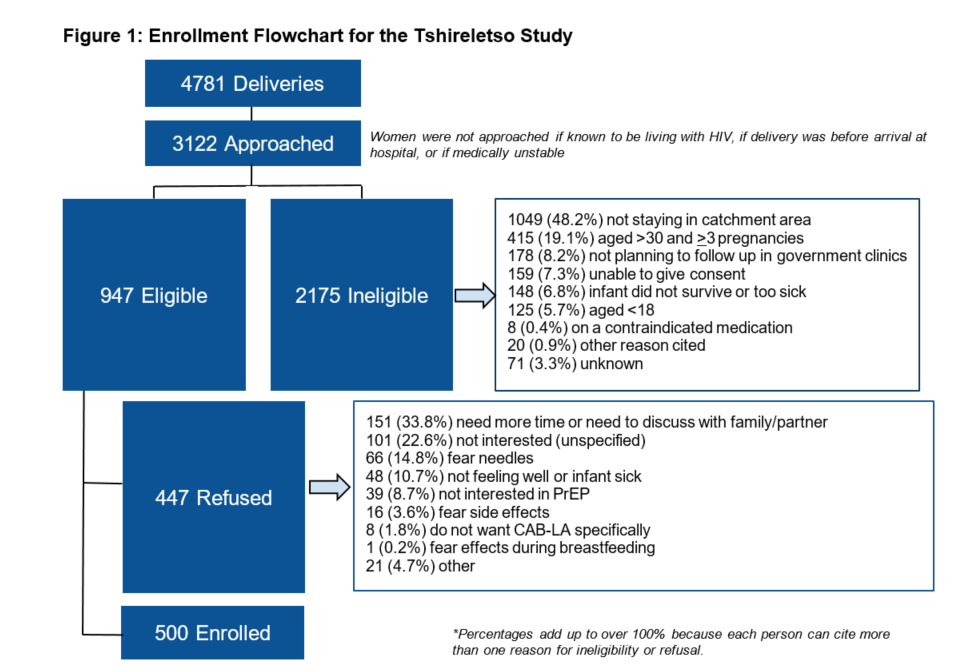
From Nov 2023—May 2025, 4781 women delivered, 3122 women without HIV were approached, and 2175 (70%) were ineligible (Figure 1) due to largely study-specific reasons. Of 947 eligible women offered participation, 500 (53%) accepted and started CAB-LA at a median of 1 day after delivery (IQR 1-2 d). Uptake was higher in Molepolole (69%) than in Gaborone (43%). Reasons for refusal included needing more time to decide (34%), unspecified lack of interest (23%), and fear of needles (15%) (Figure 1). Only 1.8% were specifically not interested in CAB-LA and 0.2% not interested because of breastfeeding. Among women starting CAB-LA, median age was 23 yrs (IQR 20-27 yrs), 95% were single, 71% unemployed, and 89% exclusively breastfeeding. Seventy (14%) women had prior PrEP use and 4 (0.8%) were on oral PrEP at enrollment. In the last 12 months, 5.2% reported >2 sexual partners and 62% had >1 partner >5 years older. Nineteen (3.8%) women had a partner known to be living with HIV, twenty (4.0%) reported a history of exchanging sex for money or goods, and 192 (38%) suspected partner infidelity. Of women with a current partner, 14% reported potential violence with condom negotiation. Most women (71%) felt they had some lifetime chance of getting HIV, while only 32% felt their baby had risk of HIV. Despite nearly all (97%) enrolled women feeling people using PrEP are praised as being responsible, 27% reported that PrEP users experience negative judgement and 29% said PrEP users are seen as “promiscuous”
Conclusions
Uptake of CAB-LA was high when offered to postpartum women based on epidemiologic HIV risk criteria. Offering PrEP on the post-natal ward is a potentially effective option to reach young women.
Table or Figure