Background
Although previous studies have detected HIV RNA in ART-treated people with HIV (PWH), the prevailing dogma is that this “residual transcription” represents a rare exception rather than the rule and the viral reservoir is thought to be generally silent. For the most part, this stems from the absence of sufficiently accurate and sensitive assays to enumerate the reservoir cells that transcribe HIV RNA.
Methods
We developed AREA (Active Reservoir Evaluation Assay) – a novel sensitive and precise assay based on limiting dilution-multiplex seminested RT-qPCR that measures frequencies of cells transcribing cell-associated HIV gag, env, and multiply spliced (MS, tat/rev/nef) RNA. We applied this assay to evaluate the active reservoir in peripheral blood of untreated (UT), ART-treated, and elite controller (EC) PWH without ex vivo cellular stimulation.
Results
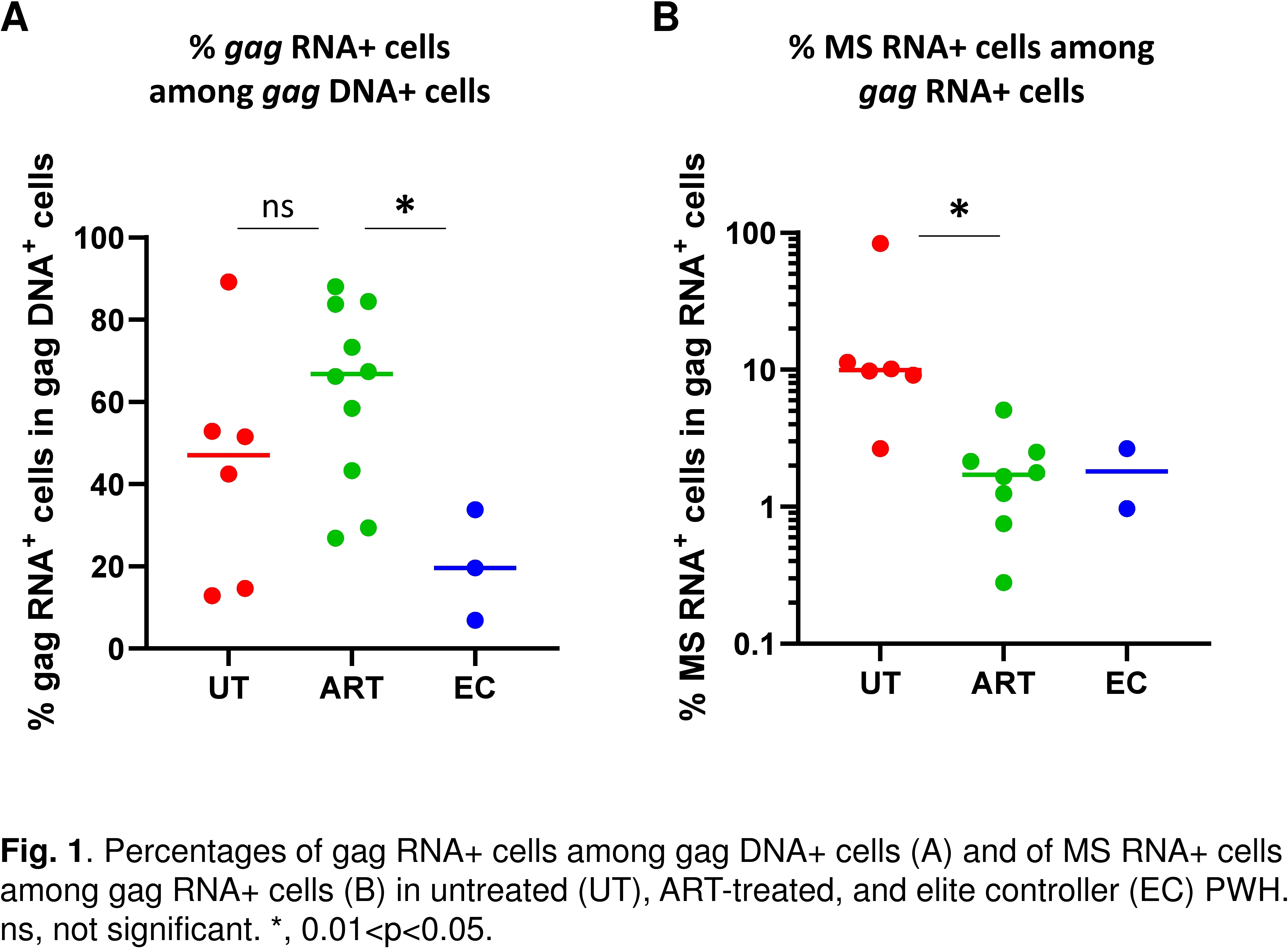
The highest frequencies of gag RNA+, env RNA+, and MS RNA+ cells were measured in UT, intermediate in ART-treated, and the lowest in EC. Surprisingly, in ART-treated PWH, majority (median, 66.8%) of HIV gag DNA+ cells transcribed gag RNA (Fig. 1A). However, only a median of 1.7% of these gag RNA+ cells transcribed MS RNA (Fig. 1B), due to post-transcriptional latency blocks and/or proviral genetic defects that prevented HIV splicing. In comparison, in UT PWH, 47.0% of HIV gag DNA-positive cells transcribed gag RNA (Fig. 1A), but of the latter, 10.0% transcribed MS RNA (Fig. 1B). Only a median of 8.4% of env DNA+ cells transcribed env RNA in ART-treated PWH, however in UT PWH this percentage was 91.3%. The median env RNA+/gag RNA+ cell frequency ratio was 0.33 in ART-treated and 1.23 in UT PWH, despite the corresponding median env DNA/gag DNA ratios of 1.08 and 1.17, respectively. This suggests the existence of a latency block at the distal elongation stage of HIV transcription in ART-treated PWH.
Conclusions
AREA revealed a large, previously underestimated, HIV active reservoir in ART-treated PWH, questioning transcriptional latency as the main mechanism of HIV persistence on ART. However, the low percentages of MS RNA+ cells in all groups implies that with or without ART, most gag RNA+ cells are still not productively infected. Our results argue for the shift of HIV latency reversal strategies from stimulating HIV transcription initiation and proximal elongation to the downstream steps such as distal elongation and splicing of HIV RNA. AREA can serve as a robust tool for the measurement of HIV reservoir in the curative interventions.
Table or Figure