Background
Metabolic dysfunction-associated steatohepatitis (MASH), defined as steatosis with hepatocellular ballooning and lobular inflammation, is more common in people with HIV (PWH) and linked to systemic inflammation and extrahepatic complications, including cognitive impairment. We previously showed cross-sectional associations between MASH and poorer cognitive performance in older PWH. Here, we examined whether MASH predicts accelerated cognitive decline in older PWH.
Methods
This study used data from the HIV Netherlands Australia Thailand Research Collaboration (HIV-NAT) 006 and 207, a single-site, prospective study involving older PWH, aged ≥50 years, who were first assessed during 2015-2017 and followed up with a second assessment during 2021-2024. Participants underwent transient elastography (TE) to measure liver stiffness measurement (LSM) and controlled attenuation parameter (CAP) at the baseline. MASH was defined using the non-invasive FibroScan-AST (FAST) score, which combines CAP and LSM from TE and AST levels, with a cutoff score of ≥0.67. Cognitive performance was assessed at baseline and follow-up using the Thai-validated Montreal Cognitive Assessment (MoCA), with a score of <25 indicating cognitive impairment. Longitudinal changes in MoCA were compared between participants with and without baseline MASH using multivariate linear mixed model.
Results
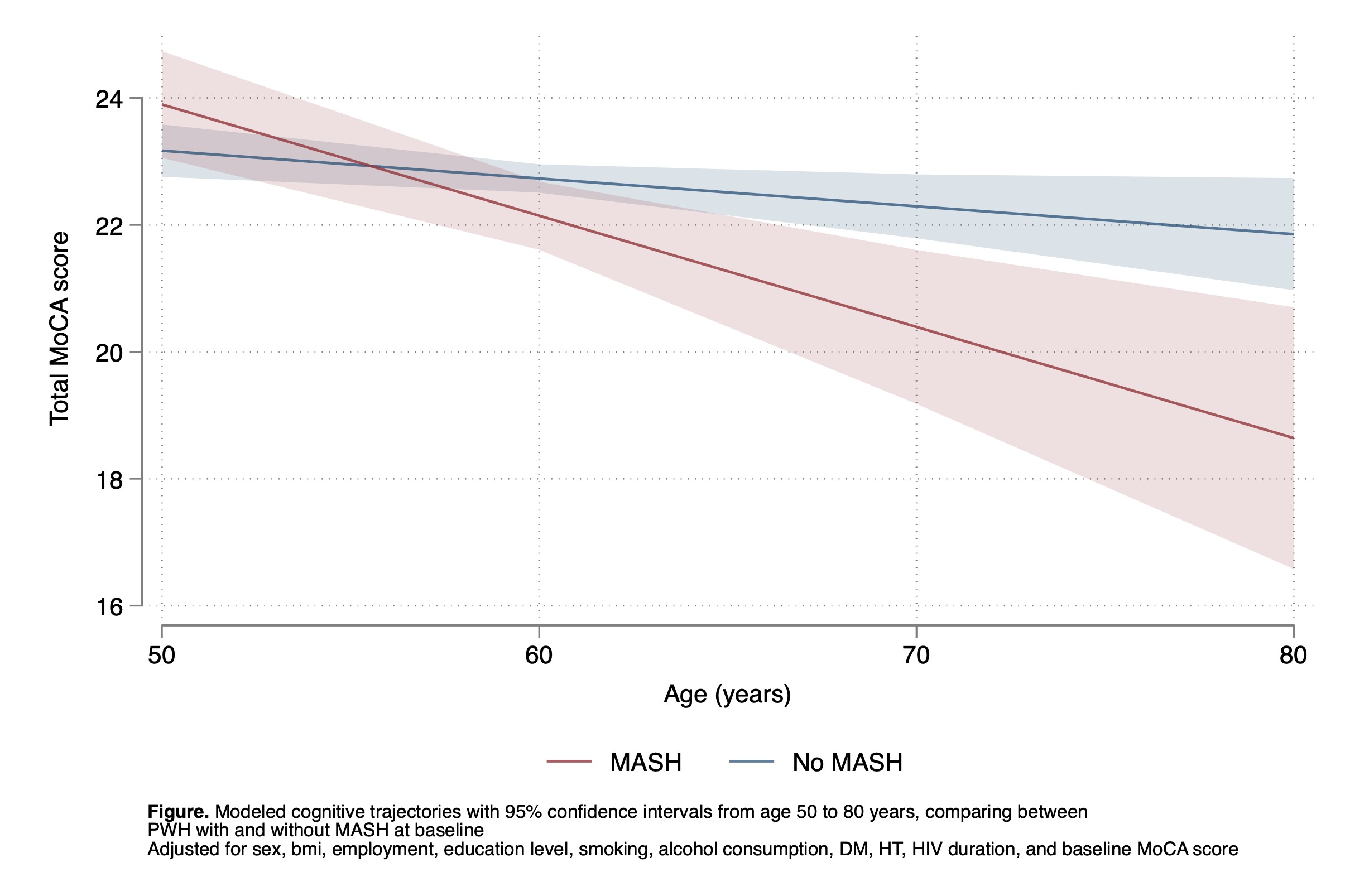
Among 291 participants (60.5% male; median age 54.4 years [IQR: 51.8–59.1]; median HIV duration 18.2 years [IQR: 15.0–20.9]), 20.6% had MASH at baseline. Baseline characteristics were comparable between those with and without MASH, except for a higher proportion of male in the MASH group (73.3% vs. 57.1%, p=0.022). The median interval between the MoCA assessments was 5.9 years (IQR: 5.6–6.8). After adjusting for age, sex, body mass index, education level, employment status, smoking, alcohol consumption, diabetes, hypertension, duration of HIV infection and ART regimen, participants with baseline MASH showed a significantly greater decline in cognitive performance (mean change -3.5 [95%CI -5.3 to -1.7] than those without MASH (-0.9 [95%CI -1.7 to -0.1]) from ages 50 to 70 years (P-interaction=0.006) (Figure).
Conclusions
MASH was independently associated with accelerated cognitive decline in older PWH over 6 years of follow-up. Early identification and management of MASH in PWH may help mitigate this risk.
Table or Figure