Background
Ensuring antiretroviral treatment (ART) success and reducing HIV transmission requires preventing interruption in treatment (IIT). We developed a screening tool to identify clients in Malawi at highest risk of IIT who may benefit from additional services at ART initiation or re-initiation.
Methods
We enrolled clients in a prospective cohort from nine ART clinics in four districts of Malawi. Enrollment criteria included (1) age ≥15 years, (2) living in facility catchment area, (3) newly initiating or re-initiating ART ≥28 days after IIT. Participants completed an enrollment survey on sociodemographics, mobility, ART history, and depression; medical charts were reviewed ≥7 months later to identify clients who had experienced IIT (missed appointment by ≥28 days) within six months of enrollment. Using 70% of our data as a “training” dataset, logistic regression was performed to identify characteristics that predicted IIT (p≤0.10) with stepwise backwards elimination to select characteristics for inclusion in screening tools. Using the 30% “testing” data, we compared areas under the receiver-operator curve (AUROC), sensitivity, and specificity for predicting IIT at each tool’s cutoff point. We attempted the same process for subpopulations including women, men, new initiates, and re-initiators.
Results
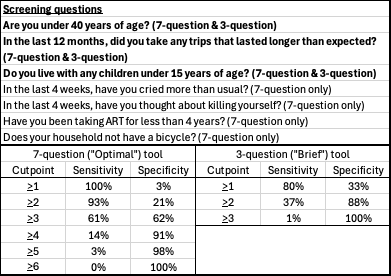
We enrolled 894 clients: 253 new initiates (28%); 543 (61%) female; and 506 (57%) married. Similar to routine data, 215 (24%) experienced early IIT. We identified two potential tools to predict IIT: a 7-question “optimized” tool had the highest AUROC (0.699), and a 3-question “brief” tool included only variables with p≤0.05 (AUROC 0.672). For the “optimized” tool, a score of ≥2 yielded sensitivity of 93% and specificity of 21%, while a score of ≥3 yielded sensitivity of 61% and specificity of 62% (Table). For the “brief” tool, a score of ≥1 yielded sensitivity of 80% and specificity of 33%, while a score of ≥2 yielded sensitivity of 37% and a specificity of 88%. No sub-population tool achieved a target of 80% sensitivity and 60% specificity.
Conclusions
Predicting IIT in this population was difficult, and as reported in other settings, an ideal screening tool may not be achievable. However, depending on specific policy goals (e.g. only offering intensive services to clients at highest risk of IIT and seeking high specificity, or exempting the lowest-risk clients from additional counseling and seeking high sensitivity) our developed tools may improve the efficiency of service delivery.
Table or Figure