Background
10 to 40% of people with HIV are classified as immune nonresponders. A reason for this wide range is the lack of a consistent definition of immune nonresponse. A review found the most common definitions include a low baseline CD4 count and an increase following 1-2 years of viral suppression. We argue these definitions do not capture nonresponse, propose an alternative definition based on predicted immune reconstitution, provide a formula predicting reconstitution, and shed light on the causes of immune nonresponse.
Methods
A mathematical formula predicting immune reconstitution was tested using data for 2,996 beneficiaries with HIV from the Military Health System (MHS), which provides universal access to care, minimizing system-level confounding and isolating patient-level causes. A mechanistic model of HIV infection consisting of a system of differential equations was built to simulate the paths over time of uninfected CD4 cells, latently infected CD4 cells, active virus producing CD4 cells, and HIV virions. Model parameter values were obtained from the literature. In silico trials were conducted on the effects of lymphocyte regeneration, apoptosis due to immunosenescence, ART effectiveness, immune activation, and residual virus replication.
Results
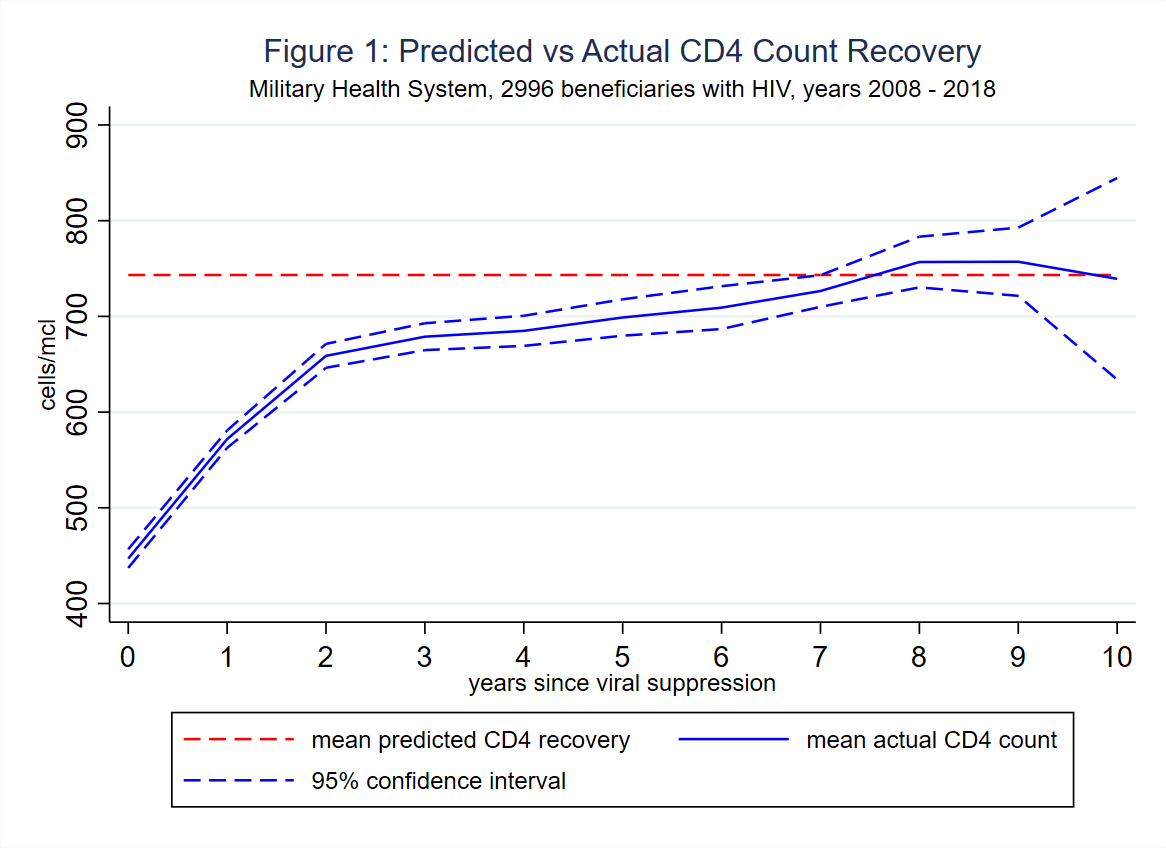
Reconstitution occurred at declining increments, which necessitates at least 3 CD4 measurements to predict an individual’s nonlinear immune reconstitution/nonresponse instead of the 2 employed in common definitions. Immune reconstitution of MHS beneficiaries converged to the level predicted by our formula in Figure 1. Potential reconstitution i.e. the CD4 steady state under perfect ART, was determined by CD4 cell production and death. Realized reconstitution was determined by target cell infection, virus production, and virus clearance rates as well as antiretroviral therapy effectiveness.
Conclusions
Immune reconstitution/nonresponse should be defined in terms of ability to realize potential reconstitution. We tested a formula using 3 CD4 measurements over time, which unlike common definitions, predicts realized immune reconstitution/nonresponse, and unlike definitions using absolute CD4 count, allows for early detection of nonresponders. Our simulations find immune system characteristics determine potential reconstitution while viral and treatment characteristics determine its realization. The findings imply nonresponse intervention should target the causes of potential reconstitution first and the causes of its realization second.
Table or Figure