Background
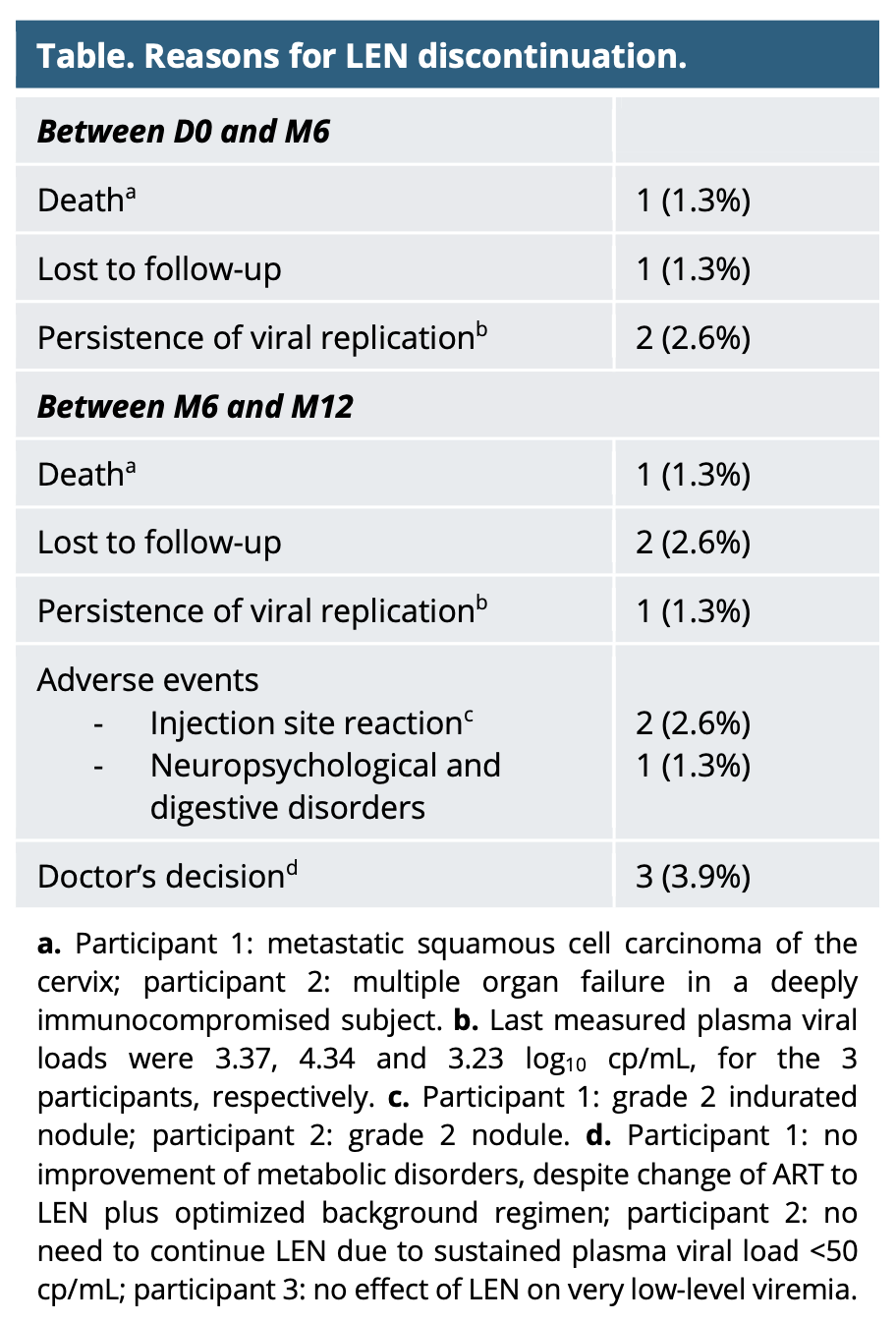
French guidelines recommend lenacapavir (LEN) for people with HIV (PWH) with multidrug-resistant virus who cannot achieve viral suppression with oral antiretroviral therapy (ART), pending validation by a multidisciplinary committee. The LENAddOn national study aims to: characterize PWH initiating LEN post-early access program in France; assess LEN continuation rates at month (M)6 and M12; describe reasons for LEN discontinuation.
Methods
Observational, retrospective study across 19 centers, including people with HIV-1 who initiated LEN between 20/06/2023 and 30/06/2024. Socio-demographic, clinical, and laboratory data were extracted from medical records. The primary outcome was the proportion of PWH receiving a second and third set of LEN injections 6 and 12 months, respectively, after initiation. Safety and virological efficacy of LEN-based regimens were also evaluated.
Results
77 PWH were included, with median age 57 years (IQR 44-63); duration of ART 25 years (17-29); history of frequent adherence issues and vulnerability factors. At LEN initiation, 20 (26.0%) had a plasma viral load (pVL) ≥400 copies/mL and 43 (55.8%) a pVL <50 copies/mL; 42 (54.6%) had viral resistance to ≥2 drugs in ≥3 classes. 21 participants (27.3%) received a fully injectable ART with LEN plus cabotegravir and/or rilpivirine. LEN continuation rate was 94.4% (95% CI 86.2–98.4%) at M6, and 81.8% (71.4-89.7) at M12, with 4 LEN discontinuations between D0 and M6, and 10 between M6 and M12 (Table). Injection site reactions (ISRs) were reported in 41/77 participants (53.2%) at D0, and 34/73 (46.6%) at M6, including 4 grade-3 ISRs, which did not lead to LEN being stopped. No other grade ≥3 clinical or biological adverse events were reported. Abdomen was the injection site in 96.3%, 92.9% and 86.3% of cases at D0, M6 and M12, respectively. Overall, 82.4% of injections were ‘on time’ (window of 26 +/- 2 weeks), 14.0% early, and 3.7% late. Median CD4 counts increased over the follow-up (418 to 515 cells/µL, p=0.016). At the end of the study period, 72/77 participants (93.5%) had last measured pVL <200 cp/mL, and 61/77 (79.2%) pVL<50 cp/mL.
Conclusions
In this observational study of PWH with high levels of vulnerability, we showed that LEN discontinuations were more frequent after the second (M6) than the first (D0) set of injections, mainly for non-virological reasons. In most cases, LEN simplified antiretroviral regimens while ensuring the maintenance or achievement of virological control.
Table or Figure