Background
HIV self-screening (HIVSS) has the potential to close HIV testing gaps by allowing individuals to test themselves rapidly and privately and thus extend testing access to populations less likely to engage with health facilities. Quantifying the downstream effects of HIVSS, particularly uptake, facility-confirmed diagnoses, and linkage to care, however, remains a challenge when relying on routine data. Demonstrating these impacts is critical to guide decisions on where and how HIVSS should be deployed most effectively. We used routinely collected data in South Africa to measure HIVSS distribution’s contribution to identifying people with confirmed HIV diagnoses.
Methods
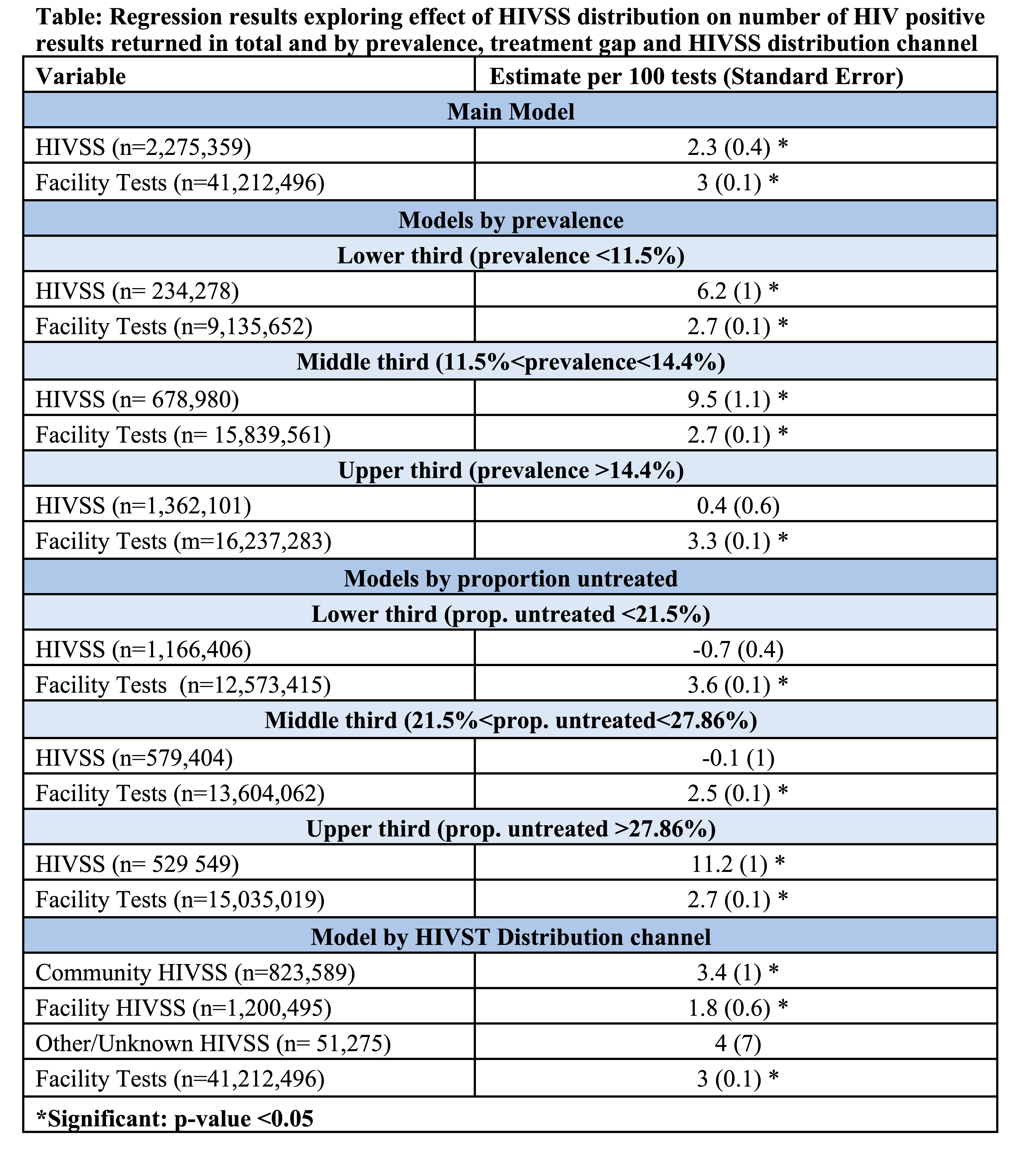
We applied multiple linear regression to evaluate the effect of HIVSS distribution (per district and quarter for October 2020–June 2023) on the number of HIV-positive results returned, adjusting for the volume of facility-based testing. Subgroup analyses examined differential effects by HIV prevalence tertiles and average treatment gap tertiles. A final model accounted for HIVSS distribution channel (community, facility, or other/unknown).
Results
HIVSS distribution was associated with 2.3 additional HIV-positive results per 100 tests distributed, compared with 3 per 100 facility-based tests (Table). Results varied by context. While no significant effect occurred in high-prevalence districts, 6.2 and 9.5 additional HIV positive results were returned per 100 HIVSS distributed in lower and middle prevalence districts respectively. In districts with high treatment gaps, HIVST yielded 11.2 additional positive results per 100 tests, with negative but non-significant effects observed in remaining districts. Distribution of HIVSS in the community had a higher yield than facility-based distribution (3.4 vs 1.8 additional HIV positive results).
Conclusions
Using routine data, we found that HIVSS distribution had a measurable and significant impact on identifying individuals with a confirmed positive HIV diagnosis. The effect was strongest in districts with lower prevalence but larger treatment gaps and where test kits were distributed through community channels. These findings suggest that targeting HIVSS to specific geographic and programmatic contexts could increase identification of people living with HIV and support progress toward the UNAIDS 95–95–95 targets.
Table or Figure