Background
We describe virological outcomes in a large multiregional cohort of children and adolescents living with HIV (CALHIV), aged 0-19 years, receiving dolutegravir (DTG)-based ART in low- and middle-income countries.
Methods
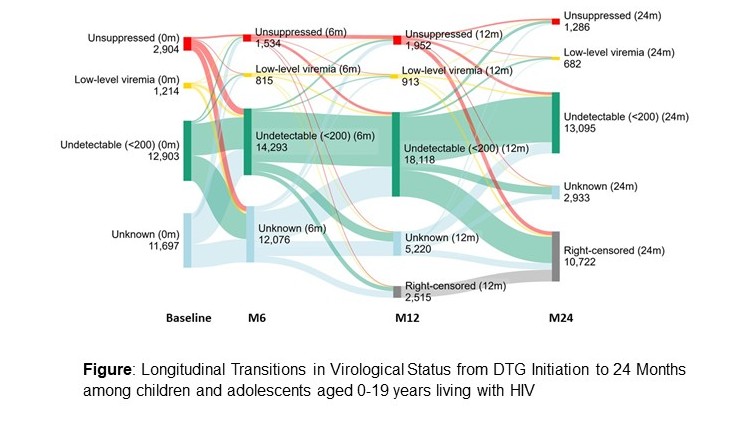
We included all CALHIV initiating or transitioning to DTG-based ART since 2018, to 2024 in clinics across West, East, Central and Southern Africa, the Asia-Pacific, and Latin America and the Caribbean, from the IeDEA consortium. We assessed viral load (VL) at baseline (within 6 months prior to and 14 days after DTG initiation), and 6 (±3), 12 (9-18), and 24 months (±6) after DTG initiation. Virological status was defined as suppressed (VL<200 copies/mL), low-level viremia (LLV, VL 200-999 copies/mL) and unsuppressed (VL≥1000 copies/mL). Changes over time were visualized with Sankey diagrams. Among CALHIV with a documented 12-month VL, factors associated with viremia were assessed using adjusted multinomial logistic regression, comparing LLV and unsuppressed VL to suppressed VL.
Results
Among 28,718 CALHIV initiating DTG, 53% were female, median age was 13.8 years (IQR:10.4-16.9), and mean duration on ART was 5.9 years (SD:4.5); 46%/18% had prior NNRTI/PI exposure, 28% switched NRTIs at DTG transition. Median follow-up from DTG initiation was 26 months (IQR: 15-38); 0.5% died and 24% were lost to follow-up (last clinical contact >12 months before database closure). Baseline VL was available for 17,021 (59%) CALHIV: 76% suppressed, 7% LLV, 17% unsuppressed. At 12 months (n=20,281), 11% had elevated VL (4.5% LLV, 6.2% unsuppressed); at 24 months (n=15,584), 11% had elevated VL (2.5% LLV, 8.3% unsuppressed) (Figure). Adjusted for sex, age, region, previous ART class and NRTI switch at DTG initiation, baseline VL predicted 12-month outcomes, with baseline LLV associated with 12-month LLV (OR = 1.51, 95% CI: 1.25–1.82), while those unsuppressed and with unknown VL at baseline had increased odds of unsuppressed 12-month VL (OR = 2.86, 95% CI: 2.26–3.62, and OR = 1.46, 95% CI: 1.24–1.71, respectively). At 12 months, those ART naïve, re-initiators, and transitioning from PIs (vs. NNRTIs) had higher odds of being unsuppressed vs. suppressed.
Conclusions
Among CALHIV initiating DTG, most achieved suppressed VL at 12 months. However, those with elevated baseline VL and prior treatment history remain at higher risk for elevated VL at 12 months. Special attention should be given to CALHIV initiating DTG with detectable VL to clarify the factors contributing to virologic failure.
Table or Figure