Background
Genital ulcer disease (GUD) is commonly caused by sexually transmitted infections (STIs) and typically occurs in genital, anorectal, or perineal areas, with herpes simplex virus (HSV) and Treponema pallidum (TP) being the most frequent pathogens, while Haemophilus ducreyi (HD) and Chlamydia trachomatis serovar L (CT-LGV) occur less often. Recently, mpox has emerged as an additional differential diagnosis in GUD. While clinical examination is essential, atypical presentations can hinder accurate diagnosis and delay treatment. This study aimed to assess the clinical performance of a molecular syndromic panel for GUD, evaluating its diagnostic concordance with routine methods.
Methods
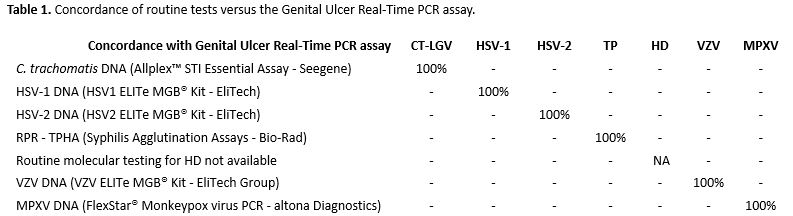
Between November 2024 and September 2025, individuals with vesicular or ulcerative lesions were recruited at two sexual health clinics in Milan, Italy. Samples were collected using the Universal Transport Medium (UTM®) – RT system (Copan, Italy) and tested with the Genital Ulcer Real-Time PCR kit (Vircell, Spain). This multiplex syndromic assay simultaneously detects DNA from CT-LGV, HSV-1/2, TP, HD, varicella-zoster virus (VZV), and mpox virus. Routine diagnostic tests were performed based on clinical suspicion: rapid plasma reagin and T. pallidum hemo agglutination assay for TP (Bio-Rad, U.S.), DNA detection for HSV-1/2, VZV (EliTech, France), mpox (Altona, Germany), and CT screening (Seegene, South Korea). Routine molecular testing for TP, CT-LGV, and HD was not available.
Results
Among 63 participants, 12 (19.0%) were living with HIV, 45 (71.4%) identified as men who have sex with men. Lesions were primarily genital (66.6%, 42) or anal (26.9%, 17); 53.9% (34) presented with single lesions. Symptoms included pain (60.3%, 38), lymphadenopathy (12.7%, 8), and fever (14.2%, 9). The syndromic panel detected mpox in 14.3% (9), HSV-2 in 12.7% (8), HSV-1 in 11.1% (7), CT-LGV in 9.5% (6), TP in 9.5% (6), and mpox-HSV2 coinfection in 1.6% (1). No HD cases were identified, and 41.3% (26) of samples tested negative for any investigated pathogen. All cases detected through routine testing were also detected with the Genital Ulcer Real-Time RT-PCR assay. Interestingly, one mpox and one HSV-2 were not detected by routine testing.
Conclusions
The molecular syndromic panel showed excellent concordance with standard diagnostic methods and reduced time to diagnosis. If further validated, it could enhance testing strategies for GUD. Larger studies are needed to confirm these findings and its broader clinical utility.
Table or Figure