Background
People with HIV (PWH) on effective antiretroviral therapy (ART) can have persistent inflammation and neurodegeneration. We have found that some biomarkers are highly stable over 12 years in PWH. Intra-individual differences in host genetics could be responsible by establishing biological set points. We hypothesized that specific single-nucleotide polymorphisms (SNPs) in neurodegeneration and inflammation-related genes significantly influence long-term biomarker stability, defined as ICC-based rank-order consistency across time.
Methods
In a longitudinal analysis of 308 participants, with a median age of 44 years at baseline, predominantly male (77%) with balanced racial representation, including 43% White, 45% Black, and 11% Hispanic participants, we measured 12 plasma and 12 CSF biomarkers at baseline and 12 -years later. We used linear mixed-effects models to test associations between 19 literature-derived SNPs and biomarker concentrations, with a random intercept for each participant to account for repeated measures. Genotypes were encoded to model additive effects. Models were adjusted for age, sex, and durations of HIV infection and ART.
Results
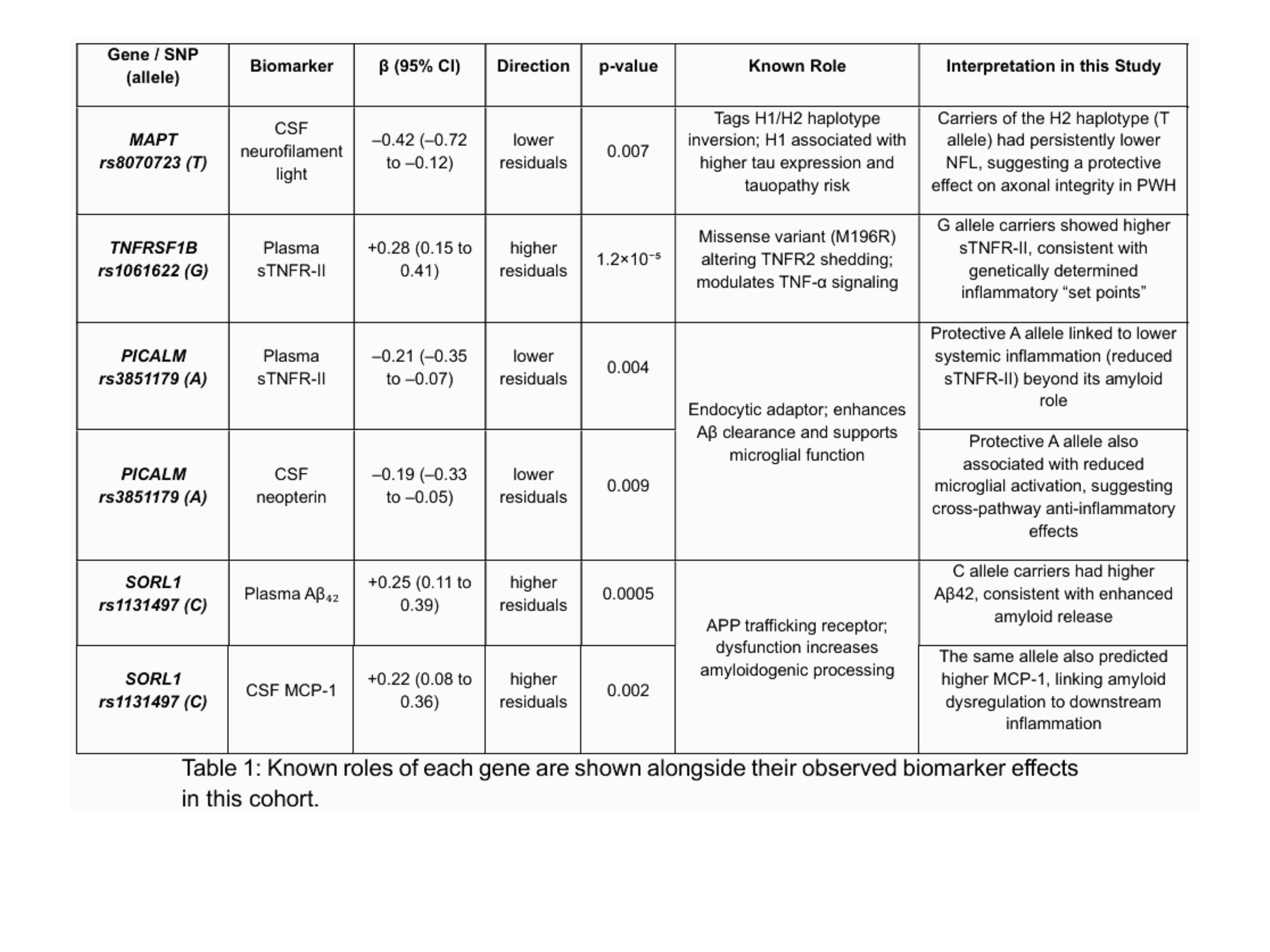
Despite viral suppression, defined as plasma HIV RNA <50 copies/mL, improving from 62% to 73.4%, and greater comorbidity burden, intraclass correlation coefficients exceeded 0.6 for most biomarkers, confirming high stability, defined by relative ranking consistency of biomarker levels over time. After false discovery rate (FDR) correction, five SNP-biomarker associations were significant (Table 1). The MAPT H2-haplotype-tagging SNP rs8070723 was associated with lower CSF neurofilament light (NFL) residuals (β = -0.42, p=0.007), a novel neuroprotective signal. The PICALM rs3851179 protective allele was associated with lower plasma sTNFR-II (β = -0.21, p=0.004) and lower CSF neopterin (β = -0.19, p=0.009). Consistent with known biology, the SORL1 rs1131497 risk allele was associated with higher plasma amyloid-β1-42 and CSF MCP-1
Conclusions
Host genetics contribute to the stable, individualized neuroinflammatory milieu in chronic HIV. Our findings show established biological pathways, such as the role of SORL1 in amyloid processing, but also uncover novel, cross-pathway associations, including a putative anti-inflammatory role for PICALM. Genetic profiling may identify subgroups with distinct biological characteristics, including neuroprotective signatures, advancing precision medicine approaches in HIV care.
Table or Figure