Background
Differentiated service delivery (DSD) streamlines HIV care for people on antiretroviral therapy (ART) by extending clinic visit intervals and refill durations. HIV treatment guidelines in sub-Saharan Africa, including Kenya, now expand DSD eligibility to include postpartum women with HIV (PPWH). We evaluated DSD implementation and retention in care for PPWH within a large HIV treatment program in Kenya.
Methods
We analyzed medical records of PPWH at 52 AMPATH-affiliated sites from 2019-2024 to determine visit spacing and retention pre- and post-release of Kenya’s 2022 guideline recommending DSD for PPWH. We included all PPWH with ≥1 postnatal clinic visit within 3 months of delivery. Visit spacing was defined as the days between attended and next scheduled visits, assessed within three 6-month postpartum periods. The primary outcome was retention through 18 months postpartum, defined as no missed scheduled visit by >30 days (i.e., gap in care). We estimated state occupation probabilities (retained vs. gap) using the working-independence Aalen-Johansen estimator, compared groups with a linear rank test, and determined associations with all gaps using a marginal Cox model with time-dependent pre/post-guideline covariates and cluster-robust standard errors, adjusting for age, facility level, and HIV diagnosis before versus during pregnancy.
Results
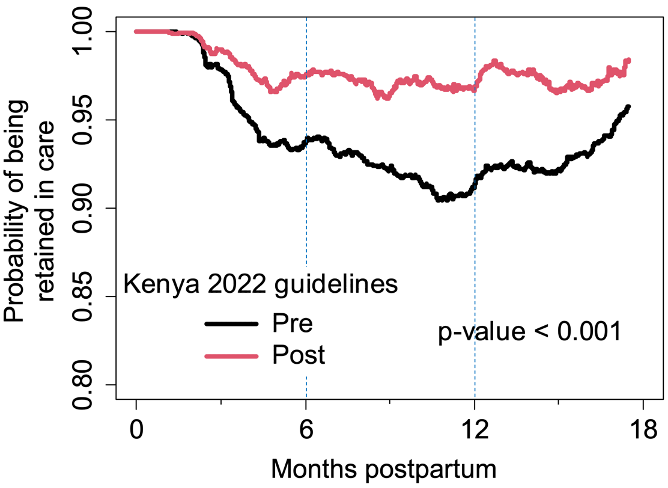
A total of 8,148 PPWH were included (median age 31 years; 23% diagnosed with HIV during pregnancy; 69% on dolutegravir-, 24% NNRTI-, 7% other ART). Across 82,807 clinic visits, median visit spacing (pre- vs. post-guideline) by postpartum period was: ≤6 months (32 vs. 37 days), 7-12 months (36 vs. 58 days), and 13-18 months (47 vs. 66 days) (p<0.001 for all). Overall, 62% of PPWH were retained through 18 months and 38% had ≥1 gap. PPWH with a gap were significantly younger, had higher CD4, shorter ART duration, and more were diagnosed with HIV during pregnancy than retained PPWH. The probability of being retained was higher post- versus pre-guideline (Figure). In multivariable analysis, the hazard of ≥1 gap was lower post- versus pre-guideline (HR 0.57, 95% CI: 0.47-0.71). Older age and higher facility level were independently associated with lower hazards; HIV diagnosis during pregnancy was associated with a higher hazard.
Conclusions
DSD implementation for PPWH was associated with improved retention in care through 18 months postpartum, supporting its adoption for this population and potential to improve maternal and child HIV outcomes.
Table or Figure