Background
Antiretroviral therapy (ART) has led to longer lifespans but an increased burden of age-associated conditions and frailty in people living with HIV (PLWH). Emerging evidence suggests that chronic inflammation and immune cell dysregulation contribute to frailty pathogenesis. The aim of this study was to examine the relationship between cellular immunosenescence and frailty in men with HIV.
Methods
One hundred people with HIV aged 50 years and older were recruited from The Alfred Hospital in 2015, and 83 men with available samples were classified as non-frail (n=65) or frail (n=18) based on the Frailty Index. Flow cytometry was performed on stored Peripheral Blood Mononuclear Cells using a panel targeting key lymphoid and monocyte populations to assess cellular immunosenescence (CD28 & p16) and senescence-associated β-galactosidase (SA-β-gal) activity. Soluble factor analysis was performed on stored plasma samples using Luminex and ELISA assays.
Results
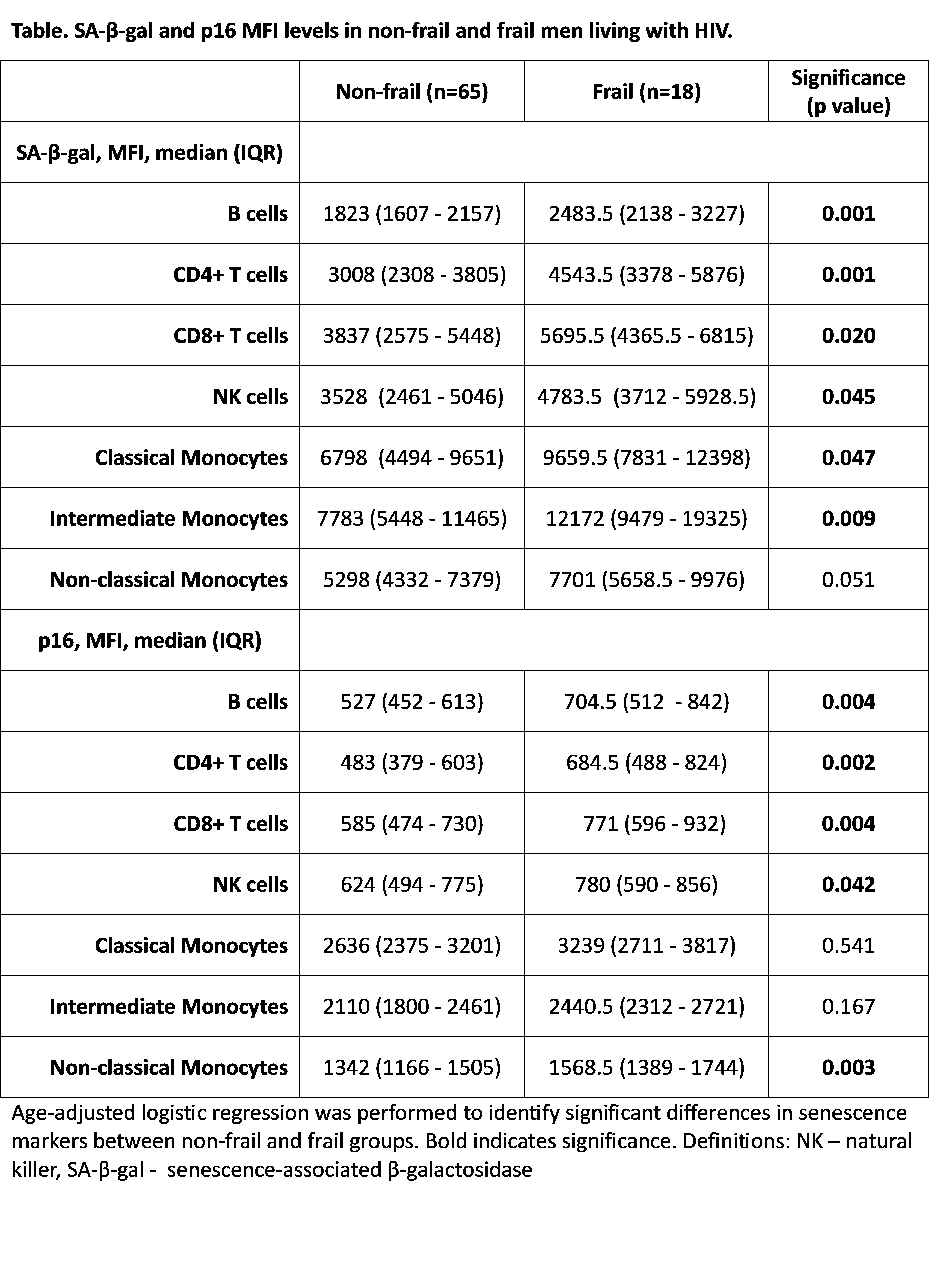
Frailty was significantly associated with older age (median [IQR], non-frail 59 [56-64] versus frail 62 [58-71], p=0.042), but not ART duration or detectable HIV viral load. In age-adjusted logistic regression, median SA-β-gal median fluorescent intensity (MFI) levels were significantly elevated in lymphocytes (B cells, T cells, NK cells) and monocytes (classical, intermediate) in frail participants compared to non-frail participants (all p<0.05, Table). Similarly, cell cycle arrest marker p16 showed significantly elevated MFI levels in frailty for all cell types except classical and intermediate monocytes (all p<0.05, Table). Frail participants also exhibited a higher median frequency of senescent CD8+/CD28- T cells (non-frail 48.7% [38.6-61.7] versus frail 59.8% [45.9-74.7], p=0.041). Median plasma interkeukin-6 (non-frail 1.56 [0.00-2.39] pg/mL versus frail 3.49 [1.84-4.62] pg/mL, p=0.005) and C-reactive protein (non-frail 1.85 [0.80-3.20] mg/L versus frail 4.80 [1.60-8.50] mg/L, p=0.0165) were significantly elevated in frailty upon univariate, but not age-adjusted, analysis.
Conclusions
We have shown that frailty in men with HIV is associated with chronic inflammation and enhanced immune cell senescence that broadly impacts the innate and adaptive immune system, potentially indicating heightened immune ageing. These cellular changes combined with increased systemic inflammation may contribute to frailty pathogenesis and represent a potential therapeutic target to improve healthy ageing in PLWH.
Table or Figure