Background
More than 10% of the 2.5 million sex workers in sub-Saharan Africa live with chronic hepatitis B virus (HBV). HIV pre-exposure prophylaxis (PrEP) using tenofovir/emtricitabine (TDF/FTC) has not been studied in this population, in part due to concerns of hepatitis flares following TDF/FTC cessation.
Methods
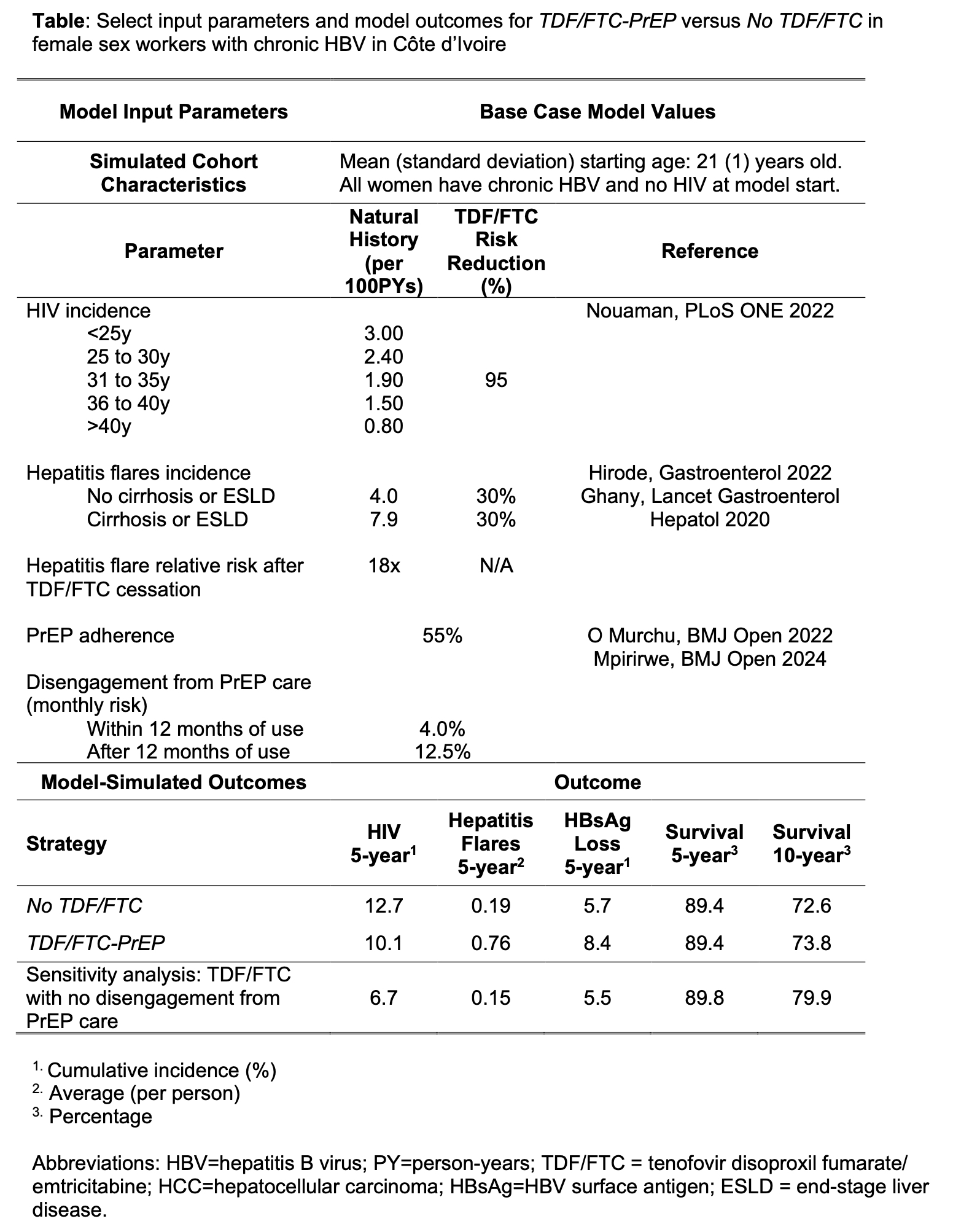
Using the CEPAC simulation model of HIV and HBV disease, we compared the clinical impact of TDF/FTC–PrEP versus No TDF/FTC in female sex workers with HBV in Côte d’Ivoire. We incorporated anti-HBV effects of TDF/FTC and the increased probability of hepatitis flares and HBV surface antigen (HBsAg) loss following TDF/FTC cessation. We defined a hepatitis flare as alanine aminotransferase >2x limit of normal. We derived input parameters from published literature: HIV incidence (0.8 – 3.0/100 person-years [PY]), PrEP adherence (55%), hepatitis flares (2.0-4.0/100PY, increasing following TDF/FTC cessation), HBsAg loss (1.0/100PY, increasing following TDF/FTC cessation), and disengagement from PrEP care (4%/month for the first 12 months, then 13%/month). Model outcomes included cumulative HIV incidence, hepatitis flares/person, HBsAg loss, and survival at 2, 5, and 10 years. We conducted sensitivity analyses varying HIV incidence, hepatitis flare incidence and mortality, PrEP adherence, and disengagement from PrEP care.
Results
Compared with No TDF/FTC, TDF/FTC–PrEP would reduce cumulative HIV incidence to 4.1% vs. 5.6% at 2 years and 10.1% vs. 12.7% at 5 years. TDF/FTC-PrEP would result in more hepatitis flares (0.76/person vs. 0.19/person) and higher cumulative HBsAg loss (8.4% vs. 5.7%) after 5 years. Survival would be similar in both strategies over 2 and 5 years, and TDF/FTC-PrEP would improve survival over longer time horizons. Improving adherence and reducing disengagement from care would increase clinical benefits. TDF/FTC-PrEP with no disengagement from PrEP care would reduce incident HIV infections (6.7%), minimize hepatitis flares (0.15/person), and extend survival over 5 years. Even with higher disengagement from PrEP care (18%/month), TDF/FTC-PrEP would reduce HIV infections and improve long-term survival.
Conclusions
Female sex workers with HBV in Côte d’Ivoire would benefit from TDF/FTC as PrEP to reduce the risk of HIV infection, despite the short-term risk of hepatitis flares. Efforts should be made to scale up PrEP in sex workers, including those with chronic HBV.
Table or Figure