Background
Use of two drug antiretroviral regimens such as dolutegravir/lamivudine (DTG/3TC) minimises exposure to NRTIs reducing drug toxicities that overlap with co-morbidities common in older persons living with HIV. The efficacy of dolutegravir/lamivude has been demonstrated in persons with no history of prior virological failure. We evaluated the efficacy and safety of switching older adults from bictegravir/emtricitabine/tenofovir alafenamide (B/F/TAF) to DTG/3TC.
Methods
The Sungura Study (NCT06444620) is an open-label, single arm, 96-week study conducted at two sites in Kenya. Eligible participants were adults ≥60 years with HIV-1 viral load <50 copies/mL on B/F/TAF with no prior virological failure and hepatitis B negative; all were switched to DTG/3TC at enrolment. The primary endpoint was the proportion of participants with viral load ≥50 copies/mL at 48 weeks using the FDA snapshot algorithm. We present the primary week 48 results, the study is continuing to week 96.
Results
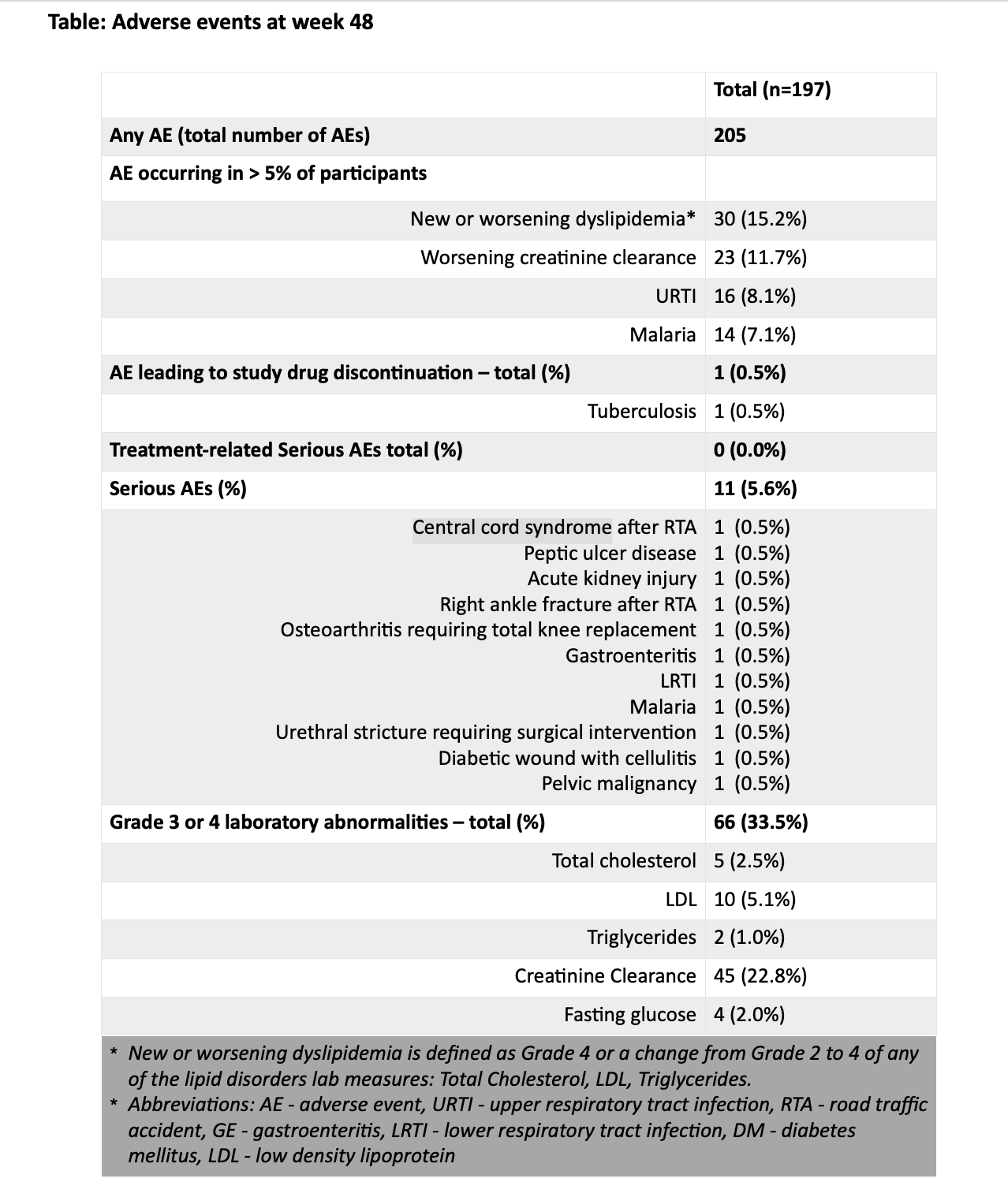
Between July and Sep 2024, 197 participants were enrolled and treated and included in the ITT-E analysis. All participants were black African, 49% were female and the median age was 66 years (range 62 to 81). HBcAb was positive in 92 participants, all of whom had HBsAb levels ≥ 10 U/ml. Baseline prevalence of co-morbidities was high. At week 48, 197 participants remained on DTG/3TC and none (0/197) had HIV viral load ≥50 copies/mL, one participant required switch to TDF/3TC/DTG + DTG at week 48 due to a diagnosis pulmonary tuberculosis requiring treatment with rifampicin. There were eleven serious adverse events with none related to the study drug (table). One participant with HBcAb positive at baseline had a grade 2 AST abnormality at week 48, the ALT was normal with no other features of hepatitis. Incident co-morbidities included hypertension in 30.5% (18/59), impaired fasting glucose or diabetes in 3.6% (6/165), dyslipidemia in 19.3% (30/151) and grade 3 or 4 creatinine clearance events in 16.9% (23/136). The median change in weight was 0.0 kg (IQR -2.0 to 2.0) with 27 (13.8%) participants having ≥5% weight gain. The median change in 10-year ASCVD risk score was 0.0% (IQR -1.7 to 2.9).
Conclusions
At week 48, there was no virologic failure or withdrawal from the Sungura study. Co-morbidities were common, highlighting additional considerations for selecting antiretroviral agents for older populations.
Table or Figure