Background
Tuberculosis (TB) and histoplasmosis are leading opportunistic infections (OIs) among people with advanced HIV disease (AHD) in Latin America and the Caribbean (LAC). Concomitant histoplasmosis, present in 15-40% of TB cases, poses a major therapeutic challenge due to drug–drug interactions and overlapping toxicities. Data on the prevalence, outcomes, and optimal treatment regimens remain limited. With the adoption of the expanded WHO/PAHO package of care for AHD, the number of coinfection cases will increase.
Methods
We pooled data from four prospective implementation studies evaluating a package of rapid diagnostic tests for OIs in people with AHD in LAC. TB and histoplasmosis were defined by a positive rapid test (TB-LAM or urinary histoplasma antigen) or microbiological confirmation (culture, histopathology, or molecular tests). Prevalence was calculated using TB cases as the denominator. Ninety and 365-day mortality rates were compared across groups, and univariate analyses identified predictors of mortality among co-infected patients.
Results
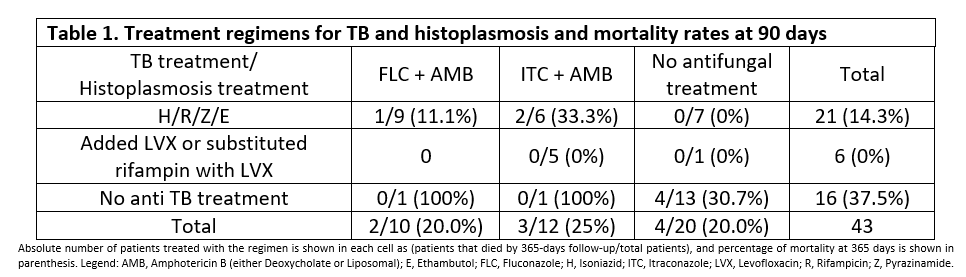
Among 1,282 individuals with AHD, 108 (8.4%) had histoplasmosis and 325 (25.3%) had TB; 46 of the 325 TB cases (14.1%) were co-infected, with complete data for 43 cases. Median CD4 count among co-infected patients was 42 cells/mm³. Mortality at 90 and 365 days was 7.8% and 9.3% in TB monoinfection versus 34.8% and 41.9% in histoplasma/TB co-infection (p<0.001). Severe histoplasmosis (OR 16.95, p<0.001; OR 16.46, p<0.001), TB meningitis (OR 7.13, p=0.008; 4.96, p=0.026), and lower CD4 counts (OR 0.97, p=0.023; OR 0.97, p=0.014) were associated with increased mortality. Mortality did not significantly differ across antifungal TB combinations (Table 1). However, regimens that avoided the itraconazole-rifampin interaction (by replacing itraconazole with fluconazole or substituting rifampin with a fluoroquinolone) showed lower 365-day mortality (11.1% vs 57.1%, p=0.027).
Conclusions
TB-histoplasmosis co-infection are frequent in people with AHD in LAC; associated with a 4.5-fold higher mortality compared to TB monoinfection. Despite limitations due to sample size, our study shows that standard TB and histoplasmosis treatments, when combined, seem to be inferior to alternatives. There is no evidence-based optimal treatment regimen for these cases, making the evaluation of non-rifamycin-containing TB regimens or the replacement of itraconazole an urgent priority.
Table or Figure