Background
Chronic HIV-1 infection is characterized by persistent immune activation that contributes to comorbidities among people with HIV-1 (PWH). Although type I interferons (IFN-I) are essential for antiviral immunity, sustained IFN-I activity has been implicated in immune dysfunction and disease progression. IFN-I comprises 13 IFNα subtypes and IFNβ, but their relative contributions to HIV-1 pathogenesis remain unclear. We previously reported that IFN-I responses are compartmentalized, with IFNβ overexpressed in the gut but not in blood, where IFNα subtypes predominate. In peripheral blood mononuclear cells (PBMC), IFNα5 accounted for 67% of IFNA transcripts among PWH. Here, we profiled genes altered by distinct IFNα subtypes and correlated these ‘interferomes’ with clinical and immunologic outcomes in PWH.
Methods
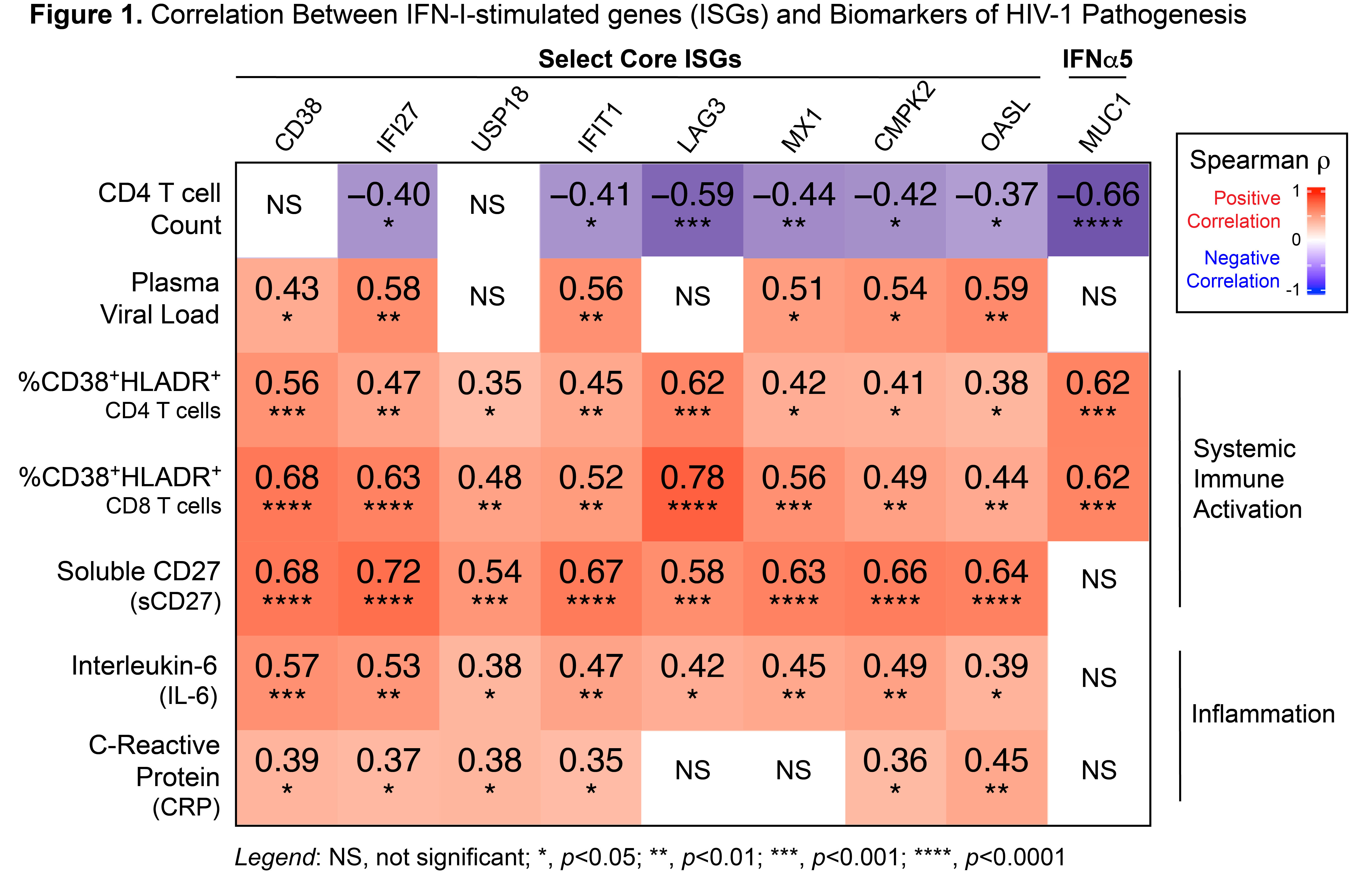
To establish IFNα subtype interferomes, PBMC from 7 HIV-uninfected donors were treated in vitro with IFNα1, 2, 4, 5, 8 and 14 for 18h, followed by RNA-sequencing. IFN-regulated genes (IRG) were defined relative to untreated cultures (≥1.5-fold up/downregulated, false discovery rate FDR ≤20%) using DESeq2. Expression of 608 IRG were compared between PBMC of 19 PWH not on antiretroviral therapy (median plasma viral load (VL): 26,000 copies/ml; CD4 429 cells/µl; 68% male) and 13 age and sex-matched controls (CD4 720 cells/µl) by RNA-seq. Associations with CD4 count, VL, systemic immune activation (%CD38+HLA-DR+ T cells, sCD27) and inflammation (IL-6, CRP) were assessed by Spearman’s rank (Figure 1).
Results
Despite comparable induction of canonical ISG15, IFNα subtype interferomes established in vitro only partially overlapped. In addition to 78 core IRG altered by all IFN-I tested, 209 IRG were IFNα subtype-specific. 16 core IFN-stimulated genes (ISG) were significantly upregulated in PWH (3.4-fold, range 1.7-15.3; FDR<10%). Core ISG linked to viral restriction (IFIT1, MX1, OASL), dNTP metabolism (CMPK) and T cell exhaustion (LAG3) correlated with immune activation and IL-6, and inversely with CD4 count (all p<0.05, Fig.1). MUC1, an IFNα5-regulated gene that encodes Mucin-1, was expressed 2.7-fold higher in PWH (p<0.01). MUC1 expression correlated positively with MX1, LAG3, and T cell activation, and inversely with CD4 count (all p<0.05, Fig.1).
Conclusions
Multiple Core ISG were altered in untreated PWH. IFNα5, the dominant systemic IFN-I in untreated PWH, may act in part via Mucin-1, a transmembrane glycoprotein previously linked to T cell exhaustion, to drive HIV-1 pathogenesis.
Table or Figure