Background
AIDS Drug Assistance Programs (ADAPs) provide access to antiretroviral therapy for people with HIV with low incomes. Longitudinal trends in the challenges that ADAPs navigate have not been evaluated. Given recent policy shifts, such as the end of Medicaid continuous coverage, rising prescription drug and insurance costs, and federal funding uncertainty, we examined trends and changes in ADAPs’ challenges from 2017 to 2023.
Methods
Data were obtained from the 2019-2025 NASTAD National ADAP Monitoring Project Annual Reports, which include data for 2017-2023. Due to the COVID-19 pandemic, the survey was not conducted in 2020. State ADAP leaders rated program challenges on a 3-point Likert scale (Not, Somewhat, or Very Challenging), or could indicate Not Applicable. We collapsed Somewhat and Very Challenging into one category- Challenging. We calculated the overall percent change from 2017 to 2023 to assess longitudinal trends about whether challenges remained constant or increased.
Results
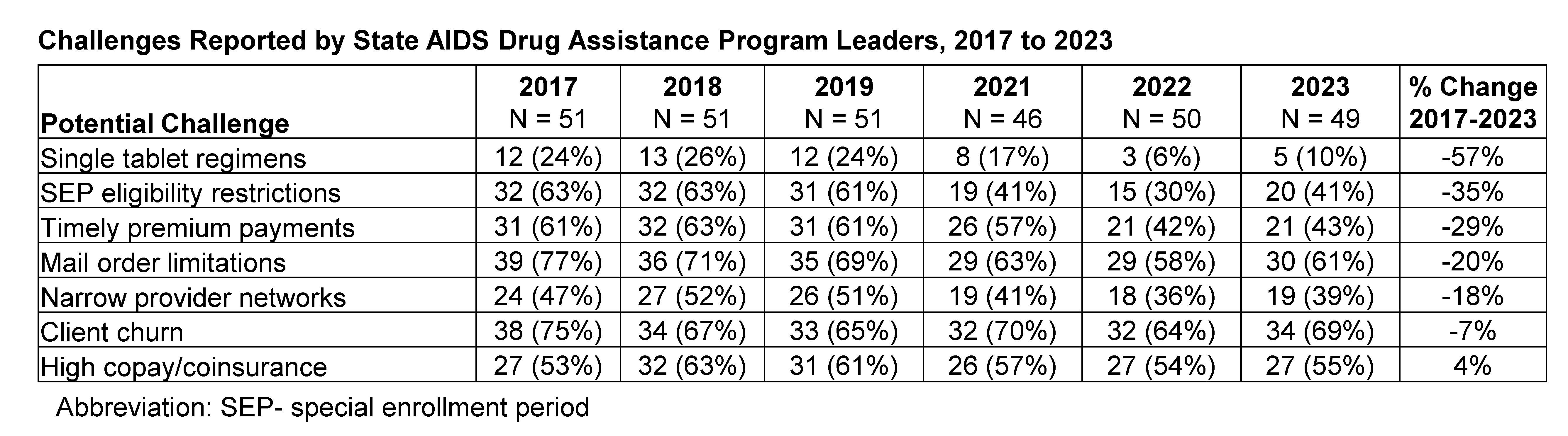
Data were submitted by 46–51 state ADAPs annually (see table). Overall, the mean number of domains rated as challenging by ADAPs decreased by 20%, from 5.4 (SD 2.0) in 2017 to 4.3 (SD 2.2) in 2023. Despite this improvement, three domains were rated as challenging by over 50% of ADAP each year: pharmacy mail order limitations, client churn, and high copay. Pharmacy mail order limitations and client churn did see improvements with decreases of 20% and 7% from 2017 to 2023, respectively. High copay had a 4% increase. Special enrollment period eligibility restrictions and timely premium payments improved over time, decreasing by 30%. Importantly, the domain that had the lowest percent of ADAPs rate it as challenging in all years was access to single tablet regimens (2017: 24%; 2023: 10%) and there was a 57% decrease in states reporting it as a challenge over time.
Conclusions
Our findings suggest that while some ADAP challenges have eased over time, there are some challenges that persistently impact more than half of states over the entire study period. Client churn remains a challenge that must be closely tracked, as it can be influenced by changes in Medicaid eligibility. Similarly, high copays/insurance costs will need to be tracked, given that insurance premiums are increasing each year. ADAPs’ decreasing concerns about accessing single tablet regimens are reassuring. This work may highlight priority topics for technical assistance or HRSA evaluation of policy and resources.
Table or Figure