Background
The Families First Coronavirus Response Act mandated continuous Medicaid coverage during the COVID-19 Public Health Emergency (PHE; March 2020–May 2023), ensuring uninterrupted coverage for millions, including low-income people with HIV (PWH). When the PHE ended, states resumed Medicaid determinations, leading to disenrollments. As the safety net for uninsured PWH, the demand for the AIDS Drug Assistance Program (ADAP) is affected by Medicaid policies. We studied changes in clients served by ADAP from 2016 to 2023, by state Medicaid expansion status and PHE policy period.
Methods
We analyzed annual state-level data on the number of ADAP clients from 2016 to 2023 using data from the NASTAD National ADAP Monitoring Report. States were categorized by Medicaid expansion status as of 2020 (expansion vs. non-expansion). The study period was divided into three policy-relevant intervals: pre-PHE (2016–2019), during the PHE with mandated continuous Medicaid coverage (2019–2022), and during PHE unwinding (2022–2023). We calculated the annual percent change in the number of ADAP clients served (receiving at least one service during the calendar year) within each state and policy period and compared trends between expansion and non-expansion states.
Results
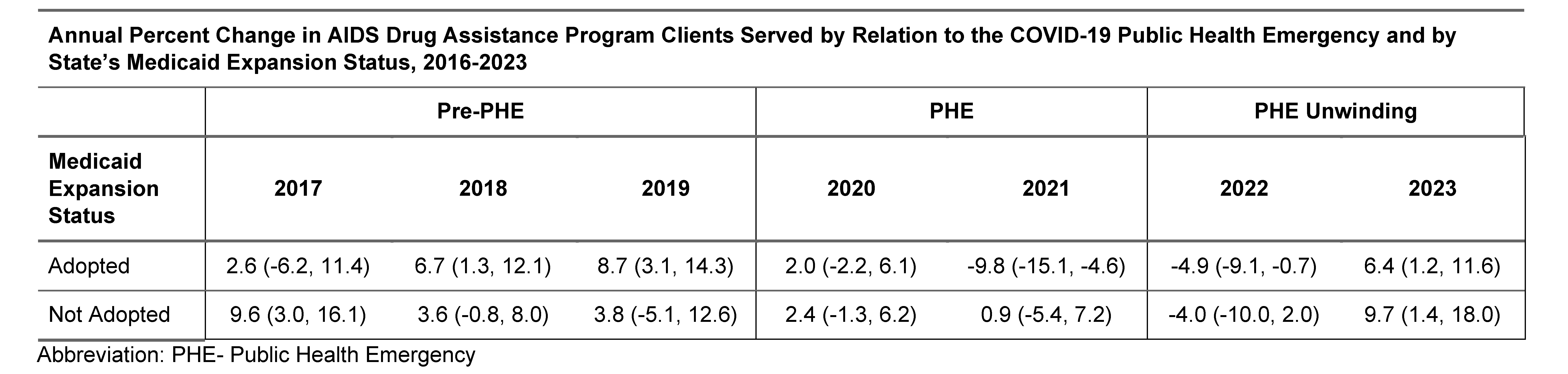
From 2017–2019 (pre-PHE), ADAP clients served increased in both Medicaid expansion and non-expansion states, with a peak annual increase of 8.7% (95% CI: 3.1, 14.3) in expansion states and 9.6% (95% CI: 3.0, 16.1) in non-expansion states. During the continuous Medicaid coverage period (2020–2022), expansion states experienced larger declines in ADAP clients (2021: -9.8% [95% CI: -15.1, -4.6]) compared with smaller fluctuations in non-expansion states (2021: 0.9% [95% CI: -5.4, 7.2]). In the PHE unwinding period (2022–2023), ADAP clients rebounded in both groups, increasing by 6.4% (95% CI: 1.2, 11.6) in expansion states and 9.7% (95% CI: 1.4, 18.0) in non-expansion states.
Conclusions
The COVID-19 PHE demonstrated that stable Medicaid coverage dramatically reduces reliance on ADAP safety-net services, particularly in expansion states. The subsequent rebound in ADAP clients during the unwinding period underscores the immediate vulnerability of PWH to coverage disruptions from policy shifts. These findings affirm ADAP’s essential, counter-cyclical role in preserving access to care when primary insurance is lost. ADAPs need to have contingency plans for changes in Medicaid policy.
Table or Figure