Background
Doxycycline post-exposure prophylaxis (doxy-PEP) effectively prevents bacterial STIs among men who have sex with men (MSM) and transgender women (TGW). The real-world impact of doxy-PEP will depend partly on provider willingness to prescribe, yet data on provider knowledge, attitudes, and practices (KAP) remain limited.
Methods
We conducted a cross-sectional pilot survey (May–September 2025) among HIV and PrEP providers at two academic medical centers (Weill Cornell Medicine, Columbia University Medical Center). Eligible providers had prescribed HIV treatment or PrEP to ≥5 MSM/TGW patients in the prior year. An online questionnaire adapted from a validated HIV PrEP acceptability tool assessed provider knowledge of STI trends, self-rated and objective doxy-PEP knowledge, and doxy-PEP attitudes and practices. STI trends and objective knowledge questions were binary; self-rated knowledge and attitudes questions used 4-point Likert scales. Knowledge scores were summed from correct responses; attitude scores were transformed to reflect positive views and summed. Median total scores were compared between primary care (non-specialists) and ID/HIV-trained (specialists) providers using one-sided Mann-Whitney U-tests to assess whether non-specialists had lower knowledge and attitude scores. Prescribing practices were compared with Fisher’s exact test.
Results
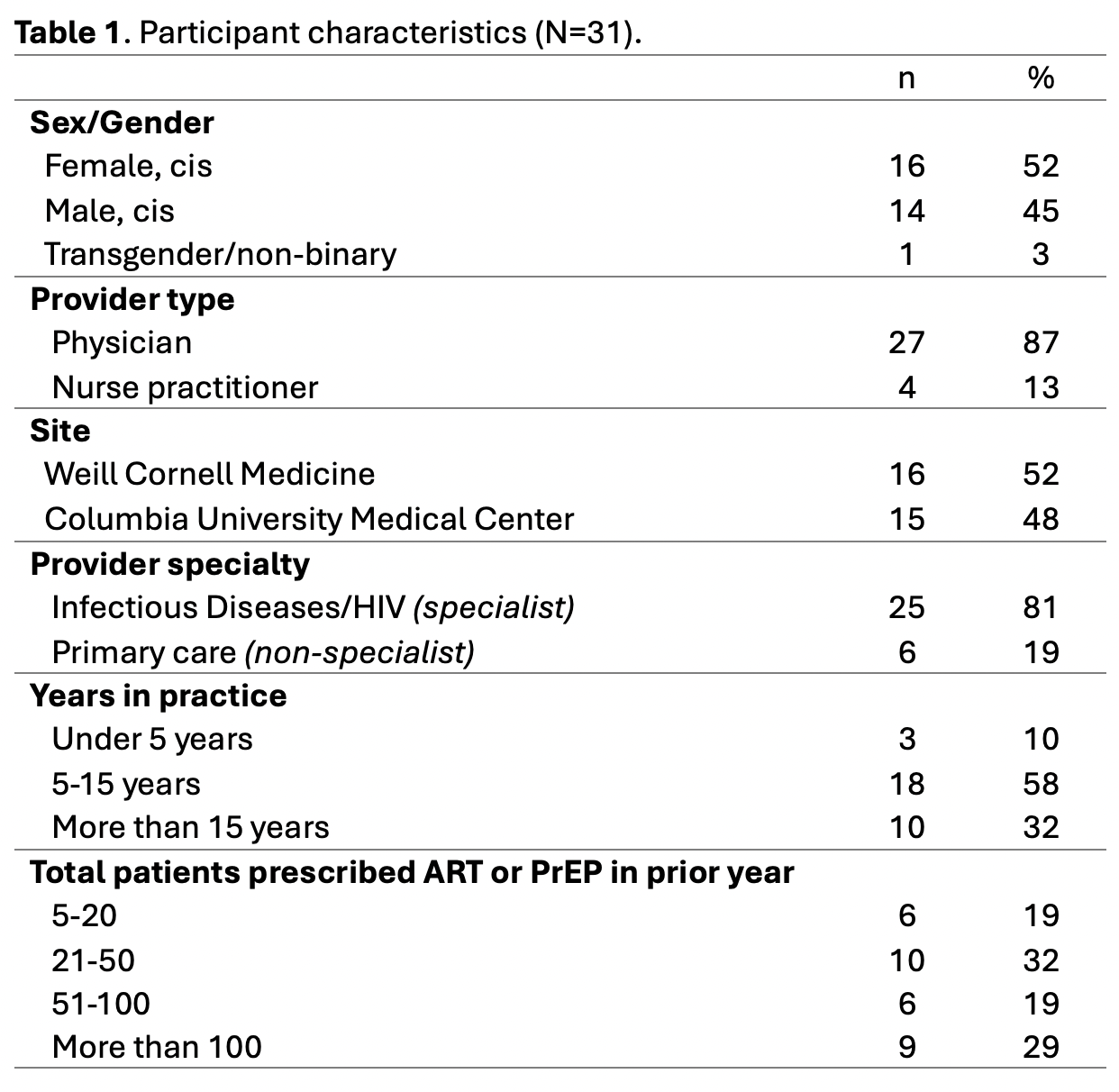
Of 40 providers screened, 31 were eligible (52% female; 87% physicians; 81% specialists). Self-rated knowledge was high in both groups (median, non-specialists: 11/12; specialists: 12/12; p=0.02), while objective knowledge was lower among non-specialists (4.5/7 vs 6/7; p=0.03). Attitudes towards doxy-PEP were positive (median, non-specialists: 48/60; specialists: 51/60; p=0.13). Non-specialists reported prescribing doxy-PEP to fewer patients (50% vs 24% prescribed to < 5 patients; p=0.27), whereas only specialists reported prescribing doxy-PEP to non-MSM/TGW patients. Barriers included antimicrobial resistance (45%), adverse effects (32%), and microbiome concerns (26%). If available, formal training was expected to increase prescribing comfort for 50% of non-specialists vs 40% of specialists (p=0.17).
Conclusions
Non-specialists endorsed favorable doxy-PEP attitudes but had lower objective knowledge scores. Interest in training and reported barriers such as antimicrobial resistance highlight opportunities for targeted education to improve doxy-PEP knowledge and prescribing confidence among generalist PrEP providers.
Table or Figure