Background
People with HIV (PWH) disproportionately experience both housing instability and frailty, an aging-related state of functional decline and vulnerability. While housing instability and frailty have been observed to commonly co-occur among PWH, it is critical to estimate how much of this association is related to housing instability preceding frailty.
Methods
We studied adult PWH engaged in care at 6 sites across the United States within the Centers for AIDS Research Network of Integrated Clinical Systems (CNICS) cohort from 2019-2024. Clinical and self-administered survey data were collected during routine visits approximately every 6 months. We measured frailty using a validated modified Fried frailty phenotype, which defines frailty as having at least 3 of 4 components (fatigue, weight loss, immobility, inactivity) vs. less than 3 components. Housing status was based on self-reported living situation in the past month, and dichotomized as Stable vs. Not Stable (“Homeless”, “Unstable”, or “Don’t know”). We estimated the association between time-varying housing status and frailty incidence using hazard ratios (HR) and 95% confidence intervals (CI) from Cox proportional hazards models among PWH who were not frail at baseline. Models were adjusted for site, demographic characteristics, and time-varying characteristics including HIV viral load, CD4 count, drug and alcohol use, and smoking.
Results
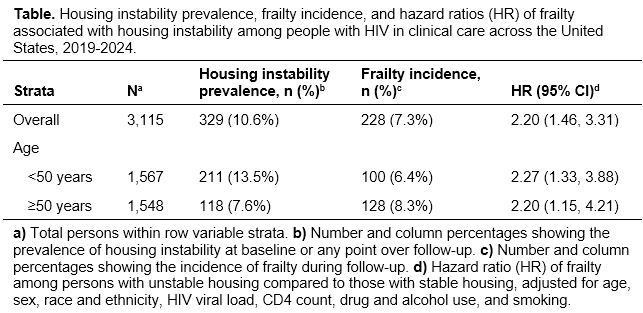
There were 17,658 observations among 3,115 PWH (86% male, 14% female; 87% virally suppressed at baseline), with a total time at risk of 6,753 person-years (mean: 2.2 years per individual). PWH were racially and ethnically varied (44% White, 38% Black, 13% Hispanic or Latino/a/e, 6% other) with a median baseline age of 49 years (IQR: 37-58). Over the course of the study, 10.6% of PWH (n=329) experienced housing instability and 7.3% (n=228) had incident frailty (Table). In adjusted models, housing instability was associated with a 2.2 times greater risk of frailty (95% CI: 1.5, 3.3) compared to stable housing. The association between housing instability and frailty incidence was similar when stratified by age (<50 years: HR=2.3, 95% CI: 1.3-3.9; ≥50 years: HR=2.2, 95% CI: 1.2, 4.2).
Conclusions
Housing instability was associated with incident frailty across ages in this large, longitudinal cohort of adult PWH engaged in clinical care. These findings underscore the importance of assessing and addressing housing instability to mitigate accelerated and accentuated aging among PWH.
Table or Figure