Background
Prior studies suggest that food insecurity may be an important risk factor for the development of cardiometabolic diseases. This study was conducted in order to evaluate the associations between food insecurity and cardiometabolic diseases among people with HIV (PWH) in Togo and Côte d’Ivoire, West Africa.
Methods
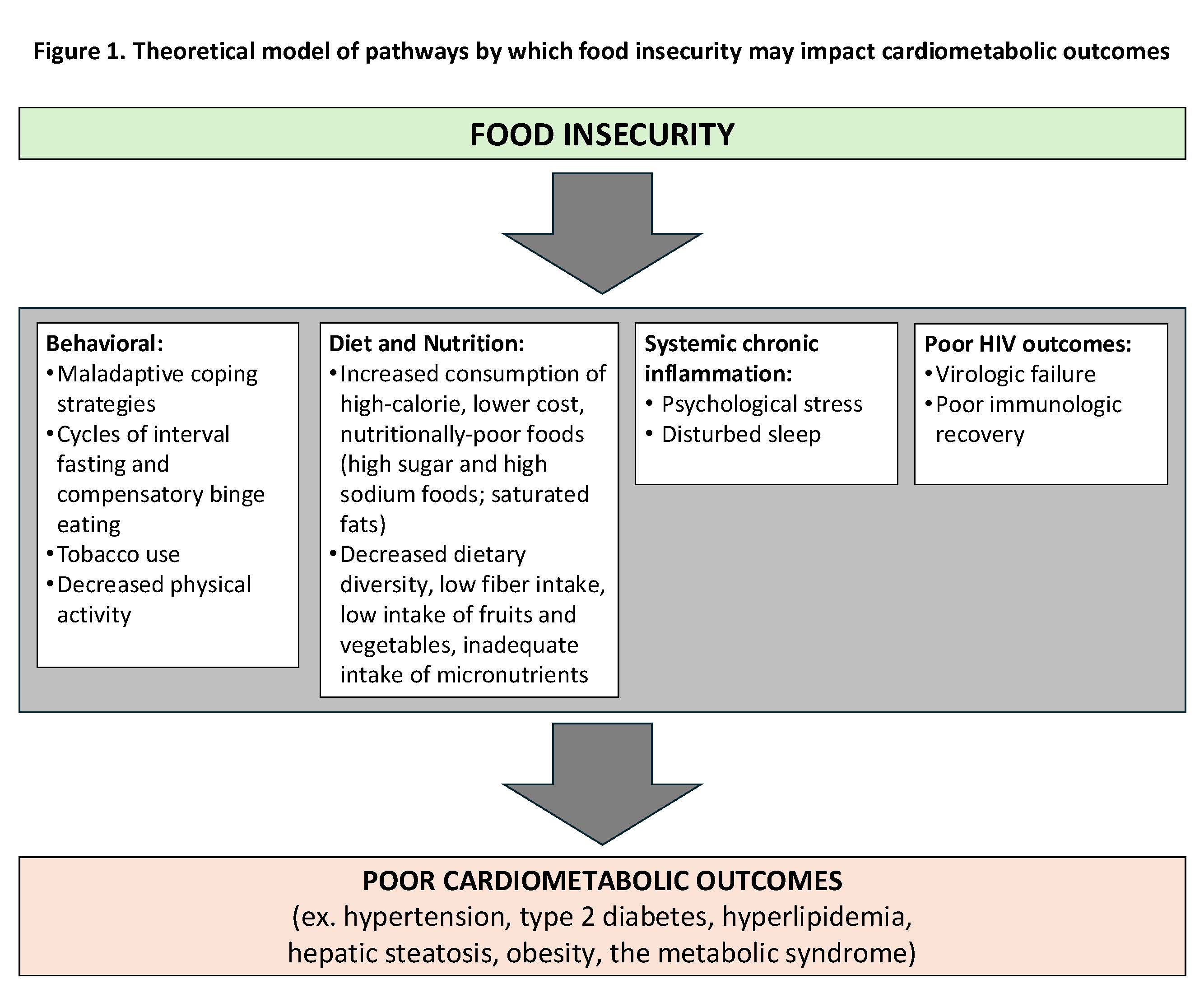
We conducted a cross-sectional study among ART experienced participants ≥40 years of age contributing to the Sentinel Research Network cohort of IeDEA West Africa. The Household Food Insecurity Access Scale was used to measure food insecurity. Dietary diversity was assessed using the Individual Dietary Diversity Scale. Physical activity was assessed using the Global Physical Activity Questionnaire. Multivariable logistic regression was used to evaluate the associations between food insecurity and clinical outcomes, including HIV outcomes (virologic failure, CD4 count), cardiometabolic outcomes (hypertension (HTN), type 2 diabetes (T2D), hyperlipidemia, hepatic steatosis, obesity) and other indicators of poor nutritional status (anemia, underweight, poor dietary diversity) (Figure 1).
Results
Among 584 participants (69% female, median age 52 years), 240 (41%) were moderately-to-severely food insecure. The prevalence of virologic failure was 9% and 7% had a CD4 count <200 cells/mm3. Nearly a third (32%) had HTN, 9% had T2D, 9% had hyperlipidemia, 17% had liver steatosis, and 24% were obese. More than half (60%) had at least one cardiometabolic disease. Nearly a third (31%) were anemic. Fewer than 5% were underweight and 45% had poor dietary diversity.
In multivariable analysis, food insecurity was associated with virologic failure (OR 1.85; 95% CI 1.04-3.28), CD4 count <200 cells/mm3 (OR 2.98; 95% CI 1.28-6.90), HTN (OR 1.89; 95% CI 1.30-2.73), underweight (OR 2.95; 95% CI 1.09-7.97), and poor dietary diversity (OR 1.60; 95% CI 1.14-2.23). Food insecurity was not associated with T2D, hyperlipidemia, liver steatosis, or anemia. Food insecurity was more prevalent among women and women had greater odds of obesity (OR 3.07; 95% CI 1.88-5.04) and anemia (OR 1.80; 95% CI 1.19-2.72) compared to men.
Conclusions
Among people ageing with HIV in West Africa, food insecurity is associated with HTN but not T2D, hyperlipidemia, liver steatosis, or obesity. The high prevalence of food insecurity and cardiometabolic diseases supports the need for integrated programs that address food insecurity and improve the prevention and treatment of cardiometabolic diseases among PWH in the region.
Table or Figure