Background
Socioeconomic status (SES) is a key determinant of health outcomes for people with HIV (PWH). Many cohort studies collect individual-level measures of SES, while others (e.g., electronic health record-based cohorts) rely on area-level SES indicators as proxies. It is unclear which area-level indicators or geographic units best represent individual-level SES among PWH.
Methods
Using 2023-2024 data from the MACS/WIHS Combined Cohort Study (MWCCS) of PWH and people without HIV (PWOH) at 13 US sites, we evaluated Spearman correlations between individual measures (annual household income, education level) and area-level measures (median annual household income, % of population living below the federal poverty level [FPL], area deprivation index [ADI] – each taken or derived from 2019-2023 American Community Study 5-yr estimates) of SES at the census tract and block group levels. Among PWH, we compared associations between these indicators and HIV virologic non-suppression (≥200 copies/mL) using multivariable logistic regression.
Results
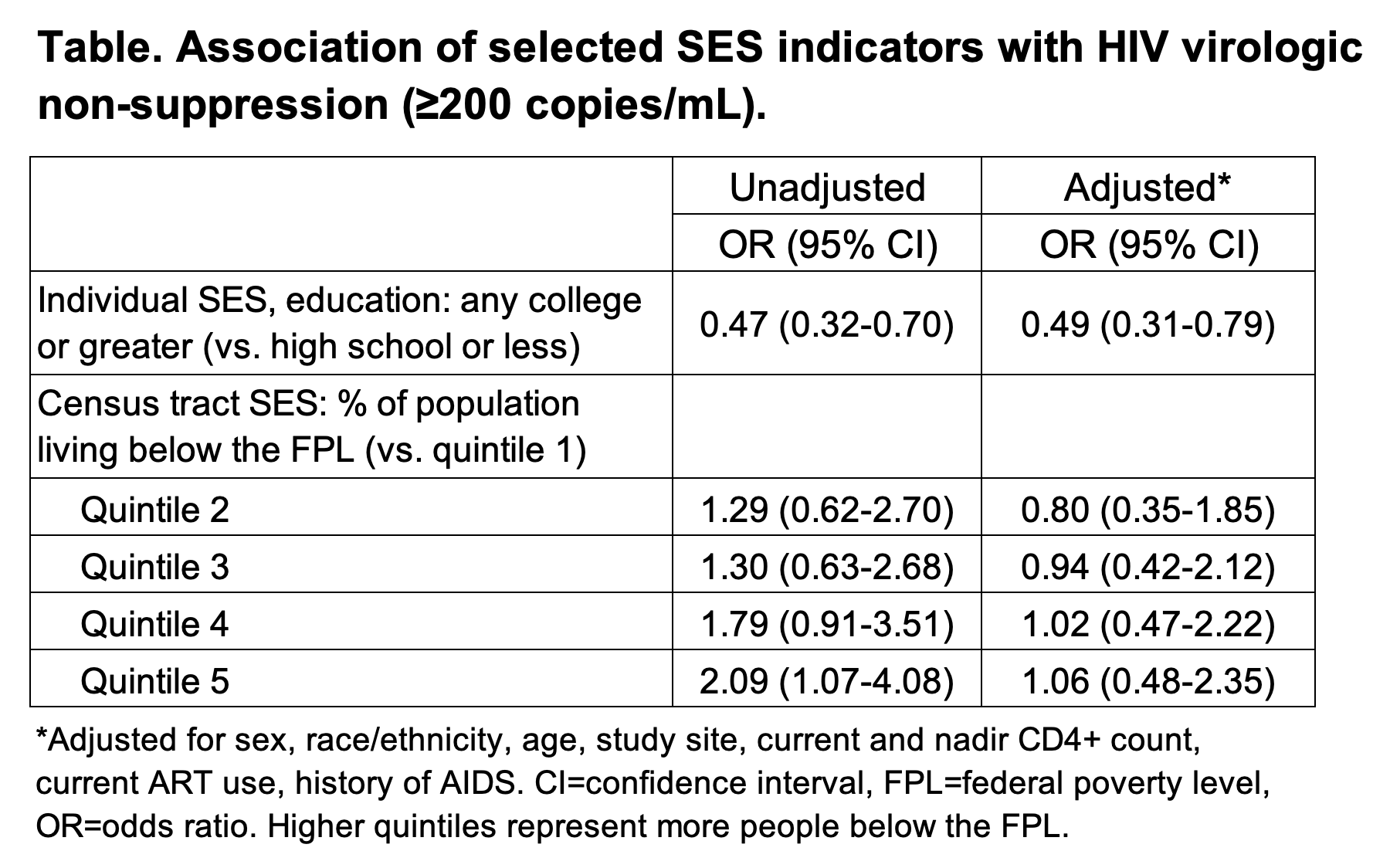
We included 2,883 participants with both individual and area-level SES available (49% women, 45% Black, 15% Hispanic, 62% PWH [6% with virologic non-suppression], median age 58 yr, IQR 47-64). Median annual household income was $24,000-$30,000 at the individual level and $68,100 at the census tract level. Correlations between individual- and area-level SES indicators were weak to moderate, ranging from 0.09 to 0.37. Individual SES measures were more highly correlated with area-level measures among men (range 0.18-0.39) than women (0.02-0.24) and among PWOH (0.13-0.42) than PWH (0.05-0.33). Census tract % of population below the FPL had similar or better correlations with individual-level SES measures than other area-level measures. Comparing associations of different SES indicators with virologic non-suppression, we found the most pronounced association for individual-level education (adjusted odds ratio 0.49 for any college or greater vs. high school or less, 95% CI 0.31-0.79). In contrast, area-level indicators were significantly associated with virologic non-suppression in unadjusted but not adjusted analyses (Table).
Conclusions
Studies of PWH should use caution when area-level SES is the only available measure of socioeconomic context, given limited correlations and weaker associations with virologic non-suppression. More work is needed to further understand these differences and the value of area-level proxies of individual SES.
Table or Figure