Background
Substance use, particularly substance use disorder (SUD), is a well-documented risk factor for HIV acquisition. However, little is known about how dynamic substance use/disorder patterns, such as SUD relapse and poly-substance use over time, influence HIV acquisition.
Methods
Utilizing data from the All of Us (AoU) participants enrolled from May 6, 2018, to October 1, 2023, a total of 5,067 adult (≥18 years) people with HIV (PWH) were included and matched with people without HIV (PWoH) at 1:10 ratio using propensity score matching based on age, sex at birth, race, and ethnicity. Comprehensive phenotyping algorithms based on multi-sourced data (e.g., electronic health records and survey data) were developed to identify substance use/disorder patterns in AoU. The Bayesian Network (BN) model examined associations between HIV status and substance use/disorder-related risk factors, with model parameters estimated using maximum likelihood and model performance evaluated through 15-fold cross-validation.
Results
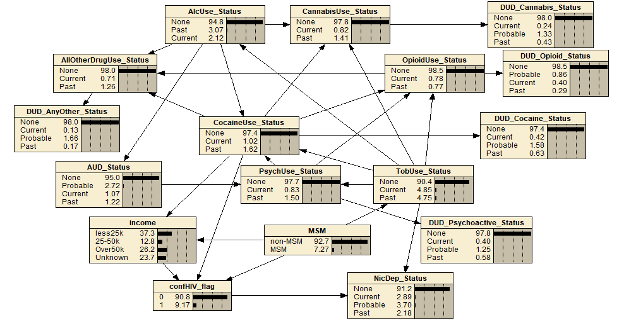
Among 633,547 AoU participants, we identified 61,457 (9.7%) nicotine dependence, 27,737 (4.4%) alcohol use disorder, and 24,599 (3.9%) illicit drug use disorder, with opioid use disorder (1.2%) and cocaine use disorder (0.9%) the two most common ones. The BN model revealed that cocaine use, men who have sex with men (MSM), and income level were directly associated with HIV status, while other substance-related factors were indirectly associated through cocaine use or income level. Participants who were current/relapse cocaine users, MSM, and with an annual income below $25,000 exhibited an 80% probability of HIV infection. Poly-substance use involving cocaine consistently demonstrated the highest risk for HIV than other combinations (33.44% to 33.53%). Strong synergistic effects were observed for other combinations, such as opioids with cannabis, which conferred a 10.69% higher risk than cannabis alone and 9.01% higher than opioids alone.
Conclusions
This study reinforced the significant role of cocaine and opioid use in HIV acquisition, both independently and within poly-substance use patterns. Synergistic effects between cocaine use and other substances further amplify risk compared to single-substance use. These findings highlight the critical need for targeted, multi-substance prevention and intervention strategies that account for the complex interplay of substance use behaviors, socioeconomic factors, and risky sex behaviors.
Table or Figure