Background
The Pitavastatin to REduce Physical Function Impairment and FRailty in HIV (PREPARE) substudy of REPRIEVE found small declines in physical function, and no evidence of pitavastatin effect. However, there was substantial individual variability, with some participants experiencing considerable declines. The purpose of this pre-specified exploratory analysis was to identify participants at a greater risk for physical function decline.
Methods
PREPARE conducted physical function assessments annually for up to 5 years. Participant-specific annualized rates of change in chair rise rate, gait speed, the modified Short Performance Physical Battery (mSPPB, composite of the latter two plus balancing time), and grip strength were estimated from linear mixed effect models. Physical function decline was defined as an annualized rate of change below the 20th percentile (P20) of the study population in at least one of the measures. Associations between baseline factors and physical function decline were evaluated with log-binomial regression models.
Results
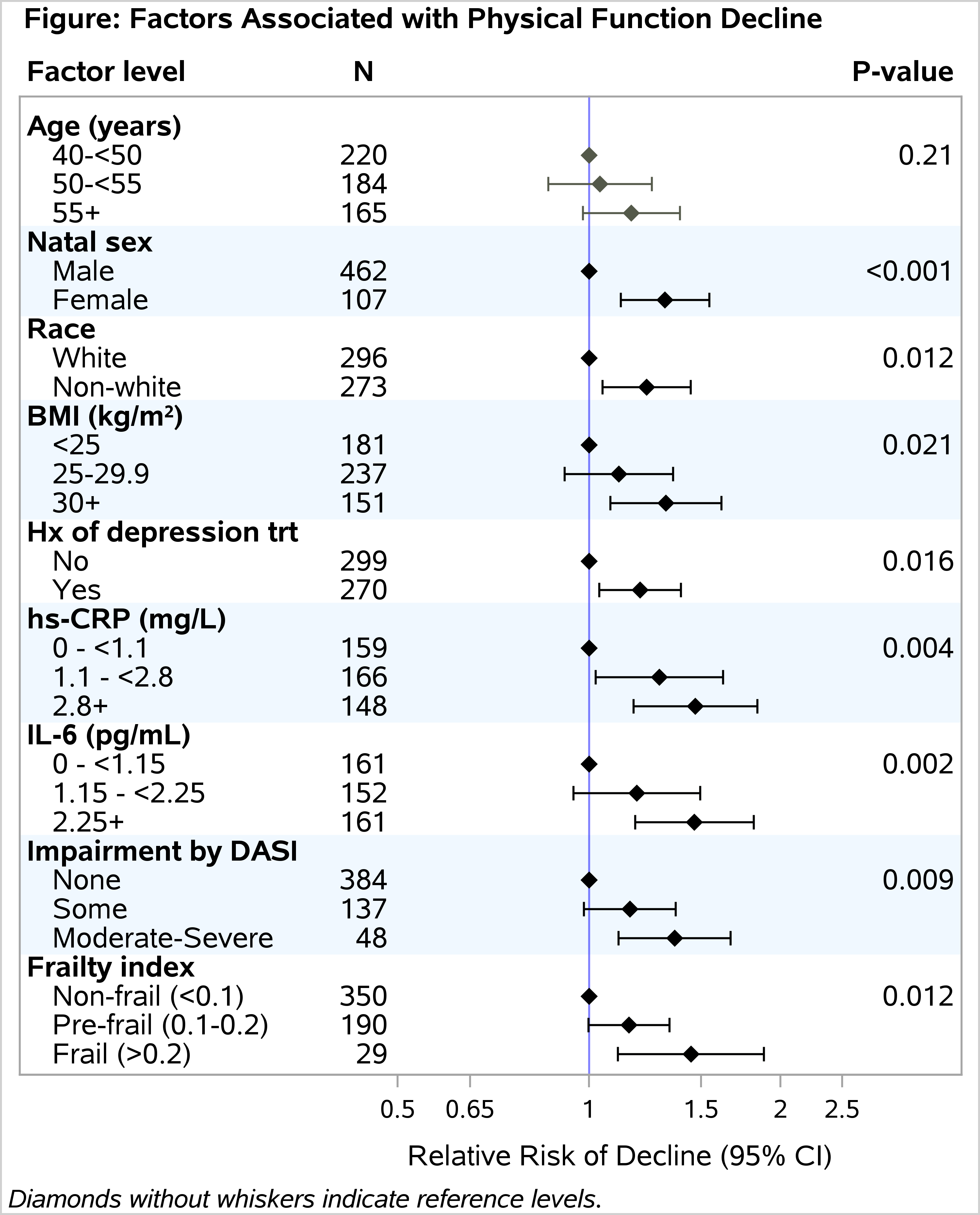
Of the 569 participants, 81% were male and 52% white. The median age was 51 (Q1, Q3: 47, 55) years. The P20 participant-specific annualized rates of change were -0.354 rises/minute/year in chair rise rate, -0.028 meters/second/year in gait speed, -0.032/year in mSPPB and -0.70 kg/year in grip strength. 52% had a decline in at least one physical function measure: 1% had a decline in all four, 7% in two, 11% in three, and 33% in one. We found a higher risk of physical function decline among females (relative risk: 1.32, 95% confidence interval: 1.12-1.55), non-whites (1.23, 1.05-1.45), and a trend of higher risk with increasing age (1.04, 0.86-1.26 in 50-55 and 1.17, 0.98-1.39 in 55+ vs. 40-<50 years). In models adjusted for age, sex, and race, we found greater risk of decline among those with history of depression treatment, higher BMI, pre-existing functional impairment, frailty (by index), and higher baseline hs-CRP and IL-6 levels (Fig.1). The sex difference was attenuated in models adjusted for BMI, history of depression treatment, and inflammatory markers, which were higher/more prevalent among females (1.16, 0.98-1.38 in females vs. males, when including hs-CRP).
Conclusions
PWH with history of depression, high BMI or levels of inflammation and those showing signs of impairment may benefit from early intervention strategies to preserve function with aging.
Table or Figure