Background
Pediatric dolutegravir (DTG) formulations were introduced in many sub-Saharan African countries in 2019. However, little is known about the outcomes of DTG failure in children and adolescents living with HIV.
Methods
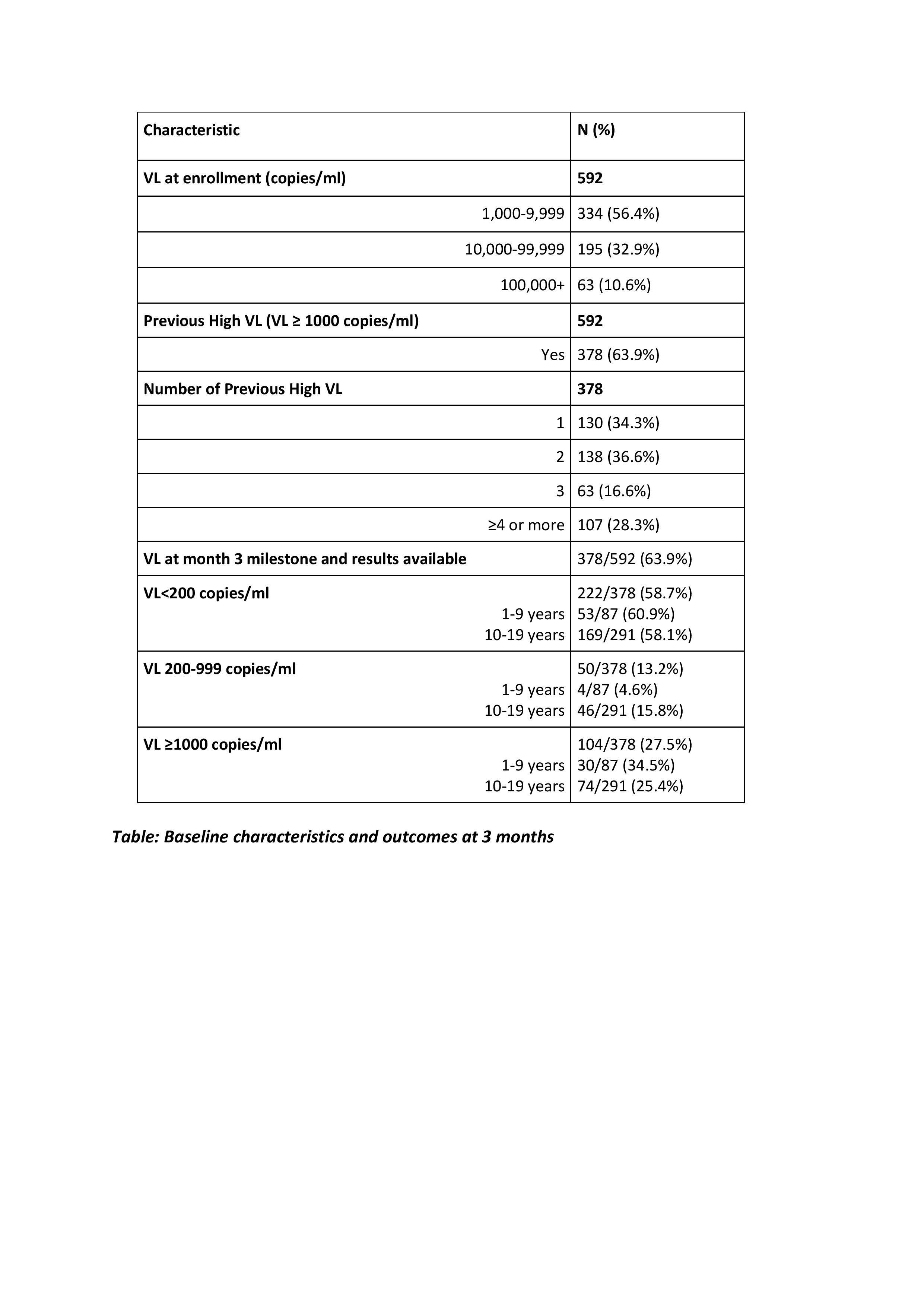
The Ndovu Study is a multi-country prospective cohort in Kenya, Mozambique, Lesotho and Tanzania enrolling people living with HIV on DTG for at least 6 months who have a viral load of ≥ 1000 copies/ml within 3 months of enrolment. Participants are followed for 12 months with viral load measurement every 3 months, and drug-resistant testing for those who fail to suppress viral load below 200 copies/ml. All participants receive enhanced adherence interventions at enrolment and monthly. The primary outcome is viral load <200 copies/ml. We describe the 3-month outcomes of the first 592 children enrolled in Kenya. Proportions of participants with viral loads <200, 200-999 and ≥1000 copies/ml and those with major DTG- associated drug resistance mutations (DRMs) were determined.
Results
Between March and November 2025, 592 children and adolescents aged 1 to 19 years were enrolled. The median age 15 years (IQR 10.4-17.9), with 297 (50%) being 15-19 years old, and 51% (300/592) male. The median time on DTG was 3.5 years and median VL at enrolment was 6028 copies/ml. Most participants, 436 (74%) had been switched from another regimen to DTG, with 225 (52%) being a protease inhibitor-based, and 210 (48%) being non-nucleoside reverse transcriptase inhibitor-based. Majority of participants, 378 (64%) had more than one prior high VL. The most common NRTI backbone was tenofovir and lamivudine in 386 (65%) followed by abacavir and lamivudine in (28%). All participants received at least one enhanced adherence intervention, 573/592 (97%) received 2 and 510 (86%) received 3 or more. At the time of reporting, 496 (84%) had achieved a month-3 milestone and viral load results were available for 378/496 (76%). Of these 222/378 (59%) had VL <200 copies/ml (table). Suppression was lowest (58%) in the age group 10-19 years. Drug resistance test was done for 66/104 (64%) of those with VL ≥1000, results were available for 55/66 (83%), and 15/55 (27%) had major DTG-associated DRMs. Two participants aged 15-19 years died before month three.
Conclusions
This study found high rates of persistent viraemia in children and adolescents failing DTG despite enhanced adherence interventions. The study highlights the need for further research on interventions for the paediatric population with DTG failure.
Table or Figure