Background
Because there are >1 million pregnant PLHIV globally, many of whom receive antiretroviral therapy (ART) to prevent vertical transmission, a large population of HIV-exposed uninfected (HEU) children exists. HEU infants face increased severe RSV-associated lower respiratory tract illness (RSV-LRTI) rates compared to unexposed infants. The pivotal MATISSE trial demonstrated that maternal RSVpreF vaccination can prevent severe RSV-LRTI in infants through 6 months of age. However, data for HEU infants are not available because mothers with HIV were excluded from the MATISSE trial. Here we provide further data investigating RSVpreF in pregnant PLHIV and their infants from modified intent to treat (mITT) populations.
Methods
MORISOT was a maternal phase 3 trial assessing RSVpreF immunogenicity and safety conducted in South Africa in participants living with HIV. At 24−36 weeks gestation, pregnant PLHIV with stable disease and taking ART received RSVpreF or placebo (PBO). To more closely represent real-word application, here we report immune responses evaluated by RSV neutralizing titers prevaccination and at delivery in mothers, and at birth in their infants in mITT (received intervention; assay results postvaccination). Reactogenicity (mothers) and adverse events (AEs) in mothers and infants were assessed.
Results
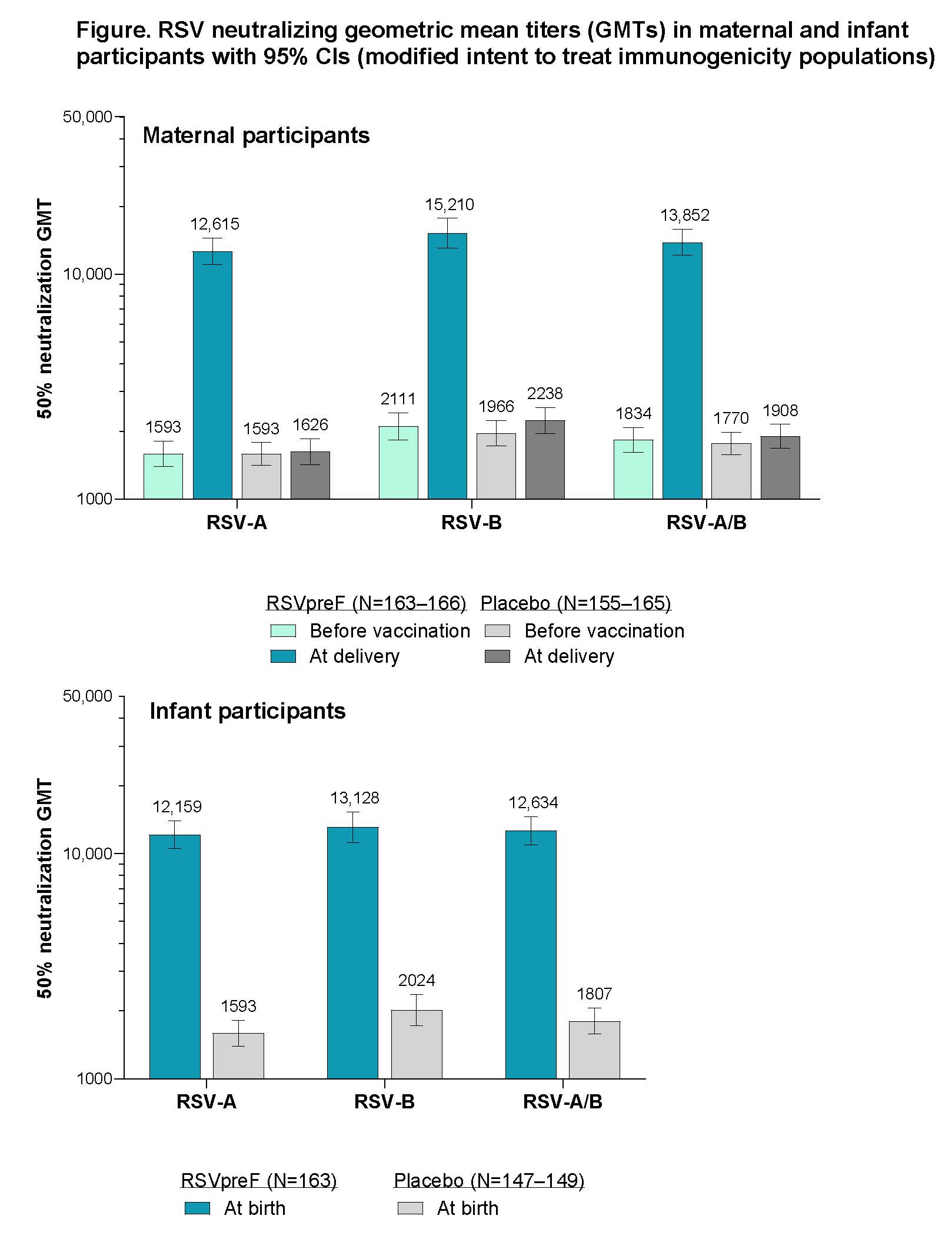
Overall, 342 pregnant PLHIV received RSVpreF (n=172) or PBO (n=170). mITT populations included 331 pregnant PLHIV (RSVpreF=166; PBO=165) and 314 infants (RSVpreF=163; PBO=151). In mITT populations, RSVpreF elicited maternal RSV neutralizing immune responses, with effective RSV antibody transplacental transfer (Figure). Neutralizing titers in infant cord blood at birth were greater in the RSVpreF group than in those in the PBO group (RSVpreF:PBO geometric mean ratio [GMR]: RSV-A=7.6; RSV-B=6.5), and similar to a cohort of HIV-unexposed infants from MATISSE (HIV:non-HIV GMR: RSV-A=0.88; RSV-B=0.78). Most reactogenicity events within 7 days postvaccination were mild/moderate. AEs (including hypertensive disorders of pregnancy and postpartum [HDP]: RSVpreF=7.0%; PBO=8.8%) and serious AEs (SAEs) were reported at similar percentages of maternal RSVpreF and PBO recipients. Percentages of AEs or SAEs in infants were similar between RSVpreF and PBO; as was frequency of preterm birth (RSVpreF=8.8%; PBO=7.8%).
Conclusions
These results provide further support for use of RSVpreF in pregnant PLHIV for preventing RSV-LRTI in HEU infants. NCT06325657
Table or Figure