Background
Hepatic steatosis (HS), including metabolic dysfunction-associated steatotic liver disease (MASLD), is common among persons with HIV (PWH). We present longitudinal HS and MASLD incidence, prevalence, cardiometabolic characteristics and cardiovascular outcomes among REPRIEVE mechanistic substudy (MS) participants.
Methods
The REPRIEVE MS was an embedded substudy (N=804) conducted at 31 US sites as part of a randomized trial of pitavastatin calcium vs. placebo among 7,769 PWH ages 40-75 years on antiretroviral therapy (ART). Non-contrast computed tomography (CT) with measurement of HS (mean hepatic attenuation <40 Hounsfield units [HU] or liver/spleen ratio <1.0) was completed at baseline and 24 months. MASLD was defined by standard criteria.
Results
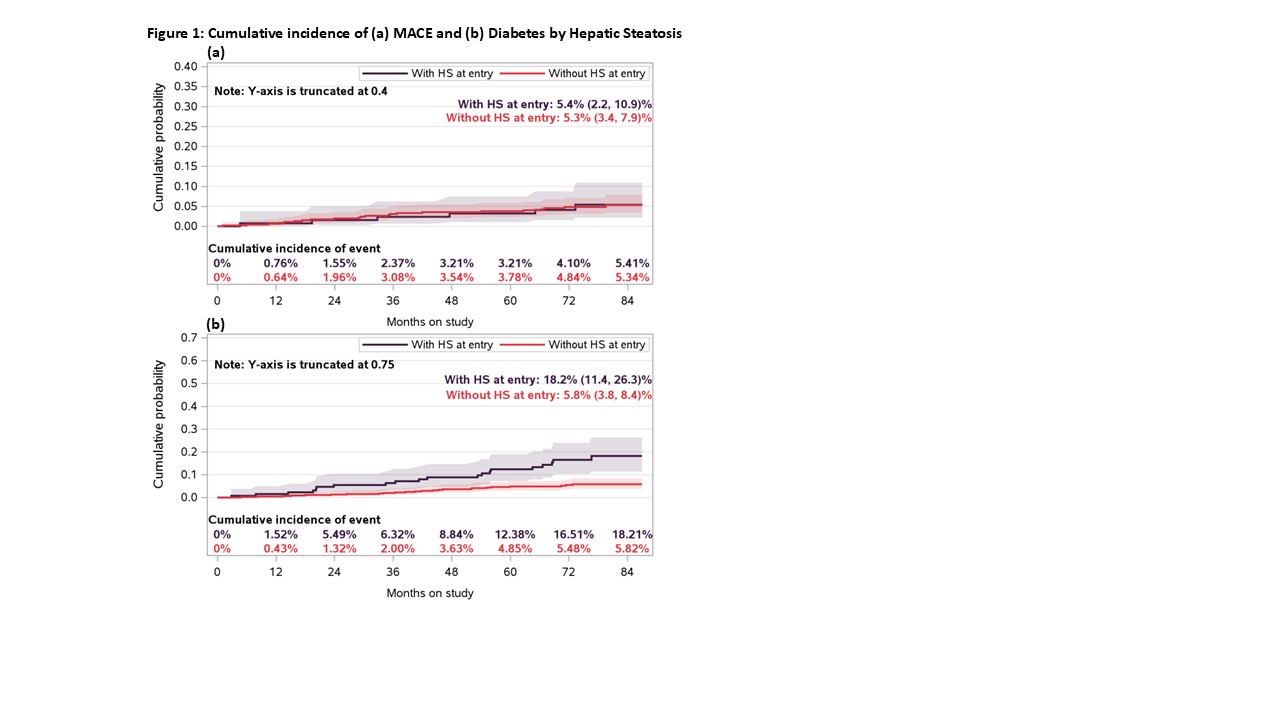
Of 688 evaluable persons, median age was 50 years, BMI 27.1 kg/m2, CD4+ T cell count 597 cells/mm3; 18% natal female sex, 34% Black, 26% Hispanic, 98% HIV-1 RNA <400 copies/mL, and median ASCVD risk score 4.4%. HS prevalence was 25% (N=76) in the pitavastatin group and 19% (N=57) in placebo group at baseline versus 25% and 20% at 24 months, respectively. MASLD was present in 15% of participants at baseline (104 of 610). Of those with baseline HS, resolution by CT was observed in 39% assigned to pitavastatin versus 44% assigned to placebo at 24 months (P=0.57). Of 477 participants without baseline HS, 15% in the pitavastatin group versus 11% in the placebo group had progression to HS at 24 months (P=0.32). Among 610 participants with complete baseline and month 24 CT scans, major adverse cardiovascular events (MACE) occurred in 4% (n=29) with no difference by baseline HS status (Figure 1a, P=0.9). New incident diabetes cases (n=44) were identified more frequently among those with baseline HS with an estimated cumulative incidence at 7 years of 18.2% (11.4%, 26.3%) versus 5.8% (3.8%, 8.4%) among those without baseline HS (Figure 1b, P<0.001). All analyses were similar when restricted to those with MASLD (data not shown).
Conclusions
In this cohort with controlled HIV and low-to-moderate cardiovascular risk, HS and MASLD were common and did not improve with the use of pitavastatin after 24 months. HS at baseline was not associated with more MACE events but was associated with more participants developing incident diabetes. In addition to statins, additional risk factors should be addressed to lower risk of MACE.
Table or Figure