Background
Long-acting cabotegravir+rilpivirine (CAB+RPV LA) and dolutegravir/lamivudine (DTG/3TC) are INSTI–based, antiretroviral therapy (ART) regimens with different indications, modalities, and dosing schedules. VOLITION (NCT05917509) is the first study to evaluate optional switch to CAB+RPV LA, based on participant choice, immediately after attaining virologic suppression with DTG/3TC in ART-naive adults with HIV-1. Median time to suppression on DTG/3TC was 4.1 weeks (95% CI: 4.1–4.3). We present VOLITION Month 11 (M11) outcomes for participants choosing to switch to CAB+RPV LA.
Methods
VOLITION, a Phase 3b, multicenter, non-randomized, open-label study, enrolled ART-naive adults with plasma HIV-1 RNA ≥1000 c/mL who received daily oral DTG/3TC during a Suppression Phase of up to 16 weeks. After attaining virologic suppression (HIV-1 RNA <50 c/mL) anytime from Week 4 to 16, eligible participants were offered the choice to switch to CAB+RPV LA, dosed Q2M, at the next study visit (Day of Choice [DoC]) or to continue DTG/3TC. A co-primary endpoint was the proportion with HIV-1 RNA <50 c/mL per Snapshot algorithm at M11 with CAB+RPV LA. Participant experience and safety were assessed.
Results
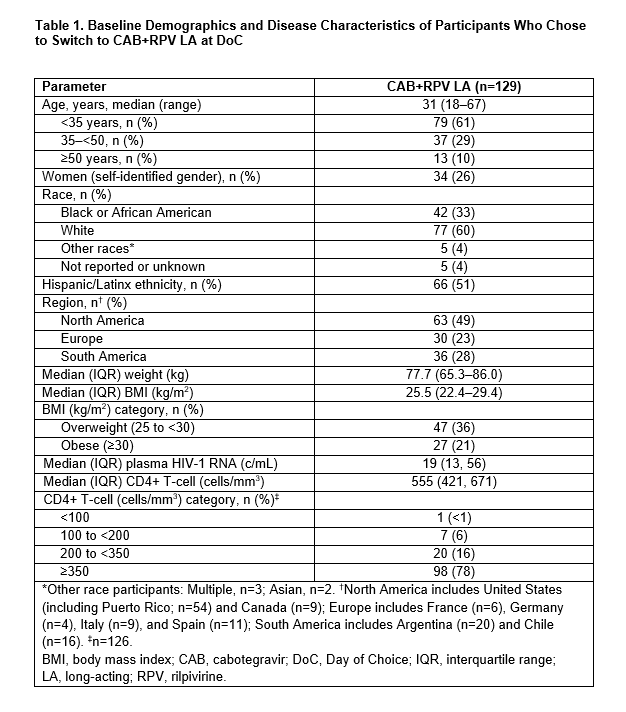
At DoC, 129/151 (85%) participants switched to CAB+RPV LA (Table 1). At M11, 113 (88%) had HIV-1 RNA <50 c/mL, six (5%) had HIV-1 RNA ≥50 c/mL, and 10 (8%) had no virologic data per the modified Snapshot algorithm. The observed virologic suppression rate at M11 was 95% (n=113/119 with available virologic data in-window). One (<1%) participant had confirmed virologic failure (CVF) with INSTI and NNRTI resistance. Top reasons for switching were avoiding missed doses (n=103, 80%), not needing pills for travel (n=88, 68%), and convenience (n=82, 64%). Participants reported high levels of treatment satisfaction (HIV Treatment Satisfaction Questionnaire score of 57.6 at DoC; 62.5 at M11). CAB+RPV LA was well tolerated, with no new safety signals identified; drug-related adverse events (excluding injection site reactions) occurred in 13 (10%) participants.
Conclusions
Most ART-naive participants chose to switch to CAB+RPV LA after achieving virologic suppression on daily oral therapy, demonstrating the importance of choice in addressing individualized needs. Empowering people to choose their preferred treatment through shared decision-making can enable treatment success, as shown by high rates of virologic suppression, low rates of CVF with resistance, and high treatment satisfaction at M11 with CAB+RPV LA.
Table or Figure