Background
The WHO and multiple countries in resource limited settings recommend switch to ritonavir boosted protease inhibitor (PI) after two consecutive HIV viral loads (VL) ≥1000 copies/mL while on a dolutegravir (DTG) based regimen without the requirement for a drug resistance test (DRT). There is limited data to support this strategy.
Methods
Ndovu is a multi-country prospective cohort study evaluating HIV-1 viral suppression among participants with VL ≥1000 copies/mL after at least six months of DTG-based ART. Adherence is assessed at every visit using the MMAS-8 score and participants receive enhanced adherence interventions every month. VL is measured every 3 months with DRT for VL ≥1000 copies/mL. Predictors of viral suppression (VL <200 copies/mL) are assessed using multivariable logistic regression. We present 3 month outcomes of the first 2994 participants.
Results
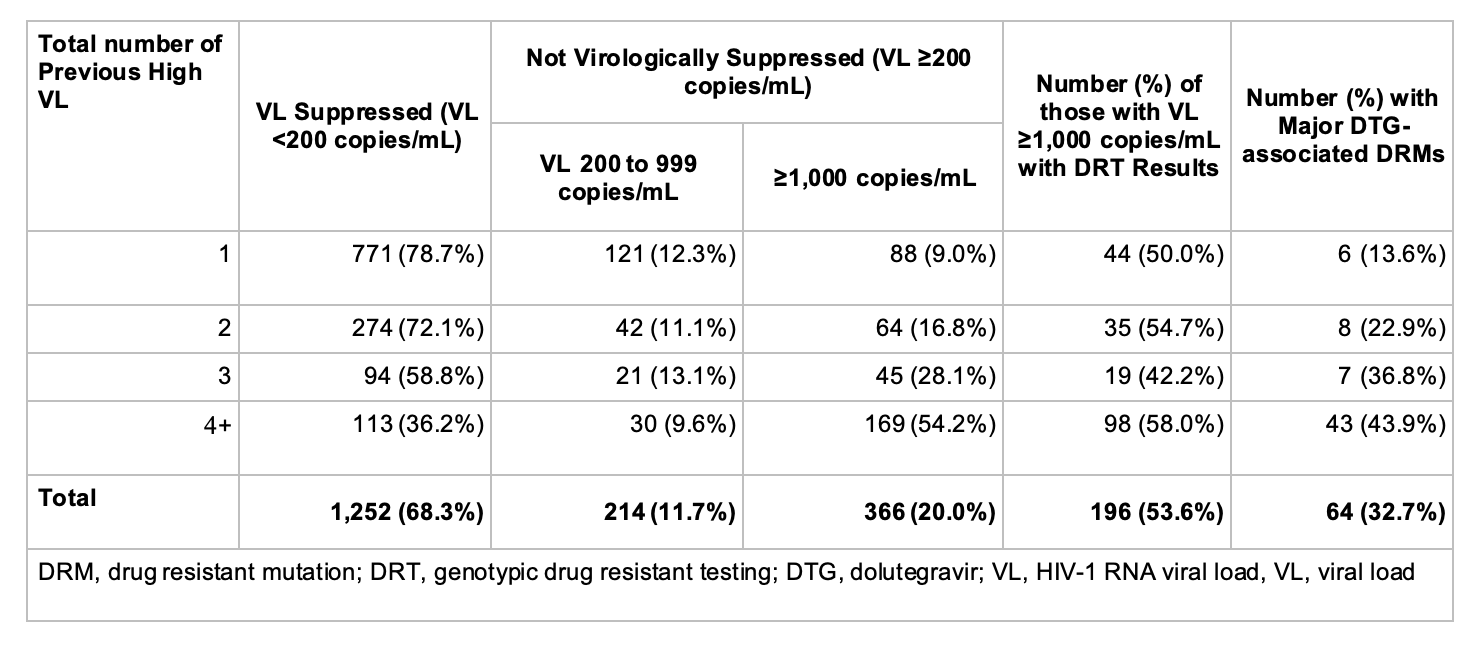
Between March 3 and December 8, 2025, 2,994 participants were enrolled in 131 sites in Kenya. The median age was 38 years (range 1-93), 61% were female, and the majority (69%) were on another ART regimen prior to switch to DTG with the most common being EFV-based (61%). The median time on DTG was 4.7 years (IQR 2.6,5.6). Most participants (90%) had low to moderate adherence assessed by MMAS-8 score and all participants received at least one enhanced adherence intervention. Of 1,821 (61%) who had completed the month 3 visit, 1,252 (68%) had VL <200 copies/mL. Factors associated with non-suppression included age 1-19 (aOR 0.78; 95% CI 0.61-1.00), enrolment VL of 10,000–99,999 copies/mL (aOR 0.66; 95% CI 0.49–0.87), enrolment VL >100,000 (aOR 0.73; 95% CI 0.54-0.99) and a history of more than one prior high VL (aOR 0.43; 95% CI 0.33–0.57). Viral suppression was highest among participants with only one episode of viraemia (79%) and lowest (36%) among those with four or more prior high VLs (Table). Where there were two consecutive high VLs, the suppression rate was 41%. Participants with four or more episodes of viraemia were more likely to have major DTG-associated drug resistance mutations (44%) compared to those with a single high VL (14%).
Conclusions
We identify subgroups of participants with DTG failure who are likely to suppress without a change in ARV regimen, and those who are likely to have major DTG-associated resistance mutations. The suppression rate in participants with two consecutive high VLs suggest that the WHO recommendation to switch to PI after a second high VL will lead to many unnecessary drug switches.
Table or Figure