Background
Pritelivir is a novel oral helicase-primase inhibitor, active against HSV-1 and HSV-2, including strains resistant to nucleoside analogues and foscarnet. PRIOH-1 evaluated the safety and efficacy of pritelivir vs. investigator’s choice therapy (ICT) in immunocompromised (IC) patients, including people living with HIV (PLHIV), with refractory herpes simplex virus (HSV) infection, with or without documented virological resistance (R±R).
Methods
In this randomized (1:1), controlled, open label trial, 101 IC patients (≥18 years) with R±R HSV mucocutaneous infection received oral pritelivir (100 mg daily; 400 mg loading dose) or ICT (IV foscarnet, IV/topical cidofovir, or topical imiquimod) for up to 28 days, extended up to 42 days, if lesions were improving. The primary endpoint was complete lesion healing within 28 days. Secondary endpoints included safety and tolerability.
Results
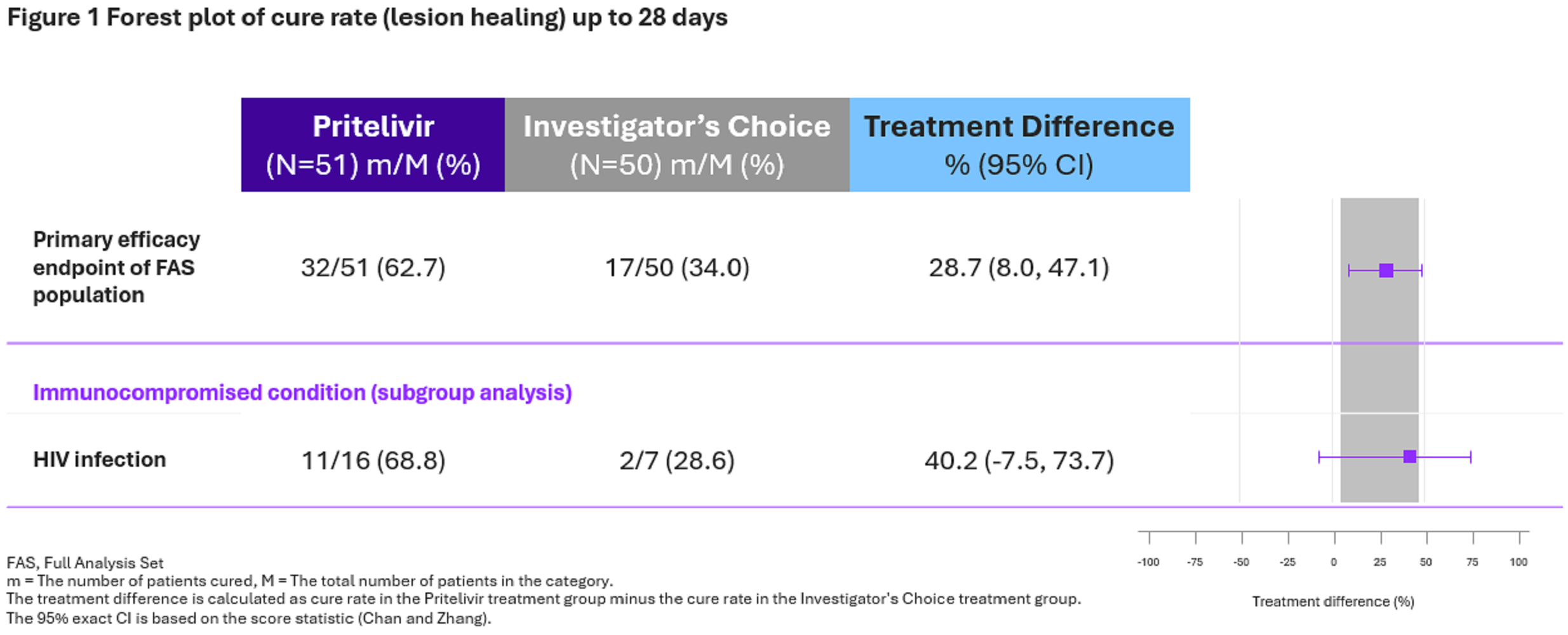
The mean age of patients was 52.6 years (range 19-84 years) and 52.5% were male. Refractory HSV without clinical improvement was reported in 71.3% of patients, and laboratory confirmed acyclovir resistance in 28.7% of patients. HSV-1 and HSV-2 were identified in 31.7% and 45.5% of patients, respectively; HSV was unspecified/not detected at baseline in 22.8% of patients. A broad range of immunocompromised conditions were included, among them 22.8% (23/101) PLHIV with a mean CD4 cell count of 350 cells/mm3; other conditions included transplant (hematopoietic stem-cell and solid organ) (43.5%), malignancy or autoimmune or inflammatory disorders (33.7%). The most common ICT was IV foscarnet (70%). Pritelivir demonstrated superior lesion healing of 62.7% vs. 34.0% for ICT up to 28 days. In a subgroup analysis, 68.8% of the PLHIV in the pritelivir arm vs. 28.6% in the ICT arm had lesion healing with a treatment difference of 40.2% [95% CI: -7.5, 73.7], consistent with the overall positive treatment effect of pritelivir (Figure 1). TEAEs were less frequent with pritelivir compared to ICT. Pritelivir was associated with fewer renal, electrolyte events and drug-related TEAE discontinuations (2.0%) compared with ICT (20.0%).
Conclusions
Pritelivir met the Phase 3 primary endpoint, demonstrating superior efficacy compared with ICT, consistent with a positive treatment benefit seen in PLHIV, with a favorable safety and tolerability profile. These findings support pritelivir as a promising oral agent to address the unmet needs of refractory HSV infections in IC pts, including in PLHIV.
Table or Figure