Background
Children acquiring HIV are typically antiretroviral therapy (ART)-dependent for life. Very-early ART initiation, along with tolerogenic early-life immunity, are hypothesised to limit latent reservoir formation and provide increased potential for subsequent ART-free remission in some children. Previous studies of very-early ART-treated children have identified cases of prolonged aviremia following unscheduled ART interruption. To characterise more precisely pediatric variation in time to viral rebound post-ART cessation, we conducted an analytical treatment interruption (ATI) study in a cohort of very-early ART-treated children in KwaZulu-Natal, South Africa.
Methods
330 mother-child pairs living with HIV were enrolled into the Ucwaningo Lwabantwana Cohort (ULC): 1-2 drug ART was initiated at birth in all infants; triple ART started within 21 days (d) of life (median 10d). ATI inclusion criteria were: enrolment in ULC; age >36months (m); plasma viral load (pVL) <30c/ml for >24m; absolute CD4 counts >750c/ul if aged 36-59m or >500c/ul if aged >60m; most recent total HIV-1 DNA load undetectable or <20c/million pbmc and/or GeneXpert undetectable/Ct>40.0; guardian/parental consent (and child assent where age-appropriate). Children with failure to thrive or suspected/confirmed tuberculosis infection were excluded. Strict safety monitoring utilized point-of-care (GeneXpert) and laboratory-based (virologic, immunologic, chemistry, hematologic) surveillance. ART was reinitiated following confirmed pVL detection of >30c/ml.
Results
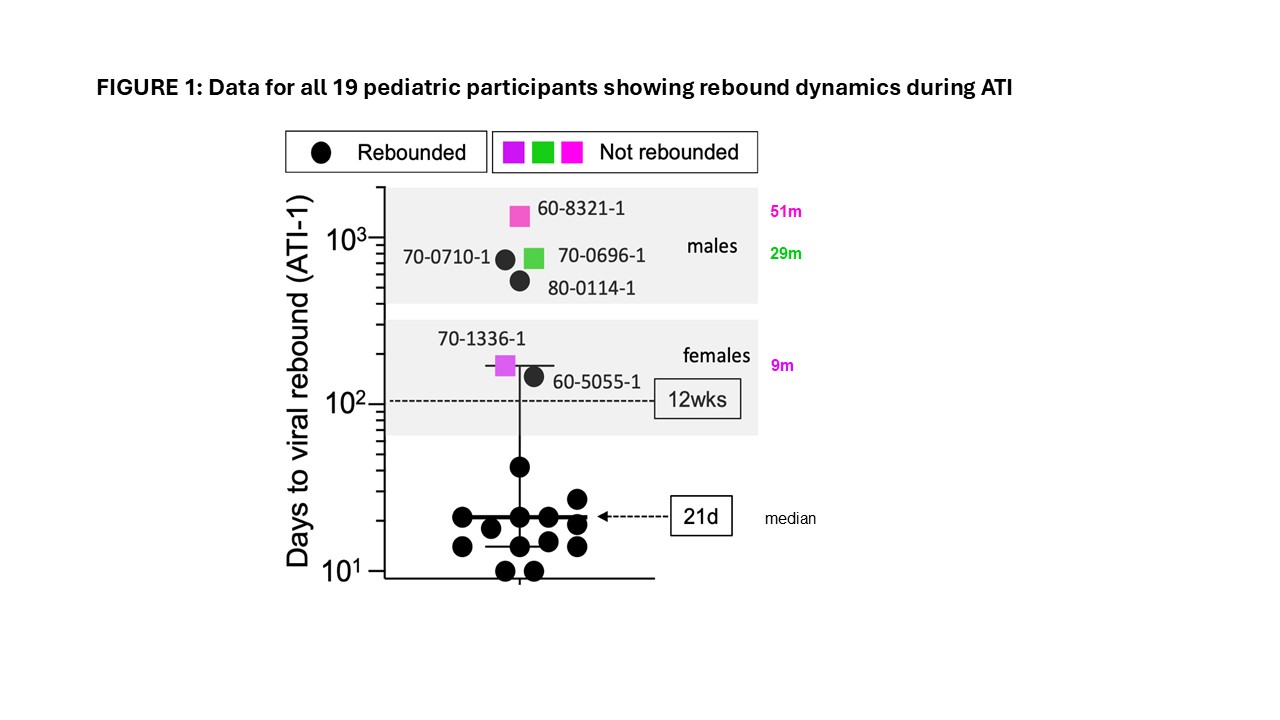
19 children (median age: 59m) underwent ATI. Nine males (47%) and ten females (53%) were enrolled. Viral rebound occurred within 6 weeks of ATI in 13/19 children. However, 6/19 (32%) children maintained aviremia beyond 12 weeks (Fig 1). Three of these 6 participants experienced viral rebound at 4.8m, 18m and 24m, respectively. Three participants remain on ATI with pVL continuously <30c/ml for 51m, 29m and 9m, respectively.
Conclusions
32% (6/19) of very-early ART-treated children enrolled onto this ATI study maintained viral suppression beyond 12 weeks post-ATI; by comparison, 6% of acute-treated adults achieve >12wks’ suppression post-ATI. These findings are consistent with the hypothesis that very-early ART-treated children have a relatively high potential to achieve HIV cure/remission and support future evaluations of additional curative interventions such as bNAbs that have been effective in delaying viral rebound post-ATI in adult settings.
Table or Figure