Background
Scotland and Ireland have committed to eliminating HIV transmission by 2030. Both countries have also expanded prevention efforts: in Scotland, PrEP access and self‑testing services have increased, alongside pilot opt‑out testing programs in emergency departments. Ireland offers free testing in clinics and community venues, and distributes self‑test kits. However, the timeline to reach transmission elimination remains uncertain. This modelling study explores the number of new transmissions acquired within the countries and the projected timeline for both to achieve HIV transmission elimination.
Methods
We developed country-specific adaptations of a previously published Markov model of HIV transmission with a 50-year time horizon and a baseline year of 2023. The models estimate the number of annual new transmissions for four key population groups: Gay, Bisexual and other Men who have Sex with Men (GBMSM), heterosexual men, women, and people who inject drugs (PWID). We model the impact of six key interventions, including PrEP uptake, HIV screening, early diagnosis (within three months of infection), timely treatment initiation, and viral suppression on the number of transmissions. HIV transmission elimination was defined as the UNAIDS 2030 target of less than one new infection acquired within the country per 10,000 population per year.
Results
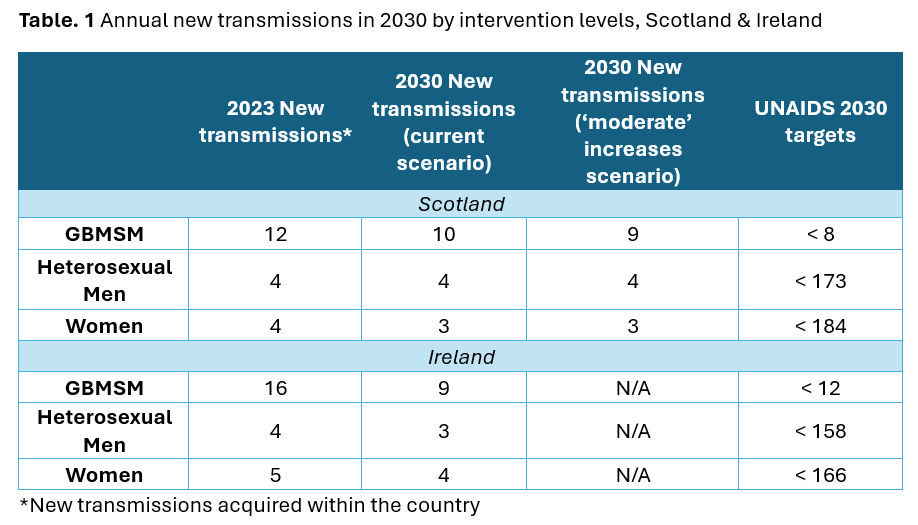
Model results (Table 1) suggest that at current intervention levels, Scotland is unlikely to achieve the UNAIDS HIV transmission elimination targets among GBMSM by 2030. ‘Moderate’ increases across all six key interventions bring Scotland close to achieving the target. Within Ireland, the target is expected to be met for GBMSM with current intervention levels. In both countries, the UNAIDS target for transmission elimination has been met among women and heterosexual men.
Conclusions
The contributions these countries have made in expanding their prevention efforts have led to decreased HIV transmissions. However, further expansion of these efforts is needed for GBMSM in Scotland to reach the target. Further analysis is also required to determine the current number of transmissions occurring among PWID within each country and the predicted trajectory over time. Finally, while few new transmissions are occurring within these countries, there is a higher number of annual diagnoses, due to acquisitions outside of the country. Ongoing investment will be necessary to continue supporting these individuals.
Table or Figure