Background
Cabotegravir long-acting (CAB LA) is the first FDA-approved injectable for HIV pre-exposure prophylaxis (PrEP). This analysis evaluated CAB-LA usage, adherence to its dosing schedule, and the incidence of HIV acquisition in routine clinical care.
Methods
Adults without HIV receiving ≥1 CAB LA PrEP injection between 21Dec2021 and 30Jun2024 in the US OPERA cohort were followed through 31DEC2024. Complete initiation was defined as receiving the first two injections within 67 days. Continuation injections administered within 68-127 days of the preceding injection were categorized as either short delays (68-97 days), or long delays requiring re-initiation with two monthly injections (98-127 days). Discontinuation was defined as a gap of >127 days between injections. The incidence rate (IR) of HIV acquisition was estimated using univariate Poisson regression analysis.
Results
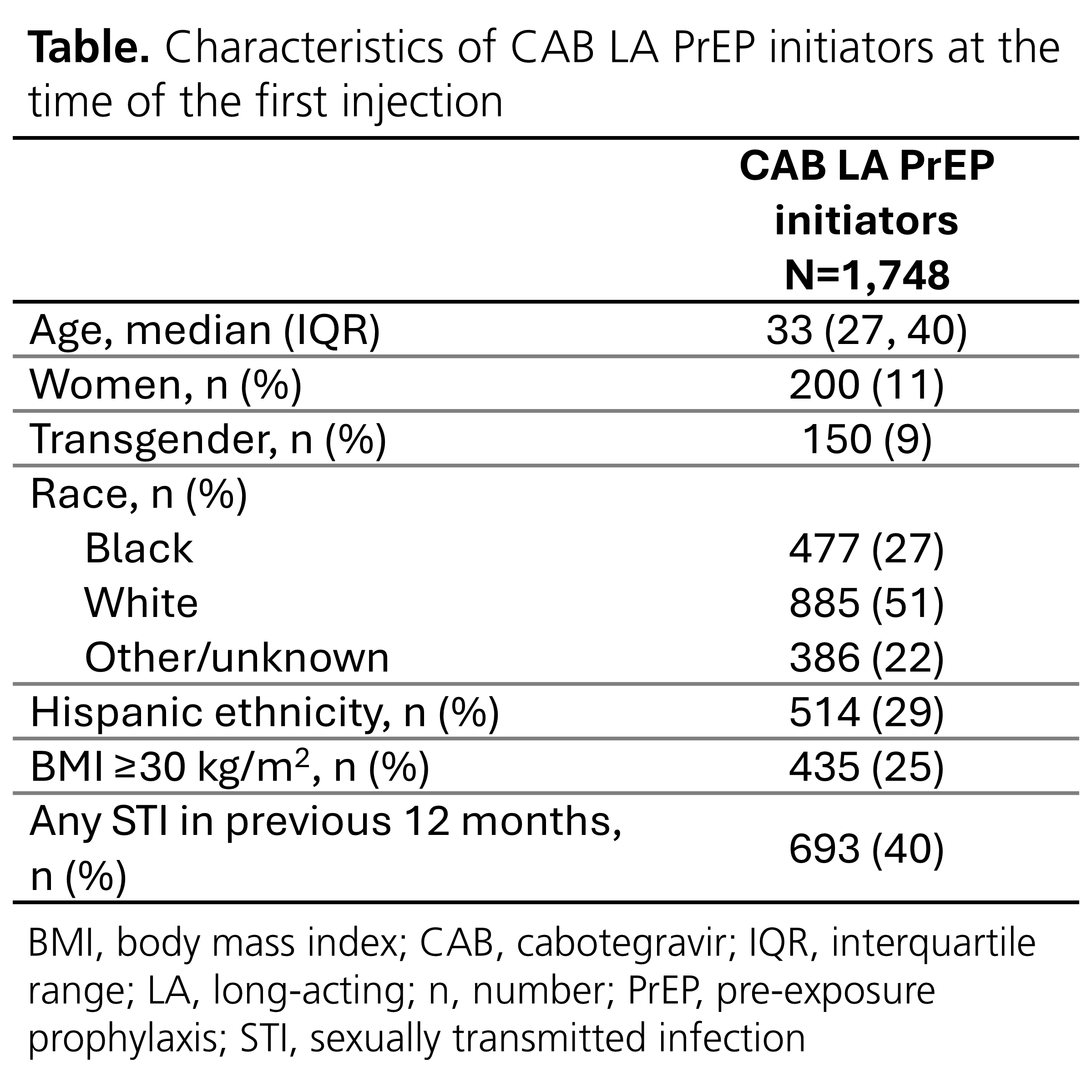
Among 1,748 adults who received ≥1 CAB LA PrEP injection (Table), 1,547 (89%) completed initiation and were followed for a median of 13.3 months (IQR: 9.2, 18.8). Of 1,411 individuals with ≥1 continuation injection, 838 (59%) received all injections on time and 573 (41%) experienced ≥1 delayed injection of any length (median: 1; IQR: 1, 2). Of 828 total delays, 705 (85%) were short (median: 4 days beyond the target window; IQR: 2, 10), and 123 (15%) required re-initiation (median: 50 days; IQR: 39, 55). Discontinuation occurred in 488 (32%) complete initiators, of whom 138 (28%) received ≥1 additional CAB LA PrEP injection after a median gap of 7 months (IQR: 5, 10). There was one new case of HIV acquisition during CAB LA PrEP use (diagnosed month 21), in addition to one previously reported last year (diagnosed month 3), for an IR of 0.10 per 100 person-years (95% CI: 0.03, 0.42). Both individuals were adherent to the dosing schedule; however, one did not have any HIV tests on record prior to or during CAB LA PrEP use until diagnosis.
Conclusions
Over the first three years of CAB LA PrEP use in the US, injection delays were observed but generally short, with 59% of individuals adhering to the recommended dosing schedule. Discontinuation and reinitiation patterns may highlight variability in perceived need for PrEP or care continuity, although incomplete records of oral bridging may have contributed to the overestimation of injection delays and discontinuation.HIV acquisition during CAB LA PrEP was rare, and comparable to trial results, reinforcing its effectiveness as a prevention strategy in routine clinical care.
Table or Figure