Background
Pre-exposure prophylaxis (PrEP) is a well-documented and effective pharmacologic strategy for HIV prevention, but less is known about how uptake patterns have shifted across successive PrEP eras, particularly following the introduction of long-acting injectable formulations. Geographic, rural–urban, and social vulnerability disparities in PrEP use have also remained understudied.
Methods
We conducted a retrospective cohort analysis of PrEP initiation using patient-level data harmonized in Epic Cosmos, an electronic health records repository with >300 million patients. PrEP receipt was defined by any documented medication event (prescribed, dispensed, or hospital-administered) for oral PrEP (emtricitabine/tenofovir disoproxil fumarate [FTC/TDF] or emtricitabine/tenofovir alafenamide [FTC/TAF]) and injectable PrEP (cabotegravir [CAB] or lenacapavir [LEN]) among patients without an HIV diagnosis code. We described PrEP initiation by medication type, initiation era (2012-2018: FTC/TDF, 2019-2021: FTC/TAF, 2022-2024: CAB, 2025+: LEN), geographic region, rurality, race/ethnicity, sex, and Social Vulnerability Index (SVI) at the ZIP Code level.
Results
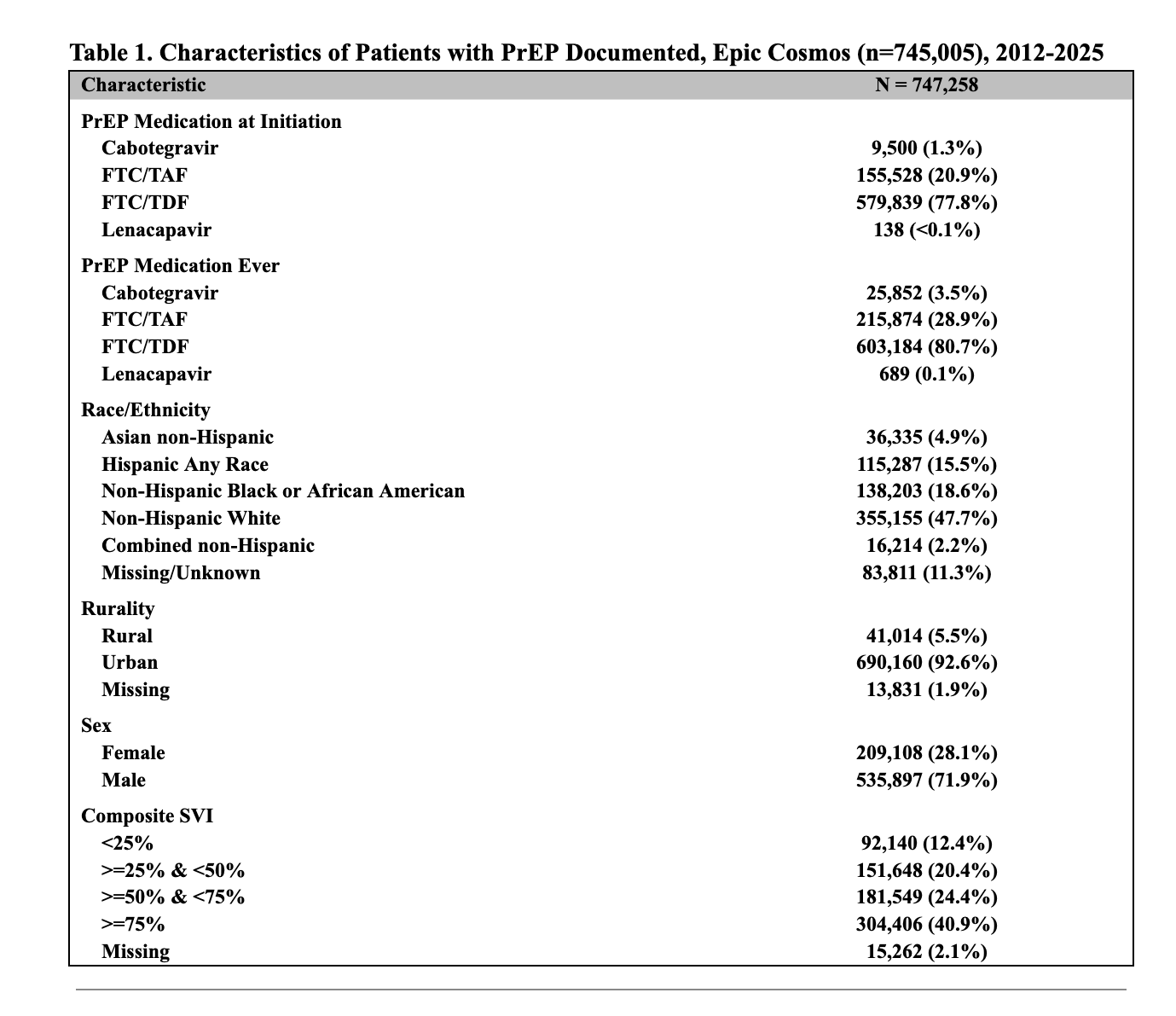
Between 2012 and 2025, 745,005 individuals initiated PrEP, with majority initiating FTC/TDF (579,839; 77.8%), followed by FTC/TAF (155,528; 20.9%), CAB (9,500; 1.3%), and LEN (138; <0.1%). When considering any PrEP exposure ever, 603,184 (80.7%) had used FTC/TDF, 215,874 (28.9%) had used FTC/TAF, 25,852 (3.5%) had used CAB, and 689 (0.1%) had used LEN.
Demographically, most initiators were male (535,897; 71.9%), with a mean (standard deviation [SD]) age at initiation of 35.8 ((SD 12.5) years. Geographically, 690,160 (92.6%) resided in urban areas and 41,014 (5.5%) in rural areas. By SVI, 304,406 (40.9%) were in the highest quartile (most vulnerable, ≥75%), and 92,140 (12.4%) were in the lowest quartile (<25%).
Conclusions
PrEP initiation has expanded substantially across successive eras, with oral PrEP remaining the dominant formulation. Nearly half of PrEP initiations were in communities with the highest social vulnerability, suggesting that access may be mediated by health system or program level supports such as medication assistance programs. Most PrEP prescriptions originated from urban areas, with persistent disparities observed across race/ethnicity, sex, and rurality. These findings underscore the significance of contextual and structural factors in determining equitable access to newer PrEP modalities.
Table or Figure