Background
Sexually transmitted infections (STI) disproportionally impact marginalized populations in the US. The Centers for Disease Control (CDC) recommends that persons screened for or diagnosed with an STI receive comprehensive screening for gonorrhea (GC), chlamydia (CT), syphilis, and HIV. STI evaluation is common in emergency departments (ED), yet rates of comprehensive screening in EDs remain low. This study assessed the impact of two novel CDS tools on comprehensive STI screening via analysis of HIV co-testing rates among patients screened for GC/CT in all free standing EDs (FSEDs) of Colorado’s UCHealth system.
Methods
We analyzed ED encounters for patients≥ 18 years with a GC-CT nucleic acid amplification test (NAAT) sent from any anatomic site in 11 FSEDs from 1/1/2019 – 5/1/2025 using EPIC Slicer Dicer. The primary outcome was completion of HIV co-testing during the same encounter. Outcomes were compared between urban, Metro FSEDs (5 sites) and rural, Outlying FSEDs (6 sites) to assess regional differences. The first CDS tool, a Comprehensive STI Screening Order Panel, rolled out 1/2024 and included prechecked HIV ½ antibody/antigen, syphilis screening, GC-CT NAAT, and linkage to Infectious Diseases (ID) Clinic. The second tool, a Comprehensive STI Agile MD Pathway integrated in EPIC, rolled out 1/2025 and includes an STI screening algorithm, the STI Order Panel, management, and ID Clinic referral. The study was QI and IRB exempt.
Results
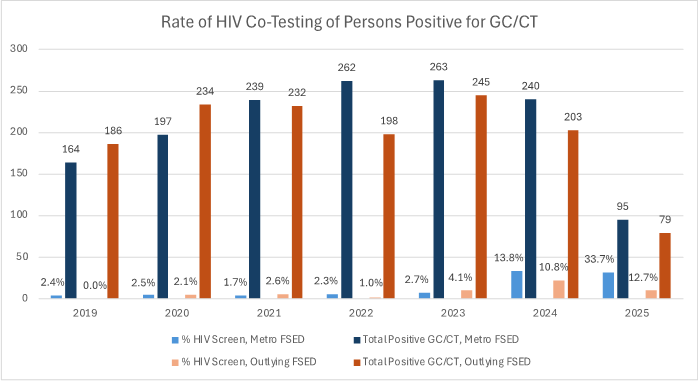
From 2019-2023, 10,895 patients were screened for GC/CT with an average HIV co-testing rate of 2.6%. 2,082 patients were GC/CT positive with an average HIV co-testing rate of 2.1%. Post-implementation of the Comprehensive STI Order Panel, the HIV co-testing rose to 11.7% in 2024. HIV co-testing rose to 15.5% from an average baseline of 3.0% in Metro FSED and to 7.3% from an average baseline of 2.1% in Outlying FSEDs. Post-implementation of the Comprehensive STI Epic Pathway, the HIV co-testing rose to 14.5% in 2025. Among GC/CT-positive patients, HIV co-testing rose to 33.7% from an average baseline rate of 2.3% in Metro FSEDs and to 12.7% from an average baseline rate of 2% in Outlying FSEDs.
Conclusions
HIV co-testing increased among persons screened for GC-CT after implementation of CDS tools in the ED with higher rates in metro as opposed to outlying locations statewide. Next steps include identification of community-level disparities in STI testing and ED provider feedback to identify barriers, facilitators and regional practice differences.
Table or Figure