Background
Sexual partner acquisition rates are correlated with the speed with which HIV can transmit across a population through new partners. Understanding systematic differences in partner acquisition rates between those engaged in HIV testing and treatment can inform populations at greatest risk of transmission.
Methods
We analyzed Population-based HIV Impact Assessments (PHIAs), nationally representative household-based surveys, among those aged 15-64. This analysis is limited to six first round PHIAs where date of first sex with up to 3 most recent partners was collected, allowing the calculation of partner acquisition rates in the 12 months prior to interview (Eswatini 2016-17, Lesotho 2016-17, Malawi 2015-16, Uganda 2016-17, Zambia 2016, Zimbabwe 2015-16). Poisson regression with log person-time offset, stratified by HIV status and gender, was used to test differences between partner acquisition rates by HIV testing and treatment status after adjusting for one-year age category, education, and country.
Results
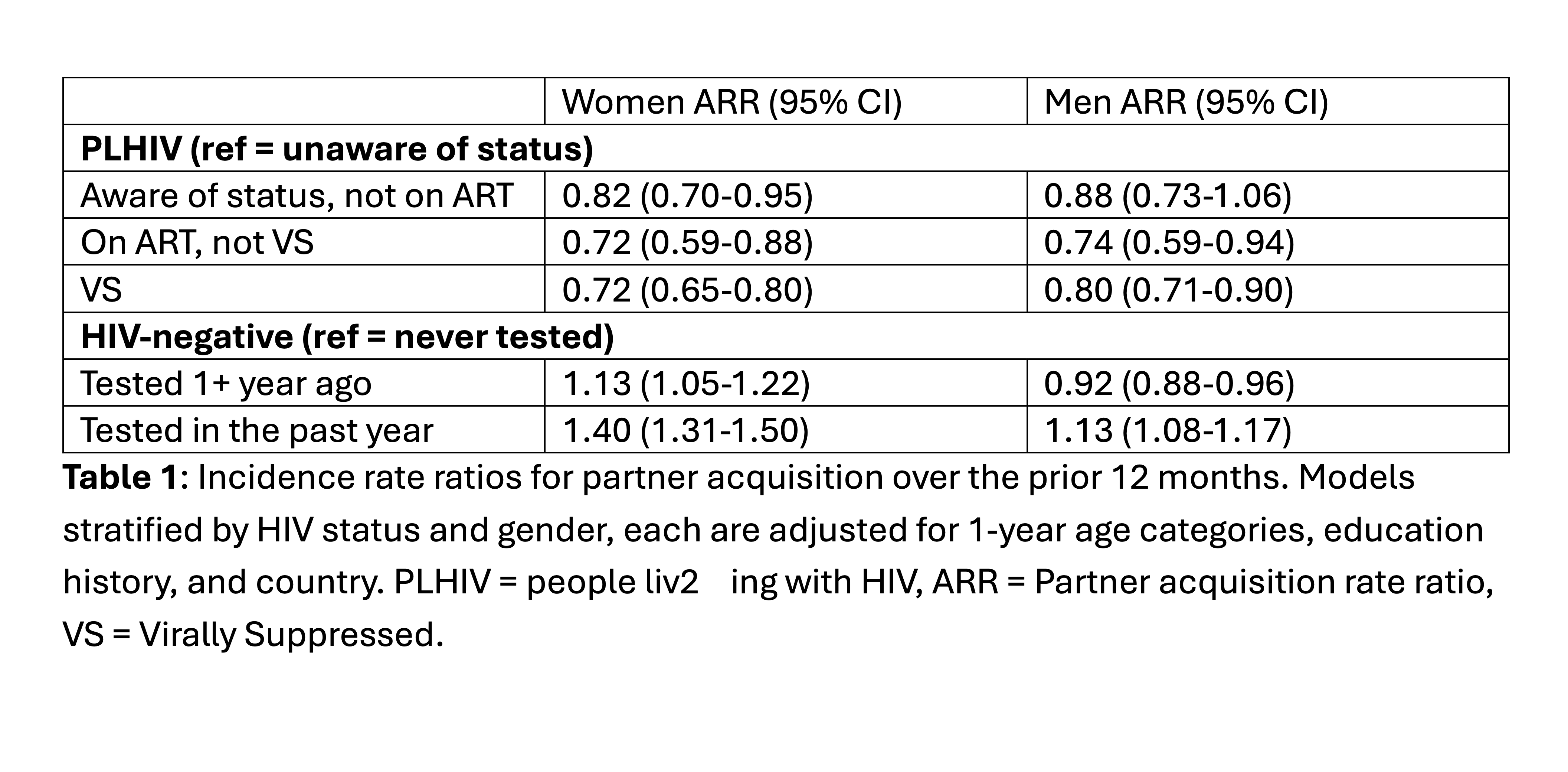
Among 96,905 participants, sexual partner acquisition rates were lower for women than men and lower for people living with HIV (PLHIV) in both sexes, after adjustment for age, education, country, and care engagement, with 28.1 (95% CI=26.4-29.9) new partners per 100 person-years in HIV-negative men and 23.6 (95% CI=23.0-24.3) in men LHIV, compared to 16.5 (95% CI=15.6-17.5) in HIV-negative women and 11.1 (95% CI=10.7-11.5) in women LHIV. In both men and women LHIV (Table 1), we observe a statistically significantly lower rate of partner acquisition for those on treatment, whether virally suppressed (VS) or not, compared to those unaware of their status (VS women acquisition rate ratio [ARR] = 0.72, 95% CI=0.65-0.80; men ARR = 0.80, 95% CI=0.71-0.90). Among HIV-negative participants, women had statistically significantly higher rates of partner acquisition if previously tested for HIV, relative to never testers, while among men this effect was attenuated and observed only among men tested in the past year.
Conclusions
Among HIV-negative individuals, partnership acquisition is associated with past year testing, suggesting that individuals are ascertaining their HIV-status at the start of new relationships. Among PLHIV, we see that those engaged in HIV care have reduced rates of partnership acquisition, potentially representing 1) recent HIV acquisition from a new partner among those unaware of their status or 2) stigma of a known HIV-positive diagnosis in developing new partnerships.
Table or Figure