Background
Clinical retention is a key measure of quality care among people with HIV (PWH). In prior work, we showed meeting common retention metrics did not predict improved mortality, though we used static measures of retention early in follow-up. We extended this approach to assess retention as a time-varying exposure, more closely reflecting the realities of clinical care.
Methods
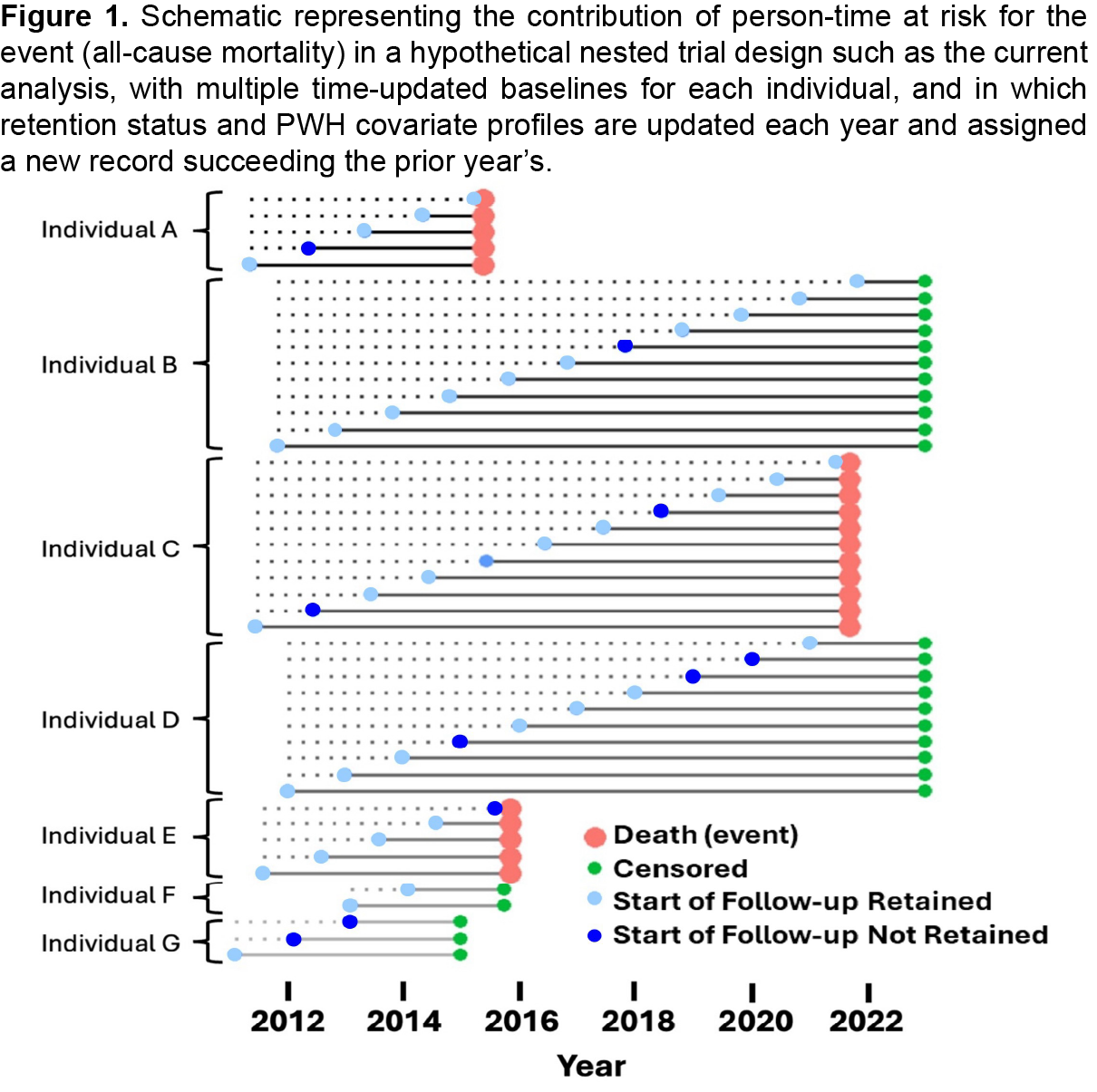
Adult (≥18 years old) PWH enrolled in 7 North American AIDS Cohort Collaboration on Research and Design (NA-ACCORD) clinical cohorts from 2011-2021 were assessed for HIV care retention, defined as ≥2 encounters (in-person or telemedicine), >90 days apart, each year. We excluded PWH missing demographic data or enrolled in cohorts with <50% National Death Index (NDI) linkage or with last NDI linkage before 2020. We followed patients from one-year after enrollment to date of death or end of study period with a nested trials approach: each patient-year was a distinct observation representing successive baselines with time-updated retention measures (Figure). We used weighted Cox regression models to estimate the marginal hazard ratio (HR) and 95% confidence interval (CI) for mortality, accounting for sex, HIV transmission risk, race/ethnicity, and time-updated age, CD4 count (<200, 200-499, ≥500, unknown cells/µL), viral suppression (HIV RNA <200 copies/mL), AIDS diagnosis, hypertension diagnosis, diabetes diagnosis, and ART receipt status; we used robust standard errors to accommodate intra-person clustering.
Results
Among 35,258 PWH contributing 275,144 person-years, median baseline age was 44 (interquartile range: 34, 52) years, 16% were female, 31% non-Hispanic Black, 69% men who have sex with men, and 8% were deceased by study end. Over the study, the proportion retained was 63%. In our model, risk of mortality was significantly elevated among those deemed to be retained under a common definition (HR=1.71, CI: 1.57-1.82).
Conclusions
Using an analytic approach that accommodated time-varying retention status and time-updated covariates continued to reveal an association between clinical retention and worsening risk of mortality. Limitations included encounters defined by visits but not labs and potential under-ascertainment of mortality among those lost to care. However, this finding does support the idea that retention metrics may not accurately capture engagement patterns that predict key outcomes. Future research should address these gaps and adapt retention definitions to better quantify the quality of HIV care.
Table or Figure