Background
With the success of antiretroviral therapy, people living with HIV (PLWH) are reaching older ages and increasingly develop multimorbidity, geriatric syndromes as well as higher healthcare use. While hospital-related outcomes in aging PLWH have been described in high-income settings, data from Latin America remain scarce. We aimed to describe hospital readmissions and demographic characteristics among adults aged ≥50 years, by HIV status.
Methods
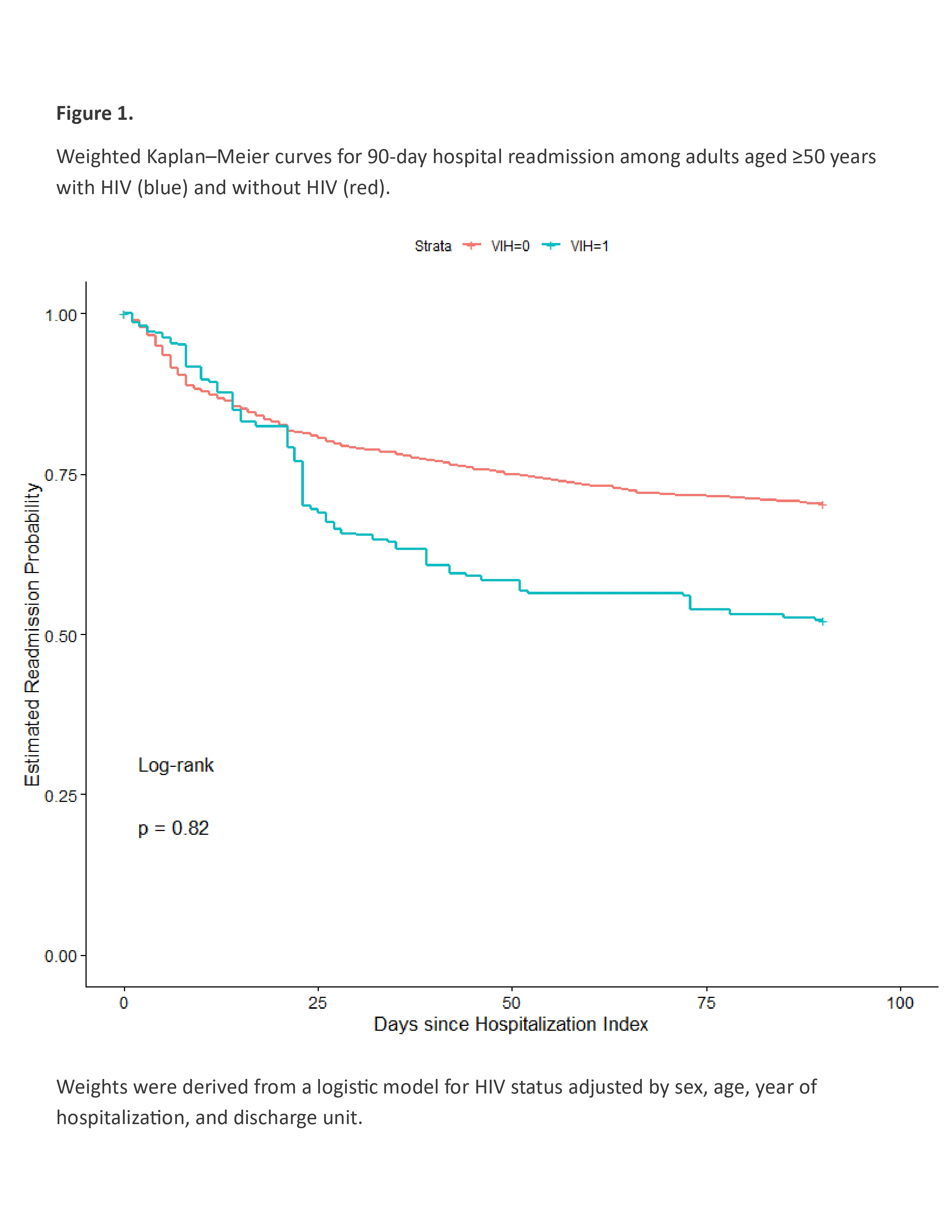
We analyzed adults aged ≥50 hospitalized at a tertiary center in Mexico City (2022–2024). Data were obtained from hospital records and the institutional discharge database. People admitted to semi-critical units, general hospitalization wards, or the ICU were included. We estimated the frequency of readmission, defined as any cause of re-entry within 90 days of discharge of a previous hospitalization. We estimated in-hospital mortality and length of stay and fitted a weighted Kaplan–Meier analyses to compare readmission between PLWH vs people without HIV. Weights came from a logistic model for HIV status adjusted by sex, age, year and discharge unit.
Results
Among 6,216 hospitalized adults aged ≥50 years, 92 were PLWH. Overall, 2,716 (43.6%) experienced at least one readmission within 90 days of discharge. This included 41 PLWH (44.6% of all PLWH) and 2,675 people without HIV (43.0% of all people without HIV), (p=0.85). The median time to readmission was 158 days (95% CI 89–357) for PLWH and 102 days (95% CI 94–111) for people without HIV. Compared with people without HIV, PLWH were younger (median 57 vs 66 years, p<0.001), more often male (88% vs 44%, p<0.001), and had longer hospital stays (7 [IQR 3–13] vs 5 [IQR 3–10] days; p<0.001). Kaplan–Meier analysis showed no significant differences in 90-day readmission by HIV status (log-rank p=0.82) (Figure 1). In-hospital mortality was lower in PLWH (2.2% vs 6.5%, p=0.14).
Conclusions
In our Institution, a high frequency of hospital readmissions was observed in both PLWH and adults without HIV aged ≥50 years. Within the first 90 days, no statistically significant differences in readmission probability were found between groups. In our setting, HIV status in people aged 50 years or older does not confer a higher frequency of hospital readmission within 90 days.
Table or Figure