Background
Food insecurity in the United States (US) is increasing. In 2023, 13.5% of US households reported food insecurity; studies in people with HIV (PWH) are often higher at ≥25%. Food insecurity has been previously associated with lower rates of viral suppression, antiretroviral therapy adherence, and CD4 counts in PWH. As food insecurity increases and PWH age, it is important to examine the impact on longer-term aging health outcomes, such as frailty.
Methods
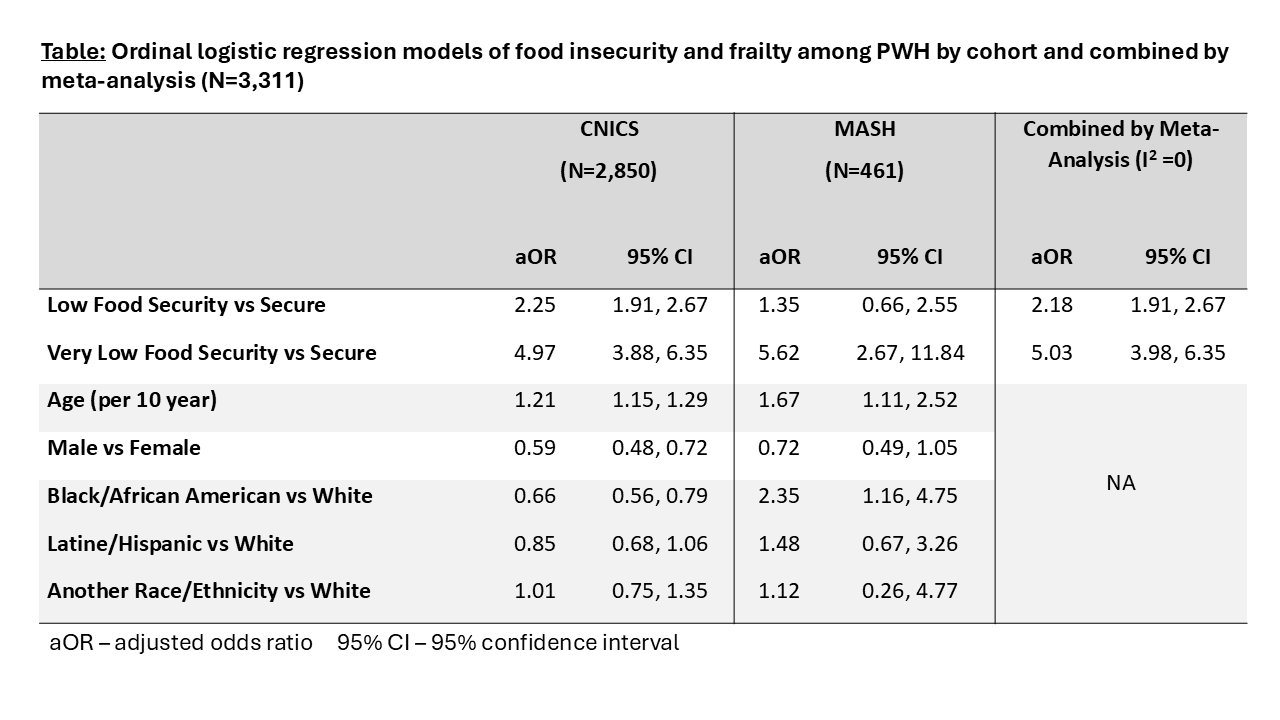
We examined associations between food insecurity and frailty among PWH in CFAR Network of Integrated Clinical Systems (CNICS), a clinical cohort, and Miami Adult Studies on HIV (MASH), a community cohort. Food insecurity was collected in both cohorts using items from the USDA Food Security Survey. Frailty in MASH was collected using the Fried Frailty Phenotype (FFP) and in CNICS using a previously validated modified version of FFP. Cross-sectional associations between food insecurity and frailty category, i.e., robust, prefrail, frail, were assessed independently in each cohort using ordinal logistic regression controlling for age, sex, and race/ethnicity and combined using fixed effects meta-analysis techniques.
Results
Across both cohorts 3,311PWH had ≥1 visit with both frailty and food insecurity measured. Included data were collected between 2022-2023 in MASH and 2023-2025 in CNICS. Overall, the mean age of PWH included was 51 years (SD +12.9), 81% were male, 40% identified as Black/African American, 17% as Latine/Hispanic, and 38% as White. Food insecurity was reported by 36% of PWH (24% with low and 12% with very low security), 11% were frail and 47% were prefrail. Increasing frailty status was associated with both low and very low food security (adjusted odds ratio (aOR)=2.25, 95%CI:1.91-2.67 and aOR=4.97; 95%CI:3.88-6.35 respectively) in CNICS and very low food security (aOR=5.62; 95%CI 2.67-11.84) in MASH. In meta-analysis low and very low food security were associated with increasing categories of frailty (aOR=2.18; 95%CI:1.91-2.67 and aOR=5.03; 95%CI:3.98-6.35 respectively). Findings were after further adjusting for for viral load and substance use and when stratifying by sex.
Conclusions
In this study of PWH in clinical and community cohorts, food insecurity, frailty and prefrailty were prevalent. Our findings suggest that food insecurity may contribute to frailty in PWH and therefore may be an important consideration for intervention. Given 36% prevalence observed, it is important to address food insecurity in PWH.
Table or Figure